People watching their fat intake
You’re looking for an almond drink that meets the threshold for a ‘low fat’ claim, rather than relying on a product name that simply suggests it’s light.


To choose a low-fat almond drink, check that it contains no more than 1.5 g of fat per 100 ml, then compare the sugars, protein and ingredients. It can be added to a smooth preparation for an easy-to-chew meal, provided its thin consistency is suitable for the person. If they have difficulty swallowing, a healthcare professional should advise on the right consistency.
You’re looking for an almond drink that meets the threshold for a ‘low fat’ claim, rather than relying on a product name that simply suggests it’s light.
You’re thinking of adding almond drink to porridge, a custard or a purée, and would also like to compare the sugars, protein and ingredients.
If you or the person you’re caring for has difficulty swallowing liquids, ‘easy to chew’ alone isn’t enough to determine the right consistency. France’s National Authority for Health says this should be recommended according to the person’s individual swallowing difficulties.
Start by comparing the fat content per 100 ml, then consider how the drink will be used in the meal and the consistency the person needs. Under European Union Regulation (EC) No 1924/2006, a liquid can be labelled ‘low fat’ only if it contains no more than 1.5 g of fat per 100 ml.
| Criteria | What to check | Who is it for? |
|---|---|---|
| Fat | Compare the figure per 100 ml with the 1.5 g threshold for liquids; the product name isn’t enough. | I want to choose a drink based on its actual fat content, even if other claims appear on the carton. Around 40% of consumers put this first. |
| Meal composition | Check the sugars and protein per 100 ml, then the ingredients, allergens and, if needed, the stated calcium content. | If I add the drink to a puréed meal, I want to know what it contributes without assuming it replaces other parts of the meal; around 30% of consumers put this first. |
| Texture | If the person has difficulty swallowing, ask a healthcare professional to advise on the required consistency before serving or thickening the drink. | When swallowing liquids is difficult, my priority is a consistency that’s right for the person. This comes first for around 30% of consumers. |
These claims refer to different things. The Carrefour Bio No Added Sugars product listing states 1.7 g of fat per 100 g. This figure can’t be compared directly with the threshold expressed per 100 ml for a liquid.
Check the ‘fat’ and ‘of which sugars’ figures separately, using the same 100 ml basis.
A thin drink may not have the consistency needed by someone with a swallowing difficulty. France’s National Authority for Health says the appropriate consistency should be recommended according to the person’s needs.
If texture guidance has been given or the person has difficulty swallowing, ask which consistency to use before offering the drink.
The Joybuy listing for Alpro Unsweetened UHT Almond Drink states 0.4 g of protein per 100 ml. Its low fat content doesn’t tell you what the meal as a whole provides.
If the drink makes up a significant part of the meal, check the protein content of the other foods you plan to serve too.
Almond drinks aren’t suitable for people with an almond allergy. Ingredients can also vary between products.
Read the ingredients list and allergen declaration for the product you choose, especially if you switch varieties.
These products are examples of labels to compare for this meal. A ‘no sugars’ or ‘organic’ claim doesn’t, by itself, tell you the fat content per 100 ml.
Alpro’s no-added-sugars almond range includes Alpro Unsweetened UHT Almond Drink, which the Joybuy listing states contains 1.1 g of fat per 100 ml.
Carrefour Bio’s organic almond drink with no added sugars is worth considering for its ingredients, but don’t infer its fat content from that claim alone.
At E.Leclerc, the organic no-sugars almond drink and the Intense Almond version have different nutritional values.
Lidl lists a product called ‘Organic Sugar-Free Almond Drink’.
ALDI sells a 1 L carton of MY VAY organic almond drink.
This almond drink may be suitable as an addition to an easy-to-chew meal if a thin consistency is right for the person. Compare the label on the product you buy with your requirements for fat, sugars and allergens.
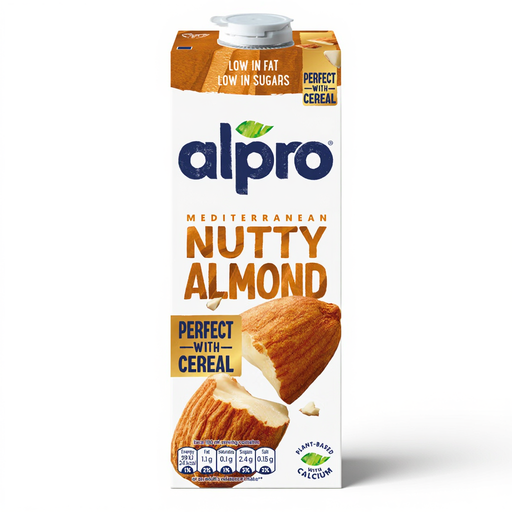 Image unavailable
Worth considering as an addition to an easy-to-chew meal if a thin consistency is right for the person.
Pack size shown: 1 L. Check the sugars and allergens on the product you buy. If texture guidance has been given, confirm the required consistency before use.
European Union Regulation (EC) No 1924/2006 sets the maximum for a ‘low fat’ claim on a liquid at 1.5 g of fat per 100 ml. Compare this with the figure on the packaging of the drink you choose.
No. Sugars and fat are two separate criteria. Check each in the nutritional information, using the same 100 ml basis.
Not necessarily. An easy-to-chew meal doesn’t determine the right consistency for someone with a swallowing difficulty. France’s National Authority for Health says a healthcare professional should recommend the right consistency based on the person’s needs.
Don’t assume so based on its fat content. For example, the Joybuy listing for Alpro Unsweetened UHT Almond Drink states 0.4 g of protein per 100 ml. Check the rest of the meal and the nutritional values of the product you buy too.