What should you check?
If you have coeliac disease, start by checking for a ‘gluten-free’ claim on the variant you’re buying. Then compare the sugar content and ingredients according to what you’ll be serving at breakfast.
| What to check |
Look for |
Who it matters to |
| Gluten-free status |
Look for a ‘gluten-free’ claim on the exact product variant, or the crossed grain logo if present. Don’t rely solely on the absence of wheat from the ingredients. |
If I have coeliac disease, I need to be able to confirm the drink’s status before adding it to my cereal; around 50% of consumers make this their top priority. |
| Sugars in the drink |
Know the difference between ‘sugar-free’ and ‘no added sugar’, then read the ingredients list and nutritional information for the variant you’ve chosen. |
If I’m having something sweet with it, I want to know whether the drink adds sugar too; this is the top priority for around 30% of consumers. |
| Almond content |
Compare the stated proportion of almonds and check separately for sugar in a product described as ‘intense’. |
For porridge or pancakes, I look for a recipe with an almond flavour I enjoy; around 20% of consumers make this their top priority. |
Brands and products to know
The claims below apply to the specific products mentioned, not to every drink from each brand. If you’re buying for someone with coeliac disease, always check the packaging of the variant you choose.
Provamel
The Carrefour product page for Provamel organic almond drink with no added sugar states that this product is ‘gluten-free’.
- The product page lists claims relating to both sugar and gluten for this drink.
- Check that these claims apply to the carton you’re buying, rather than another Provamel variant.
Ecomil
The Carrefour product page for Ecomil organic original almond drink with no sugar, in a 1 l carton, states that it is ‘gluten-free’ and contains 7% almonds.
- This product page lets you check the gluten-free claim and almond content separately for the product mentioned.
- These details shouldn’t be assumed to apply to other Ecomil recipes.
Bio Village
E.Leclerc lists an organic almond drink with no sugar containing 2.8% almond purée, and an intense version containing 7% almond purée.
- The ingredients make it possible to distinguish between the no-sugar version and the intense version.
- The intense version contains cane sugar. If you have coeliac disease, look for a ‘gluten-free’ claim on the variant you choose before buying it.
Auchan
The Auchan product page for an unsweetened almond plant drink states that this product contains 2% almonds.
- The ingredients list helps you check the exact recipe of this drink.
- If you have coeliac disease, check for a ‘gluten-free’ claim on the exact carton; the ingredients alone aren’t enough.
Alpro
The Carrefour product page for Alpro Roasted Almond states that this product contains 2.3% almonds.
- It gives you a point of comparison for the ingredients in a roasted almond drink.
- Don’t assume it’s gluten-free based on its almond content: check the claim on the variant you’re buying.
An option on Joybuy
This unsweetened almond drink is suggested as an accompaniment to cereal at breakfast. If you have coeliac disease, check for a ‘gluten-free’ claim on the exact carton before buying.
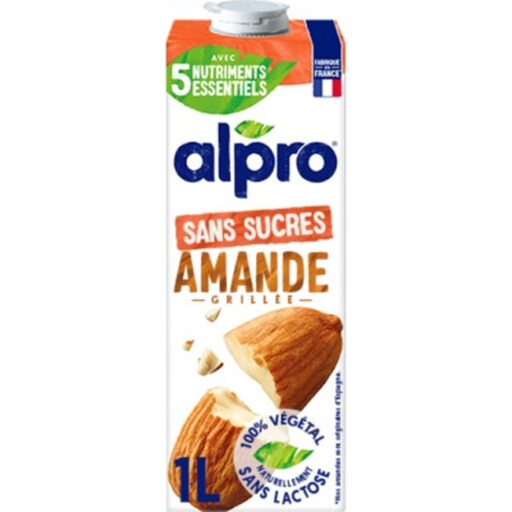 Image unavailable
Alpro Almond Unsweetened UHT, 1 l
An option to consider if you’d like an unsweetened almond drink with your cereal.
The description of this product says it is gluten-free; if you have coeliac disease, check this claim on the packaging of the exact variant. Also check its storage instructions for after opening.
View on Joybuy
Frequently asked questions
Is an almond drink automatically suitable for someone with coeliac disease?
No. Check for a ‘gluten-free’ claim on the exact product, or the crossed grain logo if it appears on the carton. The absence of wheat from the ingredients list doesn’t replace this check.
Does ‘no added sugar’ mean ‘gluten-free’?
No, the two claims relate to different characteristics. If you have coeliac disease and also want to limit added sugars, check for each claim on the same variant.
What should you choose if your breakfast accompaniments are already sweet?
An original or no-added-sugar formula may suit your preference, once you’ve checked its ingredients and nutritional information. If you have coeliac disease, treat the ‘gluten-free’ claim as a separate criterion.
How long can you keep a carton after opening?
Follow the time limit on the carton you bought and its refrigeration instructions. The Auchan product page for an Ethiquable drink says to refrigerate and use within five days of opening, but this time limit may not apply to other products.
Does a higher proportion of almonds guarantee that a drink is gluten-free?
No, the percentage of almonds describes the ingredients, not the gluten-free status. The Carrefour product page for Ecomil and the E.Leclerc page for Bio Village Intense each state that their recipe contains 7% almonds or almond purée, but only the Ecomil product page mentioned explicitly states that it is ‘gluten-free’; the Bio Village Intense version also contains cane sugar.


