What should you check on the carton?
For a late-night snack, start with the criterion that matters most to you, then compare the other values on the same 100 ml basis. A claim on the front of the carton is no substitute for checking the nutritional information.
| Criterion |
What to check |
Who is it for? |
| Fat |
Check the value per 100 ml. Under European Regulation (EC) No 1924/2006, the maximum for a ‘low fat’ claim on drinks is 1.5 g per 100 ml. |
If my main priority is a low-fat drink in the evening, this is the first figure I use to compare cartons; around 36% of consumers put this need first. |
| Sugars |
Compare ‘of which sugars’ per 100 ml and read the ingredients list, particularly to spot any added sugar. |
If I want to avoid a sweet drink on this occasion, I don’t rely on the product name alone; this is the top priority for around 29% of consumers. |
| Calcium |
Look for a specific claim and, if it appears on the carton, the amount of calcium per 100 ml. |
If I choose a plant-based drink with calcium in mind, I want to know the figure for the product I’m buying; around 21% of consumers prioritise this. |
| Recipe and storage |
Check the ingredients, allergens and storage instructions after opening. Also look for an organic label if that matters to you. |
If I only drink a small amount at a time, the ingredients and the stated time to use after opening guide my choice; this is the main concern for around 14% of consumers. |
Brands to compare
These examples refer to specific recipes. The values for a sugar-free version don’t automatically apply to other drinks from the same brand.
Alpro
Amande Grillée Sans Sucres is a useful product to compare if you’re looking to limit your fat intake.
- Carrefour lists 15 kcal and 1.1 g of fat per 100 ml for this recipe, along with a calcium claim.
- Don’t assume these values apply to another Alpro drink: check the full recipe name on the carton.
VEGE (Marque Repère E.Leclerc)
The no-added-sugars almond drink lets you compare both the fat content and a declared amount of calcium.
- E.Leclerc lists 1.2 g of fat, 0.2 g of sugars and 127 mg of calcium per 100 ml.
- E.Leclerc’s product listing says this product is subject to in-store availability.
Auchan
The sugar-free almond-based plant drink is another recipe worth considering for an evening drink.
- Auchan lists 13 kcal, 1.1 g of fat and less than 0.5 g of sugars per 100 ml.
- The product listing says this drink should not be used as the sole food for an infant under 12 months, unless prescribed by a paediatrician.
Bio Village (E.Leclerc)
The sugar-free and Amande Intense versions show why two recipes in the same range need to be compared separately.
- E.Leclerc lists 18 kcal, 1.5 g of fat and 0.2 g of sugars per 100 ml for the sugar-free version.
- According to E.Leclerc, the Amande Intense version contains cane sugar and has 62 kcal, 4.3 g of fat and 4.1 g of sugars per 100 ml.
Bjorg
Amande Sans Sucres Bio shows why sugars and fat should be considered separately.
- Auchan’s product listing shows less than 0.5 g of sugars per 100 ml for this recipe.
- It also lists 1.7 g of fat per 100 ml, above the maximum for a ‘low fat’ claim on a drink under European Regulation (EC) No 1924/2006.
An almond drink on Joybuy
This option is a 1 L almond drink. To see whether it meets your fat-content criterion and sugar preference, compare its values per 100 ml with those of the other cartons you’re considering.
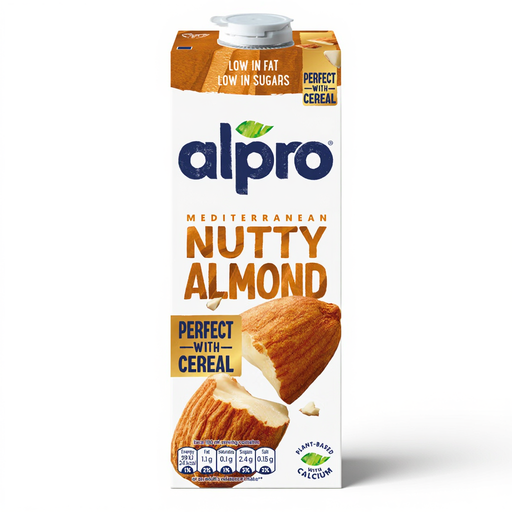 Image unavailable
Alpro Almond Drink 1L
To choose this almond drink for the evening, check the fat and sugar content per 100 ml on the packaging. Size: 1 L.
View on Joybuy
Frequently asked questions
What fat content should I look for in an almond drink?
For a ‘low fat’ claim on a drink, European Regulation (EC) No 1924/2006 sets a maximum of 1.5 g per 100 ml. Check the ‘fat’ line in the nutritional information, rather than relying only on a term such as ‘light’ on the packaging.
Is a sugar-free almond drink necessarily low in fat?
No. Sugars and fat need to be compared separately. Auchan’s product listing for Bjorg Amande Sans Sucres Bio shows less than 0.5 g of sugars but 1.7 g of fat per 100 ml, so check both figures for the recipe you’re interested in.
How can I compare two cartons of almond drink?
Compare their values on the same 100 ml basis: energy, fat and sugars each answer a different question here. The DGCCRF explains that nutritional information per 100 g or 100 ml makes products easier to compare. Then check the ingredients and product-specific instructions on each carton.
Which allergens should I check for?
Check for almond and any warnings about other nuts on the label of the product you choose. The DGCCRF states that allergenic ingredients must be highlighted. For example, Joybuy’s product listing for Alpro Amande Sans Sucres warns that other nuts may also be present.
How long can I keep a carton after opening?
Follow the storage time and temperature shown on the carton you buy, as these vary by recipe. Auchan’s product listings recommend keeping Bjorg Amande Sans Sucres Bio in the fridge for four days after opening, and Ethiquable Amande Sans Sucres Bio for five days.


