People with coeliac disease at breakfast
The “gluten-free” label must apply to the exact drink you’re buying. Check the bread and jam separately.


If you need to avoid gluten strictly, choose an almond drink whose exact carton is labelled “gluten-free”: the drink’s name alone isn’t enough. With jam on toast, compare the sugars per 100 ml if you want to limit the amount contributed by the drink, and check the bread, jam and allergens separately.
The “gluten-free” label must apply to the exact drink you’re buying. Check the bread and jam separately.
If your jam is already sweet, compare the “sugars” per 100 ml across the almond drinks you’re considering.
You can compare the calcium figures on the cartons, but don’t assume that an enriched recipe is also gluten-free or suitable for someone with an almond allergy.
For a strict gluten-free diet, first check the label on the carton you’ve chosen. Sugar and calcium are separate considerations, which you can then compare using the nutritional information for the specific product.
| Criteria | What to check | Who it matters to |
|---|---|---|
| Gluten-free label | Look for “gluten-free” on the exact carton, and read its ingredients and allergen information. | If I need to avoid gluten strictly, I can’t rely on the word “almond” alone; around 50% of consumers would make the gluten-free label their top priority. |
| Sugars in the drink | Compare the “sugars” per 100 ml and the ingredients list. Don’t confuse this with whether the drink is gluten-free. | With jam on my toast, I prefer to know how much sugar the drink adds; around 30% of consumers would put this criterion first. |
| Declared calcium | Compare the calcium per 100 ml for the option you’re considering, and check its allergens separately. | If I’m replacing my usual breakfast drink, I want to know its declared calcium content without assuming it’s nutritionally equivalent in every respect; around 20% of consumers would make this their top priority. |
A plant-based recipe, an “organic” label or the absence of lactose doesn’t tell you whether the specific product you’re buying is gluten-free.
If you need to avoid gluten strictly, look for a “gluten-free” label on that carton. Check any foods served with it separately too.
These labels refer to two different characteristics. Choosing a drink for its sugar content doesn’t automatically mean it meets a gluten-free requirement.
Read the “sugars” per 100 ml and check independently for a “gluten-free” label if you need one.
The stated shelf life may affect which size you choose if you don’t drink almond milk often.
Follow the storage instructions for the product you buy, and note when you opened it.
An opened carton that isn’t used within the stated time may need to be thrown away.
“Gluten-free” doesn’t mean an almond drink is suitable for someone with an almond allergy.
Read the ingredients and allergen information on the exact carton, including any warnings about other tree nuts.
Alpro’s French product page describes this specific Roasted Almond Original recipe as “gluten-free” and a “source of calcium”.
Carrefour offers an organic almond drink with no added sugars; its ingredients list states that it contains 2.8% almonds.
Auchan offers both a no-sugar almond drink and a standard version, so make sure you distinguish between the two recipes when comparing them.
The E.Leclerc range includes a 1 L organic, no-sugar almond drink under the Bio Village brand.
Lidl offers an organic, sugar-free almond drink under the Vemondo brand.
Aldi offers a 1 L organic MY VAY almond-based drink.
These two Alpro almond drinks can be enjoyed with jam on toast. Compare the variants, and check the label on each carton for “gluten-free” if you need to avoid gluten strictly.
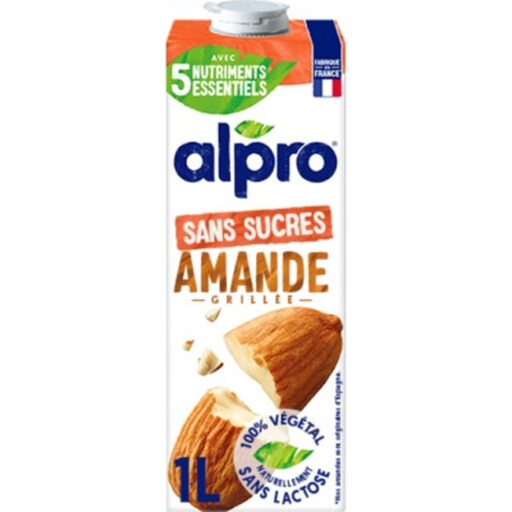 Image unavailable
This 1 L unsweetened option is worth comparing with jam on toast by checking the sugars per 100 ml. If gluten-free is essential, check the label on the exact carton before choosing it; it contains almonds.
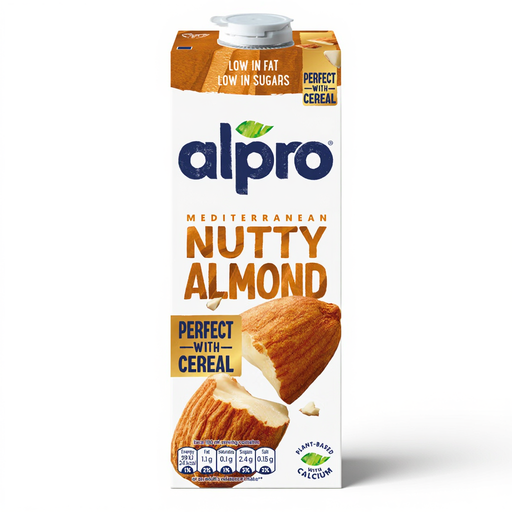 Image unavailable
This 1 L almond drink is an option to consider for breakfast, but its name alone doesn’t confirm that it’s the Roasted Almond Original recipe Alpro describes as gluten-free. Check the variant, the “gluten-free” label, the sugars per 100 ml and the allergens on the carton you buy.
No. The word “almond” doesn’t confirm that a drink is gluten-free. For a strict gluten-free diet, check for a “gluten-free” label on the exact carton; Alpro’s French product page displays this label for its Roasted Almond Original recipe.
Not necessarily: the two labels refer to different criteria. Check for a gluten-free label separately from the sugars declared per 100 ml, even if you’re choosing a drink to have with jam.
Compare the sugars per 100 ml if you want to take the amount contributed by the drink into account. The DGCCRF says that nutritional information per 100 ml makes it easier to compare drinks; check for gluten separately if that matters to you.
Follow the storage instructions and use-by period on your carton. Some Auchan products and Alpro products featured by Auchan should be refrigerated and consumed within five days of opening; don’t assume this applies to every recipe.
No. It doesn’t cover almonds or other tree nuts. If these allergens are a concern for you, read the ingredients and relevant warnings on the carton. The DGCCRF says allergens present in the ingredients must be highlighted on the labels of prepacked foods.