
Livraison le jour même ou le lendemain

Qualité garantie

Débloquez vos offres de bienvenue: Livraison GRATUITE | Jusqu'à -80 % | 30 jours d'essai gratuits à JoyPlus
Téléchargez l'application
An all-hob non-stick frying pan should work on induction, gas, electric and ceramic hobs, while remaining easy to clean. However, between marketing claims and sometimes vague technical specifications, it is not always easy to know what to look for. A magnetic base that is too thin, poorly maintained coating or an unsuitable diameter can quickly turn a promising purchase into a disappointing piece of cookware.
Before comparing models, here are the main pitfalls to avoid.
A frying pan that is compatible with gas or an electric hob will not necessarily work on an induction hob. For induction, the base must contain a magnetic material, usually a suitable type of stainless steel. So check that induction is clearly listed in the specifications, rather than relying solely on ‘all hobs’ in the product title.
Descriptions such as ‘ultra-resistant’, ‘healthy’ or ‘scratch-resistant’ are no substitute for detailed technical specifications. Whether it is made from PTFE, ceramic or combined with a honeycomb structure, a non-stick coating should be used at moderate temperatures and with suitable utensils.
The claim PFOA-free refers to a specific characteristic. It does not necessarily mean that the frying pan contains no substances from the PFAS family. If this is important to you, look for detailed information from the manufacturer about the coating’s composition.
A 20 to 24 cm frying pan is suitable for eggs, individual portions and quick meals. For a family, a diameter of 26 to 30 cm provides a more comfortable cooking surface. A non-stick wok measuring 30 or 32 cm makes it easy to toss vegetables, noodles and meat, but it requires a sufficiently large hob and suitable storage space.
If your home has several types of hob, choose a base that is explicitly stated to be compatible with gas, electric, ceramic and induction hobs. On an induction hob, a flat, sufficiently wide base ensures better contact with the cooking surface. With gas, make sure the flame does not extend well beyond the edges, to avoid unnecessarily heating the handle.
An induction frying pan can generally be used on other types of hob, but the reverse is not always true. If in doubt, rely on the compatibility symbol rather than the product photo alone.
Aluminium heats up quickly and helps keep the frying pan relatively light. It is often combined with a reinforced base to ensure induction compatibility. Multi-layer stainless steel, such as 304 stainless steel with an aluminium core, provides a more rigid structure and even heat distribution. However, a frying pan or stainless steel wok without a non-stick coating requires greater precision to prevent food from sticking.
A ceramic frying pan is another option. Its coating is valued for its smooth surface and easy care, but it is best to use low to medium heat and wooden, silicone or plastic spatulas, unless otherwise stated by the manufacturer.
The claim ‘dishwasher-safe’ may apply to the body of the frying pan without covering the handle or any accessories. Hand-washing with a soft sponge generally helps preserve coatings for longer. Avoid wire wool, abrasive powders and sudden changes in temperature.
A detachable handle makes storage easier in small cupboards. A glass lid, meanwhile, lets you monitor cooking while reducing splashes. Before each use, check that the detachable handle is properly locked in place.
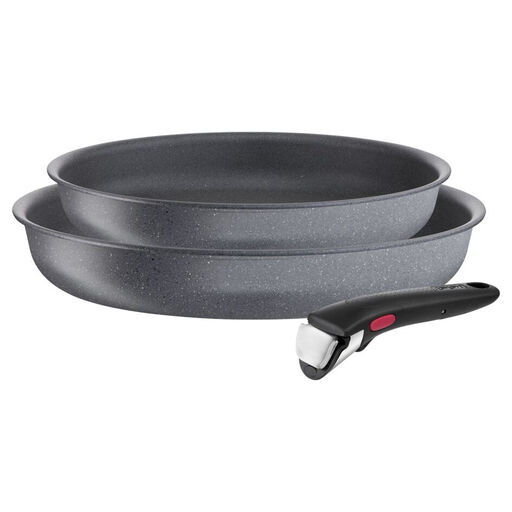
Why this choice suits this profile: Its two diameters cover individual portions as well as everyday meals, while a single detachable handle helps reduce clutter in your cupboards.
The specifications confirm compatibility with induction, gas, electric and ceramic hobs. The coating is stated to be PFOA-free. Hand-washing is nevertheless recommended, and the frying pans are not designed for oven use.
Two frying pans measuring 22 and 26 cm, a Thermo-Signal indicator and compact storage thanks to the detachable handle.
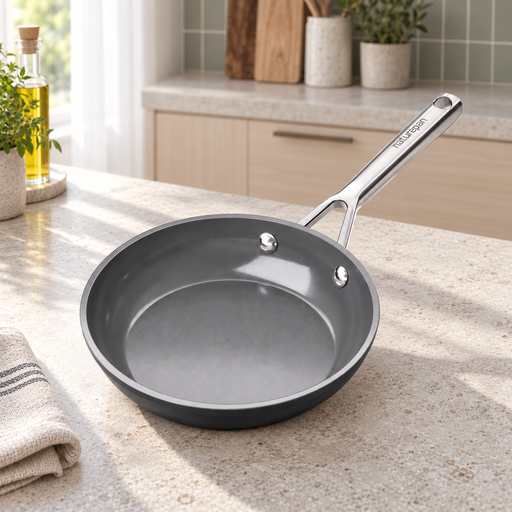
Why this choice suits this profile: Its 20 cm format and mineral coating are ideal for precise cooking, small portions and users who pay close attention to the materials specified.
The specifications state compatibility with induction, gas, electric and ceramic hobs, as well as oven use up to 260 °C. The manufacturer states that it contains no PTFE, PFAS or PFOA.
Compact diameter, stainless steel handle and stated dishwasher compatibility.
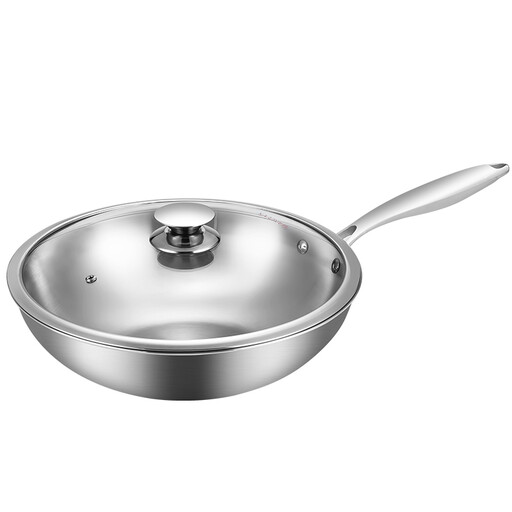
Why this choice suits this profile: This 28 cm stainless steel wok has no non-stick coating, making it suitable for users who prioritise durability and are happy to adapt their cooking technique.
The specifications make clear that it has no non-stick coating – so do not expect it to behave like a non-stick frying pan. Cooking over medium-low heat and adding oil after preheating are recommended.
Multi-layer 304 stainless steel construction, compatibility with induction, gas, electric and ceramic hobs, plus a glass lid.
We have put together a comprehensive, real-time updated selection of products that meet these demanding criteria and European safety standards.
For two people, a diameter of 24 to 26 cm is sufficient for most dishes. For three to five diners, a 28 cm frying pan or a 30 cm wok provides a more spacious cooking surface. However, remember to check the diameter of the cooking zone, particularly on an induction hob.
It depends entirely on the model and the handle. Some ceramic frying pans can withstand a maximum temperature specified by the manufacturer, while others are not designed for oven use. Check the instructions and remove the detachable handle before putting the frying pan in the oven if required.
Look for an explicit indication that it is compatible with electric or ceramic hobs. A flat, stable base is preferable. Avoid sliding the frying pan across the surface to reduce the risk of scratches and protect both the hob and the cookware.