
Livraison le jour même ou le lendemain

Qualité garantie

Débloquez vos offres de bienvenue: Livraison GRATUITE | Jusqu'à -80 % | 30 jours d'essai gratuits à JoyPlus
Téléchargez l'application
Carrying shopping, camping equipment or gardening tools quickly becomes a chore when the ground gets difficult. An all-terrain folding trolley makes it easier to move across grass, gravel, sand and dirt tracks, provided you choose a model suited to the load and terrain.
Photos and marketing claims do not always tell the whole story. A large stated capacity may conceal a limited load rating, while wheels described as ‘all-terrain’ may struggle on sand or slopes. Here are the criteria to consider before buying a folding transport trolley.
A large-capacity folding wagon may claim 150, 200 or even 300 litres without being able to support an equivalent load in kilograms. Capacity refers to the available space, while the load rating is the maximum weight supported by the frame and wheels.
To compare models properly, check these separately:
A trolley advertised as holding 200 kg is therefore not automatically more practical than a more compact model. It all depends on what you plan to transport and how much storage space you have available.
On hard ground, a small swivel wheel may work perfectly well. On sand, mud or wet grass, wide tyres distribute pressure more effectively and are less likely to sink. The presence of bearings, tyre width and the ability to lock the wheels also play an important role.
An all-terrain wheeled trolley should be assessed according to your usual route: beach, campsite, lawn, trail or outdoor market. A wheel that performs well on gravel will not necessarily behave just as well on loose sand.
A folding mechanism is only useful if it remains simple to operate. Before ordering, check for an adjustable handle, the total weight and the trolley’s folded dimensions. A model that is too bulky can be difficult to fit in a boot or a narrow storage area.
Four-sided folding and one-handed folding are convenient, but also make sure that the frame locks securely before you load the trolley.
For shopping, family outings or light gardening, a capacity of 120 to 150 kg may be sufficient. To transport bulky equipment, bags of compost or several pieces of camping gear, a 200 kg model offers more leeway. Models claiming up to 300 kg should, however, be considered carefully: this figure can only be achieved under the conditions specified by the manufacturer, on a suitable surface and with the load distributed correctly.
A lacquered steel or alloy steel frame provides good rigidity. The fabric, often made from 600D Oxford polyester, should be securely attached and sufficiently durable for the intended use. Water-repellent or coated fabric makes maintenance easier, but does not necessarily make the trolley completely waterproof.
For an all-terrain wheeled trolley, look in particular for:
A trolley fitted with a brake does not remove the need to follow the instructions for use. Lock the wheels when stationary, avoid excessively steep slopes and place heavy items at the bottom of the fabric compartment.
Large-capacity models are often between 90 and 100 cm long. Remember to measure your car boot, the width of your doors and the space available for storage. For the beach or outdoor activities, removable wheels and fabric can also make cleaning easier.
After an outing on the sand, remove any grains that have accumulated around the axles and allow the fabric to dry before folding the trolley. For routine care, a damp cloth and mild detergent are generally sufficient, in accordance with the manufacturer’s recommendations.
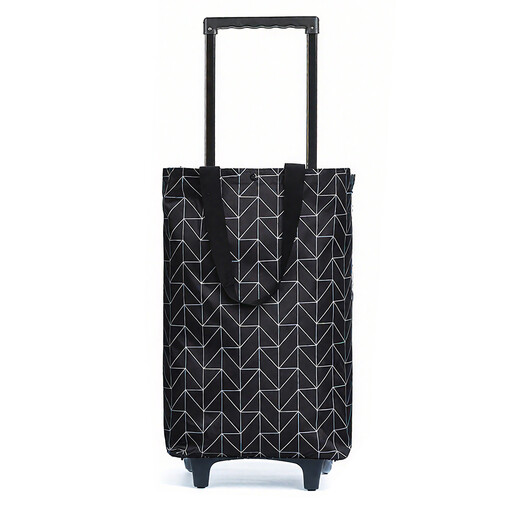
Why this choice suits this profile : Its lightweight, folding design is ideal for short trips, shopping or occasional first-time use, without the bulk of a larger model.
It avoids paying for a large trolley when the priority is to have a model that is easy to carry and store.
Folding design, black finish and pull handle. Load information should be checked on the product page before use.
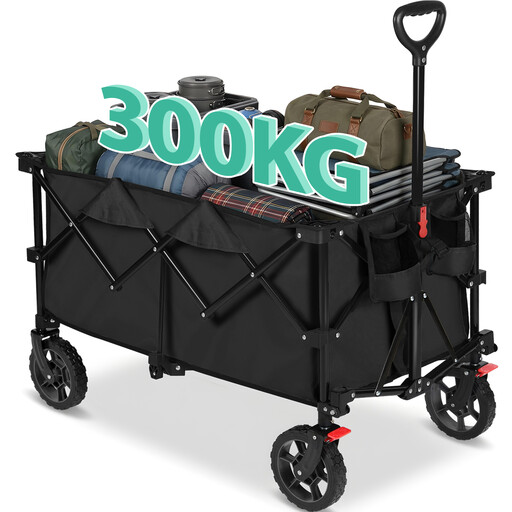
Why this choice suits this profile : Families and campers who regularly transport bulky loads benefit from a 200 L capacity and a frame advertised as supporting up to 300 kg.
The capacity in litres and maximum load are listed separately, allowing for a more objective comparison.
Lacquered steel frame, universal wheels, adjustable handle, one-handed folding and an advertised two-year guarantee.
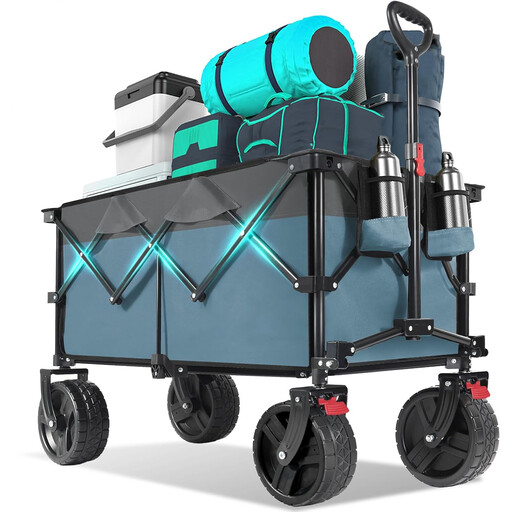
Why this choice suits this profile : Festivalgoers, gardeners and campers moving from grass to gravel can rely on 7-inch wide wheels and a brake.
The extra-wide tyres overcome the limitations of narrow wheels, while the brake helps prevent unintended movement when stationary.
200 L capacity, advertised 200 kg load, waterproof 600D Oxford fabric and tool-free mechanism.
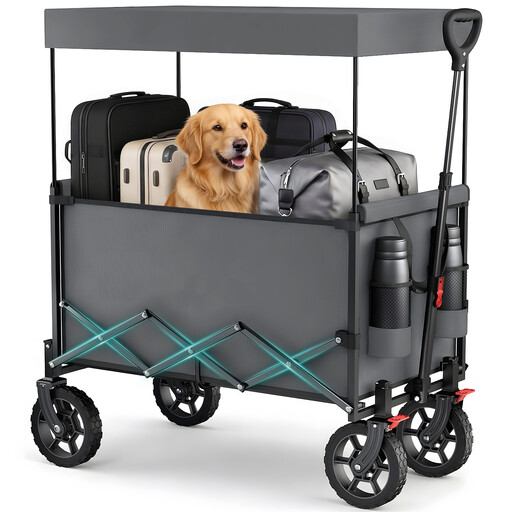
Why this choice suits this profile : This folding camping trolley is ideal for families who want to transport bags, beach accessories or picnic equipment while benefiting from removable cover.
The canopy is removable: you can take it off when you need a more compact format or easier access to the contents.
Advertised capacity of 150 L and 150 kg, all-terrain wheels with brakes, telescopic handle and removable wheels.
We have put together a complete, real-time updated selection of products that meet these demanding criteria, as well as European safety requirements.
Yes, some models can be used on sand, but it is best to choose wide wheels. Move slowly, avoid overloading the fabric compartment and distribute the weight evenly. On very loose sand, no wheeled trolley offers the same traction as it does on a firm surface.
Remove sand, mud and small stones after every outing. Dry the fabric before folding the trolley, check the fastenings and make sure the wheels turn freely. Never exceed the stated load and use the brake when the trolley is parked.
Choose according to the load you will actually be carrying, rather than relying on the highest figure. A 150 kg model may be sufficient for shopping and family outings. A 200 kg capacity is more suitable for gardening or camping with a substantial load. Models advertised as holding 300 kg are intended for heavy loads and must be used in accordance with the manufacturer’s instructions, with the weight distributed evenly.