
Livraison le jour même ou le lendemain

Qualité garantie

Débloquez vos offres de bienvenue: Livraison GRATUITE | Jusqu'à -80 % | 30 jours d'essai gratuits à JoyPlus
Téléchargez l'application
One single duvet for sleeping soundly all year round, from heatwave peaks to the coldest winter nights. On paper, the promise of the all-season duvet is certainly appealing. In reality, however, many buyers are left disappointed: their duvet is neither warm enough in winter nor light enough in summer. As a product expert, my mission is to help you read between the lines of spec sheets to make a truly informed choice.
Before you take the plunge, watch out for these two common pitfalls:
To make the right choice, focus on objective characteristics. Here are the three points to scrutinize.
The weight, expressed in grams per square meter (g/m? or GSM), measures the density of the filling and therefore its warmth. A TRUE all-season duvet is actually a 2-in-1 system, composed of two parts that clip together:
By clipping the two together (using press studs or ties), you get a thick, warm duvet equivalent to a winter duvet with a combined weight of 400 to 600 g/m?. It's this modularity that makes all the difference and guarantees tailor-made comfort, season after season.
The choice of filling directly impacts comfort, care, and cost.
A duvet that's too small lets in cold draughts, while one that's too large is cumbersome. The golden rule: allow for an overhang of at least 20 to 40 cm on each side of the bed. This ensures you won't find yourself uncovered with the slightest movement.
Rather than an endless catalogue, we've selected models that tick all the right boxes for specific user profiles.
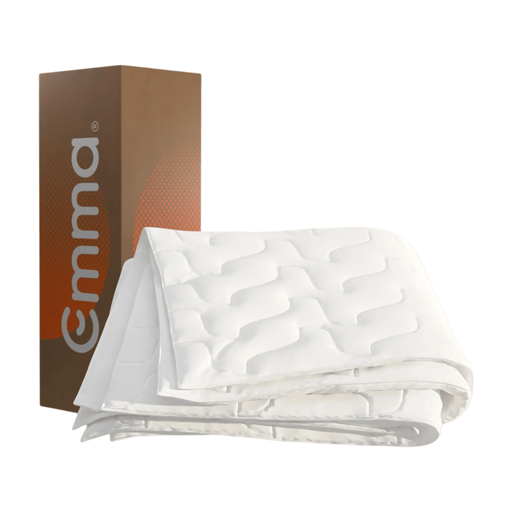
Why it's a great match: Ideal for couples, this 3-in-1 system adapts to individual preferences and temperature changes. No more fighting over the covers!
There's no smoke and mirrors here: you get two distinct duvets (a light one for summer, a thicker one for mid-season) that combine for winter. This is the very definition of a true all-season duvet.
Its 3-in-1 modularity (summer, mid-season, winter) is a breeze to adjust. It's also machine washable for hassle-free care.
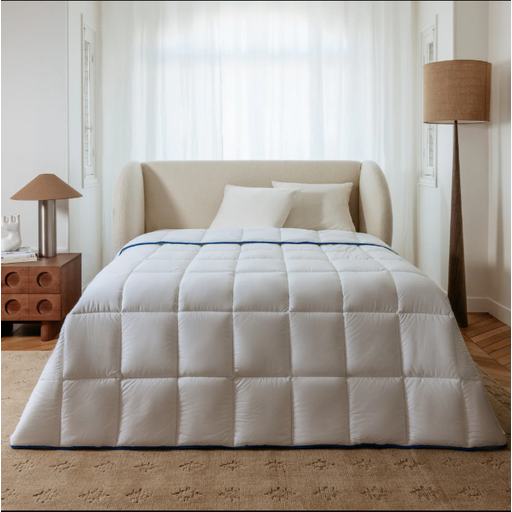
Why it's a great match: For anyone hunting down dust mites and wanting ultra-simple care, this certified synthetic model is a safe bet.
This goes beyond a simple "hypoallergenic" claim. It's backed by verifiable certifications like STANDARD 100 by OEKO-TEX, CertiPUR, and a Sanitized treatment, guaranteeing it's free from harmful substances.
Its siliconised hollowfibre filling ensures good air circulation. Fully machine washable at 40°C for perfect hygiene.
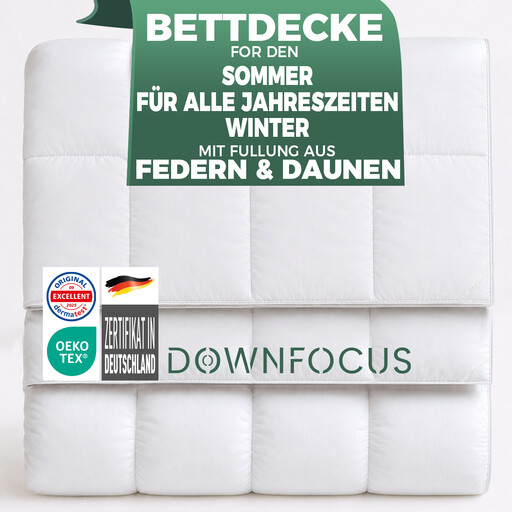
Why it's a great match: For those who love "hotel-style" comfort and the superior thermoregulation of down, without compromising on modularity or ethics.
It combines a summer duvet (200 g/m?) and a mid-season duvet (450 g/m?) for adaptable warmth. The bonus: the RDS (Responsible Down Standard) certification guarantees animal welfare, a non-negotiable ethical standard.
A filling of 90% feathers and 10% down provides the perfect balance of support and softness. The tightly woven cotton casing acts as a natural barrier against dust mites.
It all depends on its filling. A synthetic duvet is generally machine washable at 30 or 40°C. Make sure to use a large-capacity washing machine (7 kg and up) to avoid compressing it. For a natural duvet, dry cleaning is often recommended to preserve the loft and properties of the down. A good daily habit: air out your duvet every morning and shake it vigorously to redistribute the filling.
For a 160x200 cm (Queen Size) bed, the ideal duvet size is 220x240 cm. It provides a generous overhang on each side (about 30 to 40 cm), which is enough to keep you warm even if your partner tends to hog the duvet!
Absolutely, provided you choose a TRUE modular model (two duvets that clip together). The summer duvet alone will be perfect for warm southern summers. In mountainous regions or colder northern climates, combining the two duvets will give you all the warmth of an excellent winter duvet. It's this versatility that makes it a winning solution everywhere.