
Livraison le jour même ou le lendemain

Qualité garantie

Débloquez vos offres de bienvenue: Livraison GRATUITE | Jusqu'à -80 % | 30 jours d'essai gratuits à JoyPlus
Téléchargez l'application
A well-organised pantry doesn’t have to start with buying a mountain of containers. An airtight kitchen storage container set should first and foremost suit your habits, the space you have available, and the foods you actually store. Pasta, rice, flour, sugar, cereals and spices don’t all need the same size.
Before you check out, there are three pitfalls to avoid.
A set of food containers might look appealing because it contains lots of items. But several small pots will never replace a large box for cereals, flour or an opened packet of pasta. Conversely, big jars quickly take up all the space in a cupboard and prove impractical for spices.
So look at the size breakdown, not just the total number of pieces.
The effectiveness of the seal depends on the whole lid, its gasket and how it fits onto the container. A lid that’s difficult to close or clean can quickly become synonymous with leaks, trapped crumbs and lingering odours.
To choose airtight food containers, go for a closure that’s clearly described and a gasket that’s easy to access for cleaning. A good seal doesn’t mean you can ignore the manufacturer’s usage instructions.
Not all containers are necessarily dishwasher-safe, freezer-safe or oven-safe. Some materials can also warp when in contact with very hot liquids. Before buying, check the details about cleaning, temperatures and compatible appliances.
A container designed for dry foods isn’t automatically suitable for fizzy drinks, hot preparations or reheating.
To optimise storage in a cupboard, measure the height between shelves, the usable depth and the available width. Stackable boxes make better use of height, provided their bases are stable and the lids don’t slide off.
An effective organisation system can include:
Transparency also makes stock-checking easier. You can see at a glance what each box contains and avoid opening several before finding the right ingredient.
The material must be suitable for storing food and robust enough for daily use. When the product page specifies it, the mention BPA-free provides useful information about the plastic composition. However, it doesn’t guarantee that the container can withstand all temperatures or all appliances.
For storing pasta and rice, choose a box that’s easy to grip, clean and empty. With powdered foods, carefully examine the join between the lid and the container: flour and sugar tend to build up in the grooves.
Containers with airtight lids are genuinely practical when they open without force yet stay firmly closed once stored. If an integrated silicone gasket is mentioned on the product page, dry it thoroughly after washing.
Kitchen storage labels are particularly useful when several ingredients look alike. Write down the name of the food and, if needed, the date it was opened. This simple habit makes stock management easier and reduces waste, especially as part of a zero-waste approach.
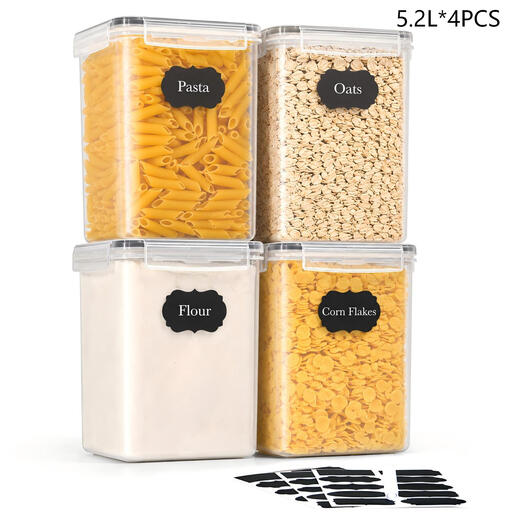
Why this choice suits this profile: This size lets you start organising dry foods without buying a whole collection of containers straight away.
With only a few pieces, you can test your needs and the available space before completing your storage.
According to its title, the set includes containers, spice jars as well as labels and tags.
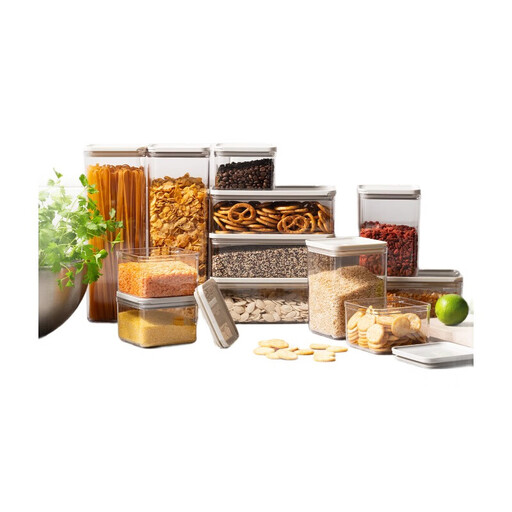
Why this choice suits this profile: With its four capacities and uniform look, this set suits kitchens where storage needs to stay harmonious and pleasing to the eye.
The breakdown is clearly detailed: 4 containers of 1 L, 2 of 1.2 L, 4 of 0.5 L and 2 of 2.6 L. You can therefore plan where they’ll go before ordering.
The set focuses on closures with silicone gaskets, stackable containers, materials stated as BPA-free and dishwasher compatibility according to the product page.
Why this choice suits this profile: This set can meet a specific need, for example to separate a few regularly used ingredients or to organise a limited space.
A compact set avoids cluttering cupboards with sizes that would end up never being used.
The product page mentions storage for fusilli, macaroni, rice, white sugar and flour, as well as the inclusion of labels and tags.
Why this choice suits this profile: This model offers a good foundation for organising everyday foods, especially when a large set isn’t essential.
You can start with the most consumed items, then add sizes you actually need.
The title mentions use for several dry foods and a labelling system to easily identify the contents.
We’ve selected a complete list, updated in real time, of products that meet these demanding criteria as well as European safety standards.
Wash the containers and lids before first use, then dry them thoroughly. A still-damp gasket can encourage odours and the build-up of deposits. When filling a box, leave a little room so you can mix or scoop out the contents without forcing the lid.
To keep dry foods in good condition for longer:
For the Bodum Canteen set, the product page states that the containers must not be used in the oven, microwave, freezer or on a hob. It also advises against liquids exceeding 60 °C and fizzy drinks. These precautions show the value of checking the limits specific to each model.
A size of around 1 to 2 L is generally suitable for typical quantities, but it all depends on the size of your packets and how much you consume. Larger models, such as the 2.6 L containers in the Bodum Canteen set, can be suitable for bigger supplies, provided you check they’ll fit in your cupboard.
No. This compatibility must be explicitly stated on the product page. For the Bodum Canteen set, the containers and lids are stated as dishwasher-safe, with a recommended wash on the top rack. Dry the gaskets thoroughly before putting them back in place.
The container limits exposure to air and moisture, but it doesn’t automatically extend the product’s best-before date. Keep the packaging or transfer its date onto a kitchen storage label, then regularly check the appearance, smell and texture of the foods before consuming them.