
Same-day & Next-day Delivery

Quality Guaranteed

Unlock Your Welcome Offers: FREE Delivery | Up to 80% OFF | Free 30-day JoyPlus trial
Download the APP
Preparing meals in advance, keeping leftovers, or taking your lunch to work all require a reliable container. An airtight glass food storage container can handle all three tasks perfectly, provided you check a few key points before ordering. The material isn't everything: to get a lunch box that's truly leak-proof and pleasant to use every day, you also need to consider the lid, the dimensions, and compatibility with your appliances.
A clip-on lid can feel secure, but the seal also depends on the silicone gasket, its flexibility, and how well it fits. A poorly positioned gasket is enough to let soup or sauce leak into the bottom of your bag.
Check for side latches, a removable gasket, and clear information about transporting liquids. Even when a container is advertised as airtight, don't fill it to the brim: leave a little room, especially with liquid-based dishes.
A small 380 ml container is fine for a single portion, a dessert, or a side dish. However, it will be too small for a full salad. Conversely, a large container takes up more space in your lunch bag and fridge.
A set of storage containers in different capacities makes meal prep much easier: small sizes for sauces, medium ones for individual portions, and large models for family-sized dishes.
Borosilicate glass generally withstands temperature changes better than ordinary glass. However, the lid, gasket, and clips may have their own limits. Before reheating a meal, remove the lid or follow the manufacturer's instructions carefully.
With a stainless steel container, caution is essential: metal must never go in the microwave. The product instructions always take precedence over a generic marketing description.
A borosilicate glass food container lets you see the contents and is usually safe for the fridge, freezer, and dishwasher. Depending on the model, it may also be microwave-safe. The Ovenglass product pages shown here indicate these uses for certain sizes.
However, you should still avoid thermal shock: don't place a very cold container directly onto an intense heat source. A gradual transition from freezer to fridge is better.
304 stainless steel is appealing for its corrosion resistance and durability, but it is obviously opaque. It can be particularly practical for transport, picnics, or storing large quantities.
For the PURECOOK model, the product page specifies a 304 stainless steel body, a borosilicate glass lid, and a silicone gasket. It also states that the container should not be used in the microwave or over a direct flame.
Look for mentions of clip-on closure, silicone gasket, and dishwasher safe. A removable gasket is easier to clean: odours and residue tend to build up in the grooves.
To keep your containers in good condition for longer:
Don't just compare capacities in millilitres: also look at the external dimensions. A storage container needs to fit in your fridge, your lunch bag, and your dishwasher.
Stackable models are especially handy for meal prep. Rectangular shapes often make better use of space, while square containers can be more suitable for individual portions and small fridge compartments.
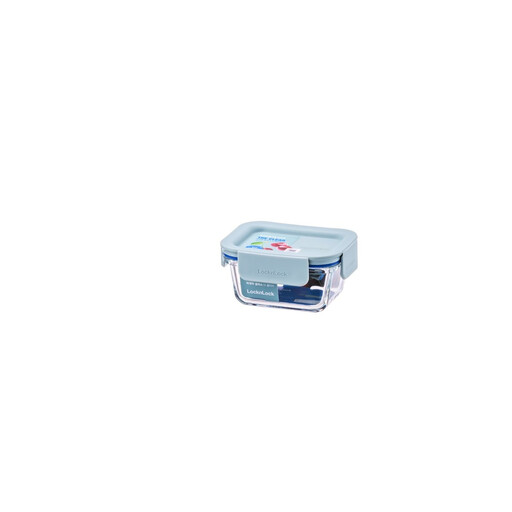
Why this suits this profile: Its 380 ml capacity is ideal for a single portion, a dessert, or a side dish, without forcing you to buy a bulky set.
The product page mentions borosilicate glass, side latches, and an airtight seal: all elements to check, rather than relying on a lid that simply sits on top.
380 ml capacity, rectangular shape, and stated dimensions of 15 × 11 × 5.8 cm.

Why this suits this profile: The eight capacities, from 150 ml to 1,040 ml, let you match the container precisely to each meal.
The variety of volumes prevents using a container that's too large for a small portion or overloading the fridge with poorly suited sizes.
Set of eight borosilicate glass containers, with graduated capacities and detachable lids according to the product page.
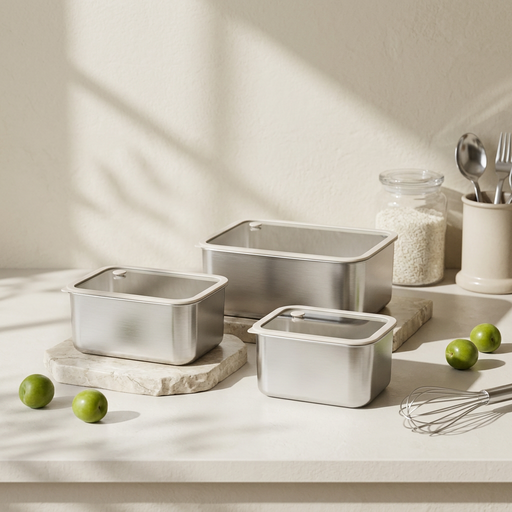
Why this suits this profile: The 1,000, 1,800, and 3,000 ml capacities are ideal for families, large batch cooking, and fridge storage.
The product page clearly states that the container should not be used in the microwave or over a flame: a useful detail to avoid any misunderstanding about the material.
Three large stackable sizes, 304 stainless steel body, borosilicate glass lids, and stated as dishwasher safe.

Why this suits this profile: The combination of five 1,040 ml boxes and five 370 ml boxes makes it easy to rotate main meals and side dishes.
The two sizes prevent you from filling a large box for a small portion and make it easy to separate the main dish from its accompaniments.
Set of ten borosilicate glass containers with clip-lock lids, according to the product page.
We've put together a comprehensive, real-time updated selection of products that meet these exacting criteria and European safety standards.
For a side dish or breakfast, 300 to 500 ml may be enough. A full individual portion usually needs between 600 and 1,000 ml, depending on the food. For a family or preparing several meals in advance, larger sizes are more practical.
It depends on the model. Check the pictograms and instructions, remove or loosen the lid before reheating the contents, and avoid sudden temperature changes. A stainless steel container must never be placed in the microwave.
Its lifespan depends on knocks, dishwasher cycles, and the condition of the clips and gasket. Replace the gasket if it becomes stiff, warped, or lets liquid through. A glass container with even a small crack or chip should be thrown away.