
Same-day & Next-day Delivery

Quality Guaranteed

Unlock Your Welcome Offers: FREE Delivery | Up to 80% OFF | Free 30-day JoyPlus trial
Download the APP
Preparing several meals in advance, storing leftovers or reheating your lunch directly becomes much simpler with an airtight glass food container. But you still need to choose the model that suits your needs. A container that’s too small will overflow, a poorly designed lid can leak in your bag, and an unchecked compatibility could damage the container or the appliance.
Before you buy, there are three pitfalls to avoid.
A borosilicate glass food container handles temperature changes better than some ordinary glasses. This material is used in several references in this selection, including the Ovenglass, Lock&Lock, JORDAN&JUDY and PYREX models.
Glass is non-porous: it generally retains fewer odours and food stains than a plastic container that’s already been used. However, do check the full product composition: the container may be glass, while the lid is polypropylene and the seal is silicone.
For those who are mindful of what their containers are made of, the BPA-free label applies to several products presented as suitable for food contact. It doesn’t mean every part is glass: the lid and seal remain separate components.
A glass container with a lid should be judged on the quality of its closure, but also on how easy it is to clean. Four-clip systems distribute pressure evenly around the seal and can help prevent leaks when the lid is properly fitted.
A removable seal makes it easier to remove food residue. Take it out, let it dry completely, then put it back without twisting it. Even when a container is advertised as dishwasher-safe, hand-washing the lid and seal can help keep them flexible for longer.
Before each use, check the following:
The volume should match your daily use:
A microwave-safe food container should always be used with care. Remove the lid before reheating food, unless the manufacturer explicitly states otherwise. For freezing, leave some space so that liquids can expand. Above all, avoid going straight from the freezer to a hot oven: even heat-resistant glass can crack from thermal shock.
The sizes below meet several needs: lunch at the office, meal prep, family storage or heavy-duty use. The features are given according to the information available on each product page.

Why this choice suits this profile: At 630 ml, this model is ideal for an individual meal or leftovers, without taking up as much space as a larger container. Its rectangular shape slides easily into the fridge and a lunch bag.
The clip closure and airtight design reduce the risk of leaks associated with simple push-on lids. However, the lid must be removed before reheating.
Borosilicate glass, 630 ml capacity and advertised compatibility with oven, microwave, freezer and dishwasher.
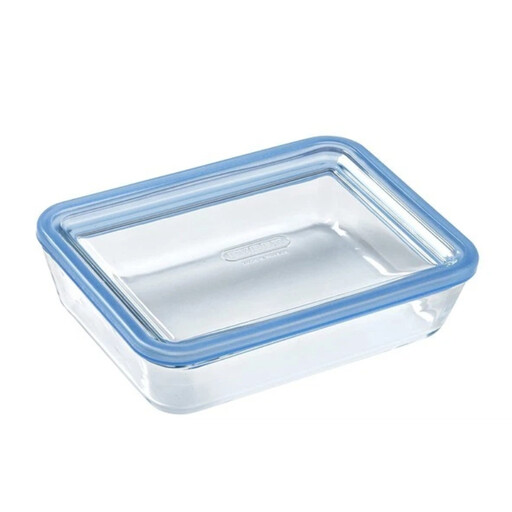
Why this choice suits this profile: This 0.8-litre size is perfect for those looking for a versatile container for leftovers, meal prep, freezing and cooking. Its stackable design makes storage easy.
The product page reminds you of the precautions to take against thermal shock: let the glass cool before placing it in the cold or cleaning it.
Non-porous borosilicate glass, 0.8-litre capacity and advertised use in oven, microwave, freezer and dishwasher.

Why this choice suits this profile: With eight capacities ranging from 150 ml to 1,040 ml, this set lets you organise portions, ingredients and snacks for the whole family or prep your meals for the week.
The variety of volumes stops you from using a large container for a small portion or filling an individual container to the brim.
Set of eight borosilicate glass containers, varied sizes and design suited for transporting meals, according to the product page.
We’ve put together a comprehensive, real-time selection of products that meet these demanding criteria and European safety regulations.
To make a rectangular or square glass container last, a few simple habits are all you need:
Yes, some models are advertised as freezer-safe. Leave enough space for liquids to expand and avoid going straight from the freezer to a preheated oven.
Generally, no. Remove the lid and seal before placing the container in the microwave, unless the manufacturer states otherwise. The lid could warp and prevent steam from escaping.
For an individual portion, a capacity of 630 to 800 ml is a versatile choice. Models from 380 to 500 ml are better suited to small portions, while a 2-litre container is more appropriate for family storage and large batch preparations.