
Same-day & Next-day Delivery

Quality Guaranteed

Unlock Your Welcome Offers: FREE Delivery | Up to 80% OFF | Free 30-day JoyPlus trial
Download the APP
Between leftovers, bulk-bought ingredients and items that need to go in the fridge, airtight food storage jars make everyday organisation much simpler. But you still need to pick a model that suits your needs. A jar that’s perfect for the pantry won’t necessarily work in the freezer, and a lid described as “airtight” can quickly become a nuisance if it’s hard to clean.
Here are the key factors to consider before you buy, along with a selection of containers suited to different usage profiles.
A lid that fits snugly doesn’t always guarantee a perfect seal. To prevent leaks and stop odours from spreading, choose a silicone seal or a closure system that the manufacturer clearly describes as airtight. A removable seal also makes cleaning easier – food residue tends to get trapped in the grooves.
A glass container may be suitable for the fridge, freezer or microwave, but it depends on the model. Borosilicate glass generally handles temperature changes better than ordinary glass, though it still doesn’t allow for every kind of thermal shock.
Plastic containers, on the other hand, are lightweight and easy to stack. However, some shouldn’t be used with very hot food or in cooking appliances. Always follow the manufacturer’s instructions.
A large container might seem practical until you realise it’s too bulky for a narrow fridge. To make the most of cupboard space, measure the depth of your shelves and check the height between levels. Stackable containers help you save vertical space, provided their base is stable and the lids can bear the weight.
For everyday use, choose containers whose material is explicitly stated as food-safe. Models labelled BPA-free address a common concern among households looking to limit certain components in their storage boxes. However, this doesn’t mean you can ignore the product’s usage instructions.
Glass is transparent, so you can quickly see what’s inside, and it generally doesn’t retain odours. On the downside, it’s heavier and can break if dropped. Food-grade plastic is often lighter and more impact-resistant, but it may scratch over time.
The dishwasher-safe label is a bonus for regular use. Still, check whether it applies to the container, the lid and the seal. For a wooden lid, like the one on the Alpina jar, hand washing is still best.
A clear kitchen storage jar lets you spot its contents at a glance. For dry foods, leave a little room at the top so you can handle the container without spilling anything.
An airtight seal limits exposure to air and moisture, but it doesn’t replace good storage practices. Let dishes cool before sealing the container, stick to the recommended temperatures, and never fill it completely before freezing – liquids expand as they freeze.
In the microwave, remove the lid as a rule. With a glass container, avoid going straight from the freezer into a very hot appliance unless the manufacturer explicitly allows it.
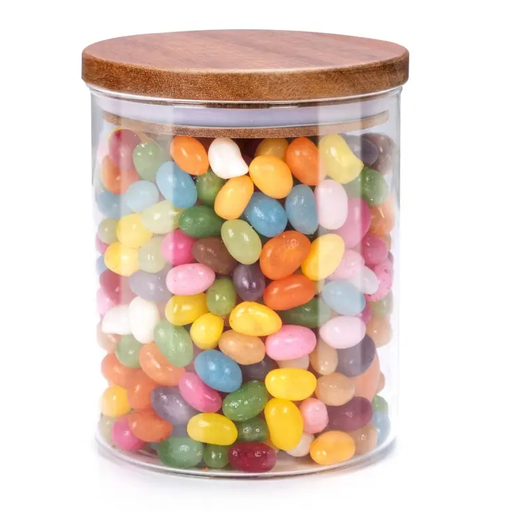
Why this choice suits this profile: At 600 ml, this jar is a great starting point for organising a worktop or cupboard. It’s ideal for spices, seeds and small quantities of dry foods.
The acacia wood lid is designed to create an airtight seal. However, the manufacturer recommends washing the glass jar by hand and wiping the lid with a damp cloth.
Clear glass container, 600 ml capacity, acacia lid and compact size of 9.5 × 9.5 × 11 cm.

Why this choice suits this profile: Its 2-litre capacity is ideal for family meals, meal prep and storing leftovers in the fridge or freezer.
Its removable silicone seal can be taken out easily for cleaning. The manufacturer states it is dishwasher, microwave and freezer safe. In the microwave, the lid must be removed.
Borosilicate glass, 2-litre capacity, dimensions 25.4 × 19.4 × 8.7 cm, BPA-free material and resistance to thermal changes up to 200 °C according to the product sheet.
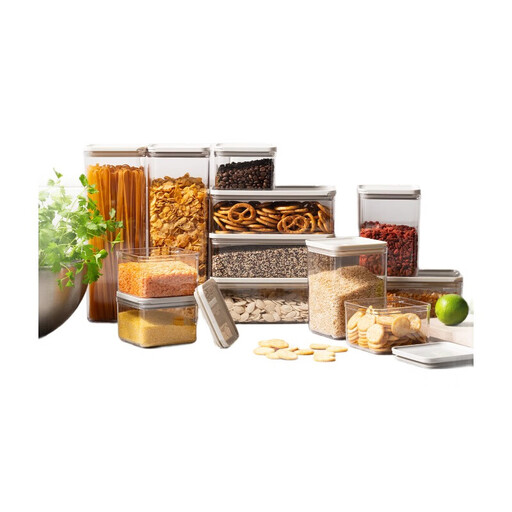
Why this choice suits this profile: This set is designed for households that keep a well-organised pantry or regularly buy dry foods in bulk.
The four different capacities let you choose the right container for the amount you need to store. The lids come with silicone seals to help keep moisture and pests out of the pantry.
Set of 12 pieces in 0.5, 1, 1.2 and 2.6 litres, BPA-free plastic, stackable design and dishwasher-safe for both containers and lids.
We’ve put together a comprehensive, regularly updated list of products that meet these exacting standards as well as European safety regulations.
Only if the product sheet explicitly allows it. With a glass container, leave some space at the top, especially for liquid preparations. Avoid sudden temperature changes and check for cracks or chips before each use.
A 1 to 1.2 litre size is generally suitable for a single portion or two small portions. For family meal prep, a 2 L glass meal prep box offers more volume, but it also takes up more space in the fridge.
Clean the seals regularly, dry the lids thoroughly and avoid abrasive products. Never force the lid shut if it’s warped. For glass models, inspect the rims after a knock. Finally, stick to the temperature limits and usage guidelines provided by the manufacturer to maintain the airtight seal over time.