
Livraison le jour même ou le lendemain

Qualité garantie

Débloquez vos offres de bienvenue: Livraison GRATUITE | Jusqu'à -80 % | 30 jours d'essai gratuits à JoyPlus
Téléchargez l'application
A well-organised pantry starts with the right containers. However, buying airtight food storage jars can quickly lead to a few unwelcome surprises: a lid that is difficult to close, a size that does not fit in the cupboard or a material that is not durable enough for everyday use. Before choosing a set of kitchen storage jars, it is worth separating marketing claims from the features that are genuinely useful.
A lid simply placed on a container is not enough to stop moisture getting in. When storing pasta, flour, rice or cereals, choose a system with a silicone seal or a closure designed to limit air exchange. The term ‘airtight’ should be accompanied by a precise description of the mechanism used.
Even with an effective lid, the container must be filled with dry food. Also check that the seal is clean, correctly positioned and completely dry.
A large container is not necessarily the most practical. A 600 to 750 ml model is suitable for nuts, coffee or small quantities of spices, while a 2-litre jar is better suited to pasta, rice or cereals. Before ordering kitchen storage containers, measure the height, width and depth available in your cupboards.
Stackable formats help you make the most of vertical space, provided the lids are stable enough and the bases do not slide.
Glass is resistant to stains and odours, but it is heavier and can break. Transparent plastic is lightweight and easy to handle, provided you check its composition and usage instructions. For BPA-free food containers, the product description should clearly state this feature, without implying other properties that have not been specified.
A wooden lid adds an elegant finish, but it will often need to be washed by hand. This is worth bearing in mind if you use your containers every day.
To create a well-structured storage system, it is best to combine several sizes:
Transparent dry food jars allow you to identify their contents at a glance and quickly see how much is left. To keep your storage organised over time, add a label with the name of the food and, if necessary, the date it was opened.
Glass, particularly borosilicate glass when explicitly stated, withstands moderate temperature changes well. However, it remains vulnerable to drops and thermal shock. Avoid pouring boiling liquid into a cold jar unless the product description specifically states that this use is permitted.
BPA-free plastic containers are generally lighter and practical for everyday use. However, the models presented here must not be used in the oven, microwave or on a hob, or with very hot liquids when the manufacturer excludes these uses.
A clean seal helps maintain an effective closure. After washing, dry the container and lid completely before closing them. Even the slightest trace of moisture can affect the storage of dry foods.
Also remember to check:
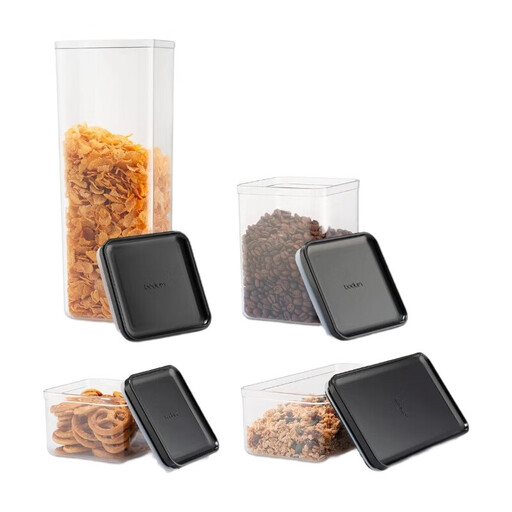
Why this choice suits this profile : this set of six containers provides a good starting point for organising a cupboard or a small kitchen. The different capacities cover a range of uses, while the transparent plastic keeps the overall set lightweight.
The range of sizes means you do not have to use a large jar for a small quantity of food. The airtight lids with silicone seals help protect the contents from moisture.
Six transparent BPA-free plastic pieces with airtight black lids and stated dishwasher compatibility.

Why this choice suits this profile : with its textured glass and acacia lid, this jar naturally belongs in a kitchen where storage containers remain on display on the worktop.
With its 750 ml capacity, it helps keep small supplies from taking up too much space. The silicone seal is described as airtight, while the glass makes it easy to monitor how much remains.
Textured borosilicate glass, acacia lid, food-grade silicone seal and dishwasher-compatible body. The lid must be washed by hand.

Why this choice suits this profile : the combination of five 1,040 ml containers and five 370 ml containers is suitable for packed meals, prepared portions and everyday storage alike.
The two clearly distinct capacities prevent you from ending up with an assortment that is difficult to use. The borosilicate glass and reinforced-closure lids are designed to withstand frequent handling.
Ten-piece borosilicate glass set, with five 1,040 ml containers and five 370 ml containers, designed for transporting meals and storing food.
We have brought together a complete, real-time selection of products that meet these exacting criteria and European safety regulations.
Airtight jars are mainly suitable for dry foods: rice, pasta, flour, sugar, cereals, coffee, spices, nuts and dried fruit. For moist or perishable foods, follow the recommended storage guidelines and temperature. An airtight container does not replace a refrigerator when refrigeration is required.
Its useful life depends on the material, how often it is handled and how well it is cared for. A glass jar can remain usable for many years if it is not cracked or chipped. Sealing components may need to be replaced when they become misshapen or damaged. Inspect the seal and lid regularly, and discard any container with a crack, deformation or faulty closure.
Yes, provided they stand on a stable base and have a lid designed to support stacking. Before stacking transparent storage containers, check that they are compatible with one another and place the heaviest containers at the bottom. To keep your pantry practical, also leave enough room to pick up each jar without causing the stack to topple.