
Same-day & Next-day Delivery

Quality Guaranteed

Unlock Your Welcome Offers: FREE Delivery | Up to 80% OFF | Free 30-day JoyPlus trial
Download the APP
A well-organised pantry starts with containers suited to every purpose. Yet buying airtight food storage jars can come with a few unwelcome surprises : a lid that is difficult to clean, dimensions that do not fit your shelves or a material that handles temperature changes poorly.
Rather than choosing based solely on appearance, here are the criteria to assess, the mistakes to avoid and a selection of models available from Joybuy.
A lid simply placed on a jar does not necessarily protect foods that are sensitive to moisture. For flour, rice, cereals or dried fruit, choose a silicone seal and a closure system explicitly described as airtight.
Multi-sided clip closures generally hold the lid more evenly in place. Before each use, however, check that the seal is clean, correctly positioned and in perfect condition.
Airtight glass jars are appealing thanks to their transparency and resistance to retaining odours. However, not all glass containers are suitable for the oven, freezer or microwave.
Borosilicate glass handles temperature variations better than ordinary glass. This does not mean it can withstand every thermal shock : for example, avoid pouring boiling liquid into a cold container or moving it directly from the freezer to a heat source. The manufacturer’s recommendations should always be treated as the definitive reference.
A capacity of 500 ml alone does not determine whether a container will fit in your cupboard. Also consider its length, width and height, particularly when choosing stackable food storage containers.
A jar that is too tall may be difficult to reach on a shelf. Conversely, a very wide format can take up the entire depth of your refrigerator. For meal prep, rectangular shapes often make better use of space than round jars.
Never assume that a container is food-safe or suitable for the microwave or freezer based on a photograph alone. Consult the product description and the manufacturer’s warnings.
When organising your pantry, match the capacity to the type of food:
Transparent containers let you check the remaining contents at a glance. It is a practical way to know when to replenish your supplies without opening every container.
Before first use, wash the container and dry it thoroughly. To maintain an effective seal:
Jars with wooden lids, particularly acacia models, should generally be washed by hand. Also avoid leaving them submerged for extended periods.
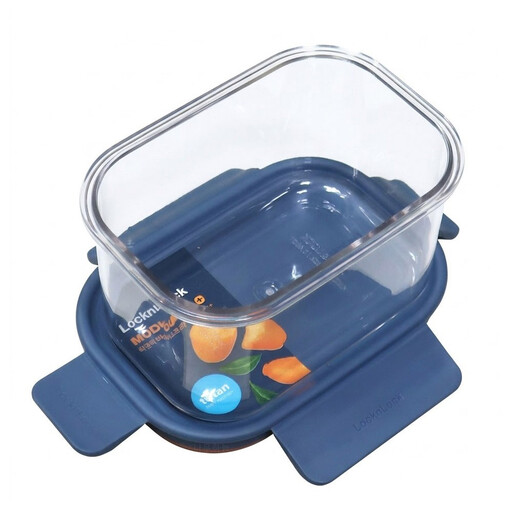
Why this format works: with its 450 ml capacity, it is ideal for individual portions, leftovers and lunches on the go.
Its BPA-free polypropylene body reduces the risk of breakage during transport, while the four-sided closure helps keep the seal securely in place.
Modular rectangular format, compatible with the refrigerator, freezer, dishwasher and microwave without the lid.

Why this format works: its 2-litre capacity is suitable for large-batch dishes as well as storing leftovers in the refrigerator.
The product description specifies use in the refrigerator, freezer and microwave, with the lid required to be removed before reheating.
Borosilicate glass, removable seal, dimensions of 25.4 × 19.4 × 8.7 cm and dishwasher cleaning according to the product description.
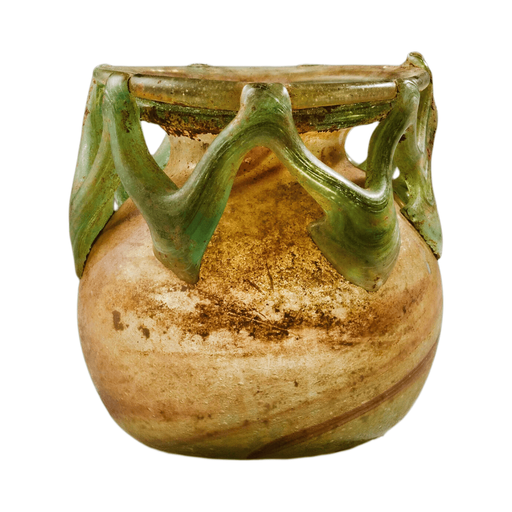
Why this format works: its textured glass and acacia lid sit beautifully on a worktop, keeping ingredients clearly visible.
The silicone ring is described as airtight. Care for the wooden lid is clearly distinguished from care for the glass container.
750 ml capacity, borosilicate glass, dishwasher-safe body and acacia lid to be washed by hand.
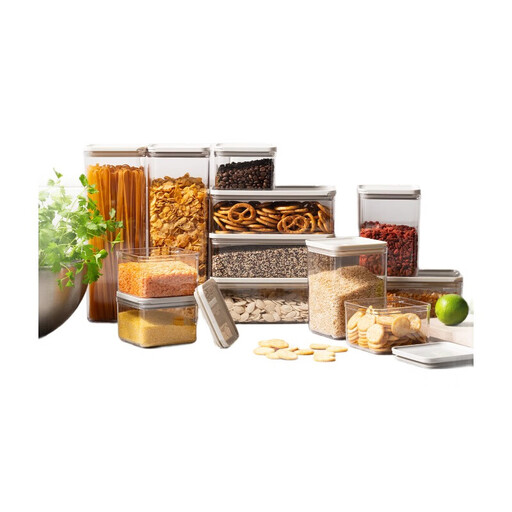
Why this format works: its four capacities make it easy to organise cereals and pasta, flour, coffee and smaller provisions.
The 0.5, 1, 1.2 and 2.6 litre formats prevent small quantities from being stored in oversized containers, making it easier to rotate your supplies.
Twelve pieces, transparent bodies, lids with silicone seals and a stackable design. Not compatible with the microwave or freezer.
We have put together a comprehensive, regularly updated selection of products that meet these criteria, helping you preserve food and organise your kitchen more effectively in France.
For dry foods, choose an opening wide enough to pour and measure with ease. Jars from 750 ml to 1.2 l are suitable for nuts, pulses, coffee and dried fruit. Larger formats are better suited to pasta, rice and cereals.
Rectangular food storage containers are more practical for leftovers and pre-portioned meals. For sauces, jars for jam and condiments designed for this purpose can complement your storage system. However, always check the storage conditions after opening stated on the label.
For a visually harmonious kitchen, sets in several sizes make organising your supplies easier. You can also add a label showing the product name and opening date, particularly when several ingredients look alike.
Only when the product description explicitly says so. When using a glass container, leave enough empty space to allow water-rich foods to expand. Avoid thermal shock, and never place a cracked or chipped jar in the freezer.
It depends on the material, frequency of use and level of care. A glass jar can remain usable for many years as long as it has no chips or cracks. Seals and lids, however, are wear parts : replace them as soon as they become rigid, deformed or less airtight.
Glass makes it easier to see the contents and is more resistant to odours. Polypropylene, on the other hand, is lighter and less likely to break during transport. To decide between them, focus on the weight, microwave and freezer compatibility, and the closure system.