
Same-day & Next-day Delivery

Quality Guaranteed

Unlock Your Welcome Offers: FREE Delivery | Up to 80% OFF | Free 30-day JoyPlus trial
Download the APP
A well-organised cupboard isn’t just about how many containers you have. With airtight food storage containers, the choice of sizes, material and lid design directly affects everyday practicality. Whether you’re cooking for a family, a batch-prepping enthusiast or simply looking for a tidier pantry, a few checks are all it takes to avoid buying the wrong set.
A lid that simply clips on will keep dust out, but it won’t necessarily block odours, moisture or small leaks. For storing flour, rice or pasta, look for a clear airtight claim, with a complete sealing system and a properly fitted gasket.
A large set of food storage containers might look like a bargain, but a collection made up of identical sizes won’t cover all your needs. Small containers are ideal for spices, seeds and toppings. Medium-sized ones are perfect for leftovers and single portions. Larger containers, meanwhile, are far more practical for pasta, rice and other dry goods.
Always check that the “dishwasher safe” label applies to both the container and the lid. A material described as durable isn’t necessarily suitable for the oven, microwave or direct heat. Always follow the manufacturer’s recommendations, and let lids dry completely before sealing the containers to preserve their airtightness.
Borosilicate glass is prized for its transparency and good resistance to temperature changes. The product page for the JORDAN&JUDY model below states it is made from borosilicate glass, with containers of 1,040 ml and 370 ml. This set can work well for storing prepared meals or taking lunch to work, as long as you follow the usage instructions.
Plastic, on the other hand, is lighter and often more practical in a cupboard or storage basket. The BODUM PRESSO model is described as being made from BPA-free plastic, with airtight lids and multiple sizes. The product page also states that both the containers and lids are dishwasher safe. However, do check the temperature limits before putting hot food inside.
For efficient kitchen cupboard storage, choose regular shapes and dimensions that fit your shelves. Measure the depth of your cupboard, the available height between shelves, and the space taken up by the lids once the containers are closed.
A selection of different sizes makes it easier to organise your ingredients. Small volumes can serve as spice jars, while 1 to 2-litre containers are better suited to cereals, sugar, flour or biscuits.
Labels for jars let you quickly identify foods and note their opening or filling date. They’re especially handy when several products look alike. Just check whether they’re included in the set or sold separately.
For foods bought in bulk, also note the contents, date and, if needed, storage instructions. An airtight container doesn’t replace good storage practices: products should be clean, dry and kept in a suitable place.
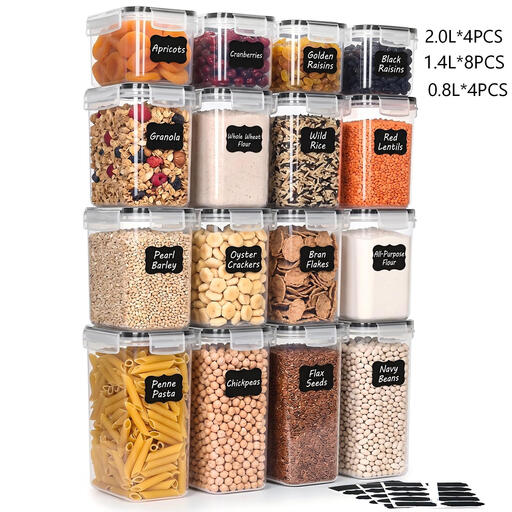
Why this choice suits this profile: This set brings together food containers and spice jars, with labels and ties mentioned in the description. A simple solution for starting to organise your pantry.
The variety of pieces means you don’t have to buy containers and labels separately. Still, check the exact dimensions before assigning them a spot in your cupboard.
A 16-piece set, labels included, and sizes designed especially for pasta, rice, sugar and flour.

Why this choice suits this profile: The borosilicate glass containers and reinforced-lid closure are aimed at kitchens where presentation and proper food preservation matter.
The two stated capacities prevent you from ending up with lots of almost identical sizes. However, confirm oven or microwave compatibility on the product page before heating the containers.
5 containers of 1,040 ml and 5 of 370 ml, in borosilicate glass according to the product name, with sealed lids.

Why this choice suits this profile: The range, from 0.25 l to 2 l, covers meal prep, leftover storage and dry goods storage all in one cupboard.
The breakdown is clearly detailed: 4 containers of 0.25 l, 3 of 0.6 l, 3 of 1 l and 2 of 2 l. That makes it easy to organise the containers by use.
The product page mentions BPA-free plastic, airtight lids and dishwasher compatibility for both containers and lids.
Start by grouping products according to how often you use them:
If your needs are modest, a 4-piece food storage set may be enough to try out a new organisation system without cluttering every shelf. You can take a look at the 4-piece food storage set. Woven paper baskets and collapsible bins can then be used to group together bags, accessories and non-food items. However, they are not a substitute for containers designed for direct contact with food.
We’ve put together a complete, real-time updated selection of products that meet these strict criteria as well as European safety requirements.
It depends on the product, its best-before date and storage conditions. An airtight container reduces exposure to moisture and odours, but it doesn’t automatically extend the date printed on the packaging. Note the opening date on a label and regularly check the appearance and smell of the contents.
No. Airtightness relates to food preservation, not heat resistance. Check for a specific microwave-safe indication. Remove or loosen the lid if the manufacturer recommends it, and never use a container over a flame or direct heat source without explicit instructions.
Glass is transparent and particularly well suited to prepared meals. Plastic, often lighter, is practical on shelves, for transport or when children are handling the containers. The right choice depends on the weight your furniture can support, the intended use and the care instructions. In either case, choose a product page that clearly states the material, capacities and usage precautions.