
Same-day & Next-day Delivery

Quality Guaranteed

Unlock Your Welcome Offers: FREE Delivery | Up to 80% OFF | Free 30-day JoyPlus trial
Download the APP
Airtight food storage containers make organising your pantry, meal prepping and transporting your lunch so much easier. But a hasty purchase can lead to a few nasty surprises: a lid that’s difficult to close, awkward sizes, or a container marketed as versatile that can’t handle hot food.
Before you choose a set of food containers, it’s worth distinguishing between your needs for storing dry goods, keeping leftovers fresh and transporting food in insulated containers. Here are the criteria to consider to avoid buying things you don’t need.
A lid fitted with a seal limits the passage of air, moisture and odours. That doesn’t mean the container can go in the oven, microwave or freezer, nor that it’s suitable for transporting hot liquids. Some plastic models shouldn’t be exposed to high heat, while vacuum jars and preserving jars serve very different purposes.
Always check the restrictions stated by the manufacturer. For example, the Bodum containers shown here are not designed for the oven, microwave, freezer or hob.
A twelve-piece set might seem like a bargain, but four small containers won’t replace two large ones for pasta, cereals or flour. Conversely, large containers quickly take up space when you’re storing spices or small portions.
To organise your pantry properly, compare the capacities in litres, the diameter and the height. Stackable food containers also need a stable base and a sufficiently flat lid.
Crumbs and moisture can get trapped around the silicone seal. Over time, this can cause lingering odours or stubborn marks. A product advertised as dishwasher-safe isn’t necessarily easy to take apart or dry.
Go for wide openings, parts that are easy to access, and make sure everything is completely dry before sealing each container.
For dry foods like rice, lentils, sugar, nuts and cereals, an airtight seal helps limit exposure to moisture and odours. It can also reduce the risk of spillage during transport, though it doesn’t guarantee indefinite freshness.
For leftovers and sauces, check for a clip-lock lid, a continuous gasket and a clear indication that it’s suitable for liquids. Containers for dry foods aren’t necessarily designed the same way as lunch boxes for transport.
BPA-free plastic is popular for lightweight, impact-resistant food containers. However, this information needs to be considered alongside the usage instructions: food-grade plastic isn’t automatically suitable for hot food.
Borosilicate glass is a heavier alternative, but often appreciated for fridge storage and being able to see what’s inside. Stainless steel, particularly in an insulated food flask, is better suited for transport and keeping food at the right temperature. The steel grade, such as 304 or 316, should be considered alongside the manufacturer’s other instructions rather than taken in isolation.
For transporting a hot or cold meal, an insulated lunch box works differently from a simple storage jar. The Maxcook models shown below claim to keep food hot or cold for 4 to 6 hours, depending on usage conditions. Pre-heating or pre-cooling the container can help minimise temperature changes.

Why this choice suits this profile: This 12-piece set covers four capacities, from 0.25 to 2 L, giving you everything you need to start organising your kitchen without buying lots of separate items.
The range of sizes means you won’t end up with only large containers that are impractical for small quantities.
BPA-free plastic, airtight lids, 4 × 0.25 L, 3 × 0.6 L, 3 × 1 L and 2 × 2 L.
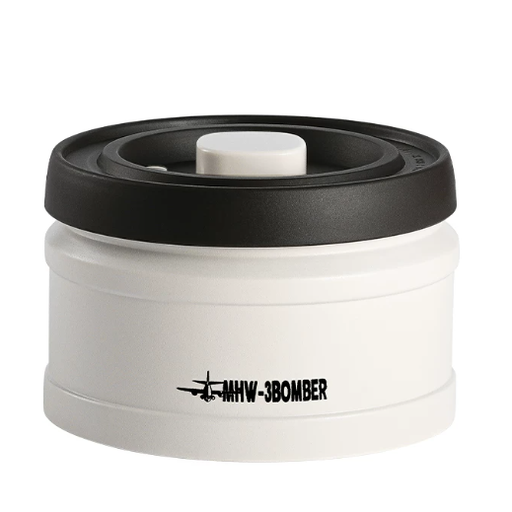
Why this choice suits this profile: This vacuum storage jar is designed for coffee lovers who want a dedicated container for their storage routine.
Its specialised use means you won’t choose a general-purpose set when your priority is preserving coffee.
Manual vacuum storage system and design tailored for coffee storage.

Why this choice suits this profile: Its 1.5 L capacity, wide opening and vacuum insulation make it ideal for meals taken to work, university or outdoors.
The product page specifies a heat retention time of 4 to 6 hours and advises against turning the jar upside down: these limitations clarify its use rather than promising absolute leak-proofing.
316 stainless steel, vacuum insulation, wide opening and leak-proof lid.

Why this choice suits this profile: The five 1,040 ml containers and five 370 ml sizes let you prepare portions, side dishes and packed lunches.
Having two sizes means you won’t fill a large container for a small portion or have to carry several mismatched boxes.
Borosilicate glass, clip-lock lids and a 10-piece set for the office or meal prep.
We’ve put together a comprehensive, real-time updated list of products that fully meet these strict selection criteria and European safety regulations.
For a single portion, a size of 370 ml to 600 ml is usually enough. A container of 1 to 1.5 L is better for several portions, a mixed salad or a prepared meal. Remember to leave a little space if the contents might expand or need to be stirred.
It depends on the model and its components. Some containers and their lids are advertised as dishwasher-safe, while Maxcook insulated jars are recommended for hand washing to preserve the seal and insulation. In any case, dry the lid and seal completely before storing the container.
The length of time depends on the food, its temperature, hygiene and your fridge. An airtight seal doesn’t replace standard food storage guidelines. For dry foods, note the opening date and keep an eye on moisture or odours. For cooked dishes, let them cool according to usual recommendations before putting them in the fridge.