
Livraison le jour même ou le lendemain

Qualité garantie

Débloquez vos offres de bienvenue: Livraison GRATUITE | Jusqu'à -80 % | 30 jours d'essai gratuits à JoyPlus
Téléchargez l'application
A well-organised kitchen often starts with the right containers. Yet choosing airtight food storage containers isn’t just about comparing capacity or the colour of a lid. Between promises of a “leak-proof” seal, sets with impractical dimensions, and materials that are difficult to maintain, certain mistakes can turn an appealing purchase into a disappointment within a few weeks.
This guide helps you compare airtight food containers based on your needs: storing leftovers, preparing meals in advance, organising the pantry, or keeping dry goods.
A lid simply placed on a container doesn’t guarantee effective protection against air, moisture, or leaks. To store flour, rice, or cereals, check for a silicone seal or a genuine airtight locking mechanism.
Even a perfectly sealed container doesn’t replace good storage practices. Perishable foods should be cooled quickly, placed in the fridge when necessary, and consumed within the usual timeframes.
A set of food containers might seem economical, but containers that are too big or too similar quickly take up all the space in your cupboards. For meal prep, a one-litre container is generally suitable for a single portion or a lunch. For a family, a two-litre container will be better suited to leftovers and batch cooking.
In a pantry, it’s often better to combine small airtight pots for spices, medium-sized containers, and large jars, rather than buying a set that comes in just one size.
A removable seal makes cleaning easier, provided you take it out regularly to prevent the build-up of residue or moisture. Not all containers are suitable for the oven, freezer, or microwave either. A box that’s dishwasher-safe may not withstand direct heat or boiling liquids.
Borosilicate glass containers appeal for their transparency, their resistance to temperature changes as stated by the manufacturer, and their low odour retention. However, they are heavier and can break if dropped.
Plastic is lighter for taking a meal to the office or storing food on a high shelf. If you choose this option, look for a specific mention like BPA-free, rather than a vague claim about product safety. Without an explicit indication, never automatically put a plastic container in the oven or microwave.
Measure the available space in your fridge, drawers, and shelves. A rectangular shape often makes better use of surface area than a round container, especially for storing leftovers and meals.
Also consider the weight once the container is full. A large glass container can become difficult to handle, whereas a large-capacity plastic model will be easier to move. The dimensions stated by the manufacturer matter just as much as the advertised volume.
The closure system should remain simple to open and lock in daily use. Check that the lid has an accessible seal and that the whole thing is dishwasher-safe if you want to minimise hand washing.
For stackable storage containers, choose a stable base and a lid that’s flat enough. In a cupboard, stacking allows you to make better use of the available height, but only if the sizes remain balanced. Wooden lids or decorative elements may also require different care from the main container.
The following products meet different needs. The features mentioned are those stated for each item: always check the product page before buying, especially for uses involving heat.
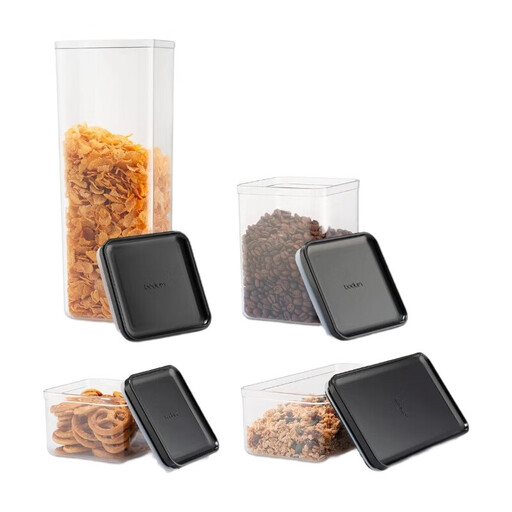
Why this choice suits this profile: This set brings together six transparent containers in different capacities, ideal for snacks, leftovers, and dry goods, without needing to make multiple purchases.
The different sizes prevent you from ending up with only large, impractical boxes. The airtight lids and dishwasher-safe parts simplify everyday use.
BPA-free recyclable plastic, transparent bodies, four capacities, and dishwasher-safe cleaning.

Why this choice suits this profile: Its two-litre rectangular format is ideal for family-sized preparations, fridge storage, and batch-cooked meals.
The silicone seal is removable for thorough cleaning. The lid must be removed before microwaving, in line with the usage instructions.
Borosilicate glass, 2-litre capacity, stated compatibility with fridge, freezer, dishwasher, and microwave without lid.

Why this choice suits this profile: The five 1,040 ml containers and five 370 ml sizes are ideal for portion preparation, packed lunches, and meal rotation.
The split into two sizes prevents using a large container for every small portion. The clip lids are designed for regular opening and closing, but check they are locked before each journey.
10-piece set, borosilicate glass as stated in the product name, and snap-lock lids.
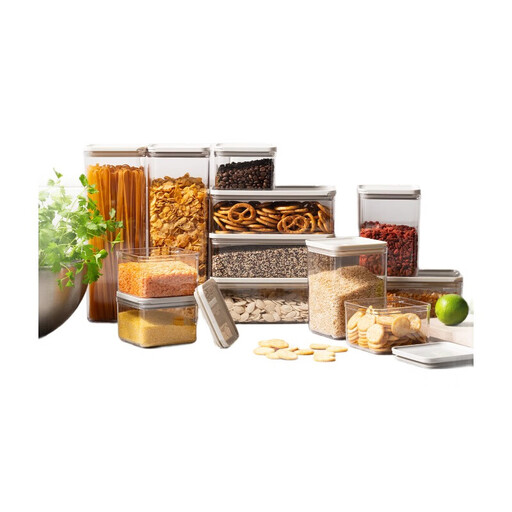
Why this choice suits this profile: The sizes from 0.5 l to 2.6 l allow you to organise cupboards for pasta, rice, flour, cereals, nuts, and baking ingredients.
The twelve pieces and four capacities make for consistent organisation. However, make sure the containers are completely dry and avoid pouring hot liquids into them.
BPA-free plastic, silicone seals, stackable design, transparent bodies, and dishwasher-safe cleaning.
We’ve put together a comprehensive, real-time updated list of products that meet these demanding selection criteria and European safety regulations.
The container mainly limits air exchange, moisture, and leaks. It does not guarantee a universal storage time. This depends on the food, its preparation, the temperature, and maintaining the cold chain. For leftovers, follow the usual fridge storage recommendations and check their appearance, smell, and preparation date.
No. The material alone does not determine the permitted uses. Always consult the model’s instructions. For the Ovenglass shown here, the manufacturer allows microwave use without the lid, but excludes ovens with a grill or fan setting, as well as direct heat sources.
No. The BPA-free label refers to the material used, but does not automatically mean the container is suitable for very hot liquids, the oven, or the microwave. Check each pictogram and usage warning separately.