
Livraison le jour même ou le lendemain

Qualité garantie

Débloquez vos offres de bienvenue: Livraison GRATUITE | Jusqu'à -80 % | 30 jours d'essai gratuits à JoyPlus
Téléchargez l'application
A well-organised pantry does not necessarily start with buying the largest set available. Between promises of leak-proof performance, awkward-to-stack sizes and lids that are incompatible with certain appliances, airtight food storage containers can quickly become a bulky and impractical purchase.
Before choosing your food storage set, there are three pitfalls to avoid:
To organise your kitchen effectively every day, it is therefore better to choose each container according to its intended use: storing pasta and rice, meal preparation, pantry organisation or displaying dry goods on the worktop.
BPA-free plastic is lightweight, transparent and less prone to breaking. It is particularly suitable for containers intended for dry foods and pantry storage. However, some models should not hold hot liquids and are not designed for use in the oven or microwave.
According to the manufacturer’s specifications, borosilicate glass withstands temperature changes better than ordinary glass. A borosilicate glass food container can therefore be suitable for meal preparation and refrigerator storage. Where explicitly stated, it may also be approved for use in the freezer or microwave. In all cases, remove the lid before reheating the contents and follow the instructions concerning thermal shock.
For any product intended to come into contact with food, check that clear information is provided about the material, intended use and care instructions. The statement ‘BPA-free’ concerns one specific substance; it does not replace general information about compliance with food-contact requirements.
An airtight food container should have a properly positioned silicone seal, with no folds or deformation. Removable lids are easier to clean, but they must be completely dry before being reassembled.
For dry foods, an airtight closure limits exposure to moisture and odours. Naturally, it does not replace the need to follow best-before dates, storage conditions and hygiene rules. For leftovers or meals to take away, also check that the lid is designed to prevent leaks.
Stackable containers make better use of cupboard height, provided that their bases are stable and their lids remain sufficiently flat. Measure the depth of your shelves before buying, particularly if you plan to keep your storage jars in the kitchen on a worktop.
For a pantry, containers ranging from 0.5 l to 1.2 l are well suited to cereals, nuts, small quantities of flour and snacks. Sizes of 2 l or more are better for pasta, rice, sugar or bulk purchases. Spice jars, meanwhile, should remain easy to pick up and identify, even when placed at the back of a cupboard.
The products below are suited to different uses. Always check the product page for your chosen model to confirm its dimensions, permitted uses and care instructions.
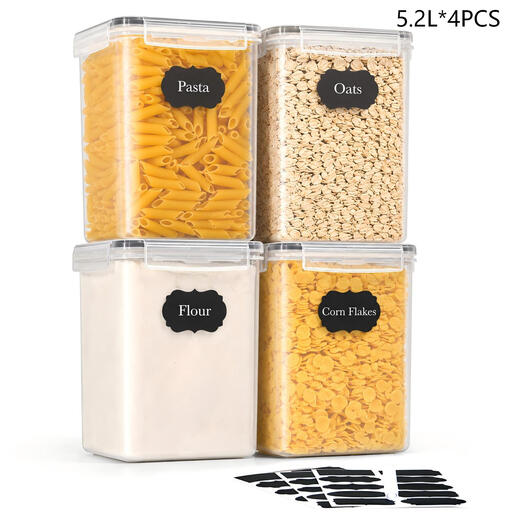
Why this choice suits this profile : This set lets you build up your collection gradually for storing dry foods, without investing in a complete collection straight away.
With just four containers, there is less risk of building up unused sizes. The included labels and markers make it easier to identify the contents.
Four-piece set with advertised airtight closure and labelling accessories for organising your pantry.

Why this choice suits this profile : With its textured glass and acacia lid, this jar will naturally fit into a kitchen where containers remain on display, whether on a shelf or worktop.
The silicone seal is presented as suitable for dry foods. This helps prevent accidental use with hot liquids or preparations it is not designed for.
Borosilicate glass, 750 ml capacity and acacia lid that should be washed by hand.

Why this choice suits this profile : Its generous capacity is ideal for family-sized portions, make-ahead meals and storing leftovers in the fridge.
The instructions clearly distinguish between permitted uses: fridge, freezer, microwave without the lid and dishwasher. The oven and direct heat sources are excluded.
2 l borosilicate glass body, removable seal and dimensions of 25,4 × 19,4 × 8,7 cm.
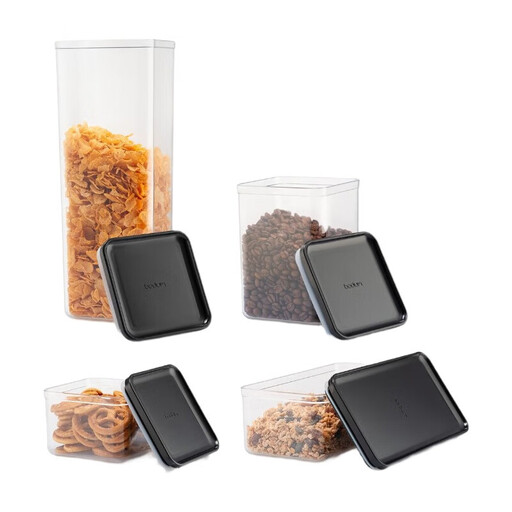
Why this choice suits this profile : Its four capacities make it easy to sort cereals, pasta, rice, flour, dried fruit and snacks within one set.
The range of sizes means you do not have to use large containers for small quantities. The jars are advertised as stackable, and their lids feature silicone seals.
12 pieces in 0.5 l, 1 l, 1.2 l and 2.6 l sizes, made from BPA-free plastic, with care instructions stating that they are dishwasher-safe.
Wash the containers before first use, then dry the boxes and seals thoroughly. Residual moisture can affect dry foods and encourage odours to develop. For wooden lids, such as the one on the NUTS model, hand washing is recommended.
A few simple habits can help extend the life of your airtight food containers:
We have put together a complete selection, updated in real time, of products that meet these demanding selection criteria and European safety standards.
Yes, sizes designed for dry foods are perfectly suitable for storing pasta and rice. Choose a capacity suited to the amount you actually consume, and always use a clean, completely dry container.
Its lifespan depends on the material, how often it is washed and the condition of the seal. Replace the container or lid as soon as you notice a crack, deformation, persistent odour or closure fault.
No. Compatibility depends on the model and its different components. Some plastic sets are dishwasher-safe but should not be used in the microwave or oven. Borosilicate glass can sometimes be used in the microwave under certain conditions, with the lid removed. Always consult the instructions before use.