
Same-day & Next-day Delivery

Quality Guaranteed

Unlock Your Welcome Offers: FREE Delivery | Up to 80% OFF | Free 30-day JoyPlus trial
Download the APP
An overflowing cupboard, a spilled bag of flour, or a packet of pasta that opens at the wrong moment – it doesn’t take much to turn kitchen storage into a headache. An airtight food storage container set can genuinely simplify pantry organisation, provided you don’t just look at the number of pieces or the promises on the packaging.
Several criteria are worth checking before you make a purchase.
A lid that simply clips on doesn’t necessarily protect the contents from moisture, odours or leaks. For truly airtight containers, look for a seal that is described as such and examine the lid design: gasket, clips, pressure system or perfectly fitted edge.
The compatibility between the container and its lid matters just as much. A fiddly system to close soon becomes annoying, especially when the containers are opened several times a day.
A set advertised as “complete” may include lots of small containers without offering enough sizes for bulky foods. For pasta and rice containers, flour or sugar, the available capacity is often more important than the total number of pieces.
Before you choose, make a list of the foods you want to transfer and check the dimensions of the containers. An assortment of small spice jars won’t replace large-capacity containers for spaghetti, rice or cereals.
A container that’s difficult to clean will likely end up at the back of a cupboard after a few weeks. Check which parts are dishwasher-safe, referring to the manufacturer’s instructions. The BPA-free label may be useful for plastic containers, but on its own it gives no indication of heat resistance, lifespan, or compatibility with the oven and microwave.
Unless the manufacturer explicitly states otherwise, a food storage container should never be placed near a direct heat source.
A versatile set should cover several uses:
For effective kitchen cupboard storage, also choose containers that are stackable or easy to line up. Regular shapes reduce wasted space and make it easier to see what you have in stock.
An airtight lid should remain simple to use every day. If you have to force it shut, you’ll naturally tend to leave it aside. On the other hand, a lid that’s too loose can let flour, sugar or small items escape.
Think about daily use: taking the container out of the cupboard, pouring its contents, closing it again and putting it back. Lids should also stay with their matching container to avoid mix-ups during washing up.
The information to check includes:
These details help you tell apart a container designed for ambient-temperature storage from one intended for other uses. For dry foods, the essentials remain simple: a reliable seal, easy cleaning and good visibility of the contents.
Jar labels are particularly handy when several powders or cereals look alike. They can also be used to note the opening date or to better organise a shared pantry.
A set that includes labels and markers lets you get everything set up in one go. Just make sure to reserve a dry, clean surface on each container so the writing stays legible over time.
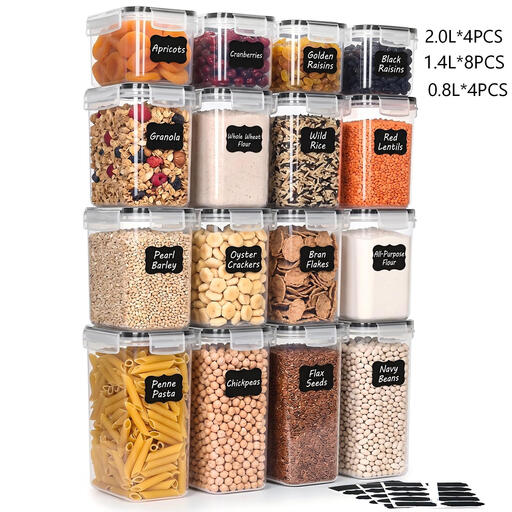
Why this choice suits this profile: This format provides a good foundation for organising dry foods, with containers and accessories suitable for pasta, rice, flour, sugar and spices.
The 16 pieces cover several categories without requiring you to buy containers and identification accessories separately.
A 16-piece set, a design described as airtight, plus labels and markers included.

Why this choice suits this profile: The four capacities offered allow you to structure your pantry with a cohesive set, in sizes ranging from 0.25 to 2 litres.
The variety of volumes prevents you from ending up with a collection made up only of small containers, which are not well suited to family supplies.
12 BPA-free plastic containers, with airtight lids and stated dishwasher compatibility.
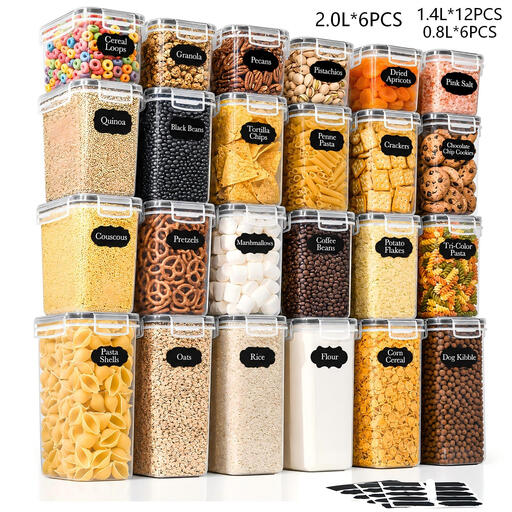
Why this choice suits this profile: With its many sizes, this set is ideal for kitchens that store several food categories and want to combine food containers with spice storage.
The 24 pieces reduce the need for incomplete purchases when several foods need to be transferred at the same time.
A 24-piece set with labels and tags included, designed for foods such as fusilli, macaroni, rice, flour and sugar.
Start by emptying a shelf, then group products by how often you use them. Place everyday foods at eye level and heavier supplies on a lower shelf. Large containers should remain easily accessible to avoid spilling their contents when you take them out.
Only transfer dry foods into perfectly clean, dry containers. When useful, note the opening date on a jar label, then keep the original packaging or any important preparation information.
For spices, dedicated storage can be more practical. You can browse the selection of spice jars to complete your organisation.
We have compiled a comprehensive, real-time updated list of products that meet these demanding selection criteria as well as European safety requirements.
For bulky foods, opt for sizes around 1 to 2 litres, depending on the quantities you usually buy. A container that is too small will force you to leave part of the product in its original packaging, while one that is far too large will take up unnecessary space in the cupboard.
Wash the containers before first use and dry the lid and gasket thoroughly, if there is one. Avoid the oven, microwave and any high heat if the manufacturer does not explicitly allow them. Do not force a deformed lid and replace any part that no longer seals properly.
A set usually allows you to harmonise the sizes, lids and overall look of your cupboard. It may also include practical accessories, such as labels. Buying individually is still more suitable when your needs are very specific, for example to top up only your large-capacity kitchen storage containers.