
Same-day & Next-day Delivery

Quality Guaranteed

Unlock Your Welcome Offers: FREE Delivery | Up to 80% OFF | Free 30-day JoyPlus trial
Download the APP
Between dinner leftovers, bulk-bought staples, takeaway meals and weekly meal prep, airtight food containers have become a must-have in many British households. But choosing the right ones is key: a poorly suited container can leak, hold onto odours or take up far too much space in an already packed fridge.
Here are the criteria to consider before buying a set of food storage containers, along with a selection tailored to different needs.
A lid that snaps on easily isn't necessarily designed to carry soup or sauce. The presence of a seal, the number of clips and the shape of the lid all directly affect how watertight it is. For a lunchbox, check the manufacturer's instructions regarding liquid foods and vertical transport.
A large set is only worthwhile if the containers stack or nest properly. Very different sizes can quickly make storage in your cupboards tricky. Before you choose, measure the space you have available and check that the dimensions are compatible with your fridge, drawers and bag.
This compatibility can vary from one part to another. The container might be dishwasher-safe while the lid, seal or locking mechanism needs to be washed by hand. So always check the instructions for each component, especially with plastic containers, glass models and those with mechanical lids.
A borosilicate glass food container is a good choice if you want to easily see what's inside and reheat your meals, provided the manufacturer allows it. However, glass is heavier and can break if dropped.
A stainless steel food container generally withstands knocks better and absorbs fewer odours. On the other hand, it shouldn't be used in the microwave. Models made from 316L or 304 steel should be used according to the instructions, particularly for long-term storage of very acidic or salty foods.
Lightweight and convenient to carry, food-grade plastic remains a sensible option for meals on the go. However, check its compatibility with cold, heat, the dishwasher and food contact. Whatever the material, replace any container that is cracked, warped or has a damaged seal.
For the pantry, capacities from 500 ml to 2 l are generally suitable for pasta, rice, flour or sugar. Smaller jars and containers are more practical for spices and ingredients used in small quantities.
For a single portion, a container of 500 to 800 ml is often enough, depending on the type of meal. Sizes from 1 to 1.5 l are better suited to hearty salads, leftovers for several people, or preparing multiple portions in advance.
Choose containers with lids that come apart easily. A removable seal makes it possible to clean the nooks where residue tends to build up. For containers that are freezer and dishwasher safe, make sure this applies to both the container and the lid.
Before first use, wash every component. Dry the seals and lids thoroughly before closing the containers – this will help limit lingering odours and prevent moisture build-up.
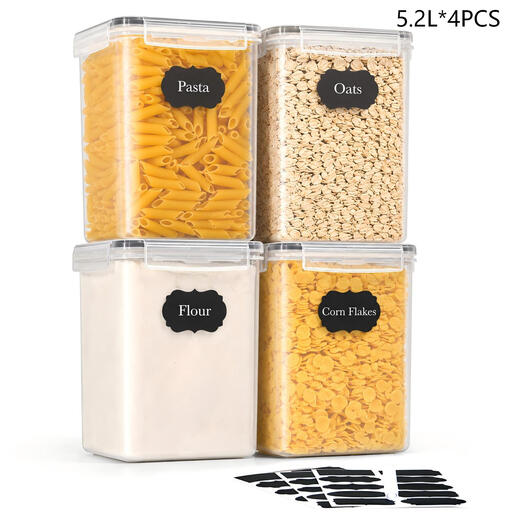
Why this suits this profile: This set lets you start organising your dry goods without investing in a bulky set straight away. It's particularly suitable for pasta, rice, flour and sugar.
A compact set minimises clutter and lets you check that the sizes and organisation work for you before expanding your storage.
4-piece set, airtight lids as per the product name, suitable for various dry foods and kitchen accessories.

Why this suits this profile: With eight capacities ranging from 150 ml to 1,040 ml, this set makes it easy to match the container to portions, leftovers and weekly meal prep.
The variety of sizes stops you from using a large container for a small portion and wasting valuable fridge space.
Borosilicate glass, eight containers in different capacities and snap-lock lids, according to the product listing.

Why this suits this profile: With four 1,600 ml containers, this set is aimed at families and meal prep enthusiasts who prepare multiple portions in advance.
The uniform size makes stacking easy and avoids juggling a multitude of different sizes that are hard to organise in the fridge or freezer.
316L stainless steel, 1,600 ml capacity per piece, fitted lids and indications of freezer and dishwasher compatibility.

Why this suits this profile: The compartments keep foods separate and are ideal for both office lunches and picnics. A single box is enough to organise several portions.
The dividers limit food mixing and stop you from having to carry several small boxes for a single lunch.
316L stainless steel, five compartments, PP lid and four clips. The manufacturer recommends hand washing and advises against use in the microwave.
A capacity of 500 to 800 ml is generally suitable for a single portion. For a hearty salad, a full meal or several portions, go for a model of 1 to 1.5 l. A compartmentalised lunch box may have a similar total capacity, divided between several sections.
No. This compatibility depends on the material, lid, seal and manufacturer's instructions. Check each product listing before buying. Glass and some stainless steel containers may be suitable for the freezer, but that doesn't automatically mean their lids are dishwasher-safe.
It depends on how often you use it, knocks, exposure to heat and how well you care for it. A worn lid or seal can compromise the airtightness before the container itself is damaged. Replace any part that is cracked, warped or whose closure is no longer reliable.