
Livraison le jour même ou le lendemain

Qualité garantie

Débloquez vos offres de bienvenue: Livraison GRATUITE | Jusqu'à -80 % | 30 jours d'essai gratuits à JoyPlus
Téléchargez l'application
Dust, pollen, cooking fumes, pet odours or particles from outdoors: an air purifier can complement your home's daily ventilation. But you need to choose a suitable appliance. A compact model designed for a bedroom may not be up to the job in a large living room, while a very powerful appliance can quickly become irritating if it is noisy.
Before placing your order, three common mistakes are worth avoiding:
CADR, or clean air delivery rate, is measured in m³/h. The higher it is, the more quickly the appliance can circulate the air in a room. For an office or small bedroom, a model such as the Alpina 12 W, rated at 60 m³/h for 5 to 10 m², may suit a targeted need. For a larger room, it is better to consider appliances offering 180, 260, 425 or 450 m³/h, depending on the layout of your home.
Also check how many air changes per hour the stated coverage area corresponds to. A large-room air purifier will be more comfortable in an open-plan living room than a compact model that has to run continuously at full power.
An appliance intended for allergy sufferers or homes with pets generally combines:
Claims such as HEPA air purifier, H11 or H13 should not be taken as a medical promise. The filtration rates stated in product specifications correspond to the test conditions declared by the manufacturer. They may vary depending on the airflow rate, room volume and filter condition. For cooking, smoke or pet odours, pay particular attention to the presence of activated carbon and the amount used.
The ionisation function also deserves a closer look. It can complement filtration, as on some Alpina models, but it does not replace a mechanical filter. If you are looking for an appliance that is simple to use, compare models whose ionisation function can be switched on or off.
In a bedroom, a quiet air purifier should remain discreet overnight. Technical specifications often state the minimum noise level in sleep mode, but the appliance will naturally be more audible at higher speeds. The ROUNY advertises a sleep mode of 25 dB or less, while the Blueair Blue Pure 511i Max has a range of 19 to 48 dB, depending on the setting.
You should also check:
A saturated filter restricts airflow and reduces the purifier’s effectiveness. Never wash a composite or HEPA filter unless the instructions explicitly allow it. Always unplug the appliance before cleaning or replacing any part.
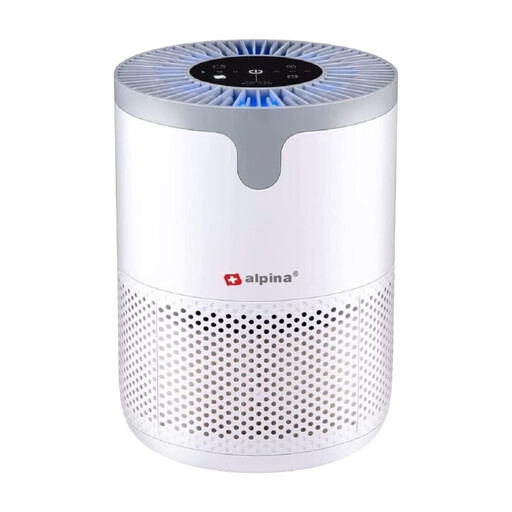
Why it suits this type of user : Its compact design and stated 12 W consumption make it a suitable choice for a small bedroom, office or space of 5 to 10 m².
Its coverage area is limited and clearly stated, so you are unlikely to choose it by mistake for a room that is too large.
Stated H13 HEPA filter, three speeds, timer and night mode.
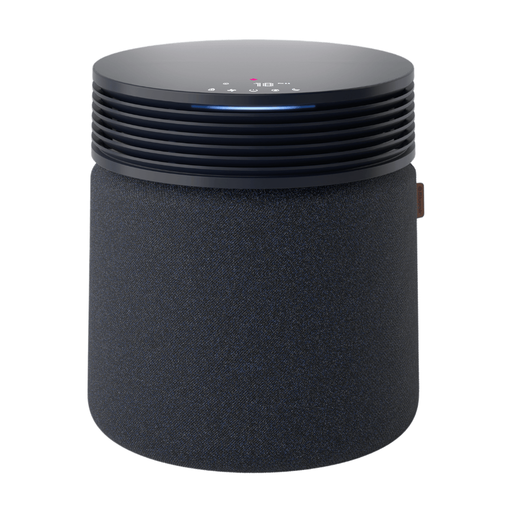
Why it suits this type of user : It is designed for households looking for automated control, a mobile app and capacity suitable for large rooms.
With a stated airflow rate of over 700 m³/h, it is better suited to a large space than a small appliance that would have to run at full power constantly.
Automatic mode, app, voice control and stated seven-stage filtration.
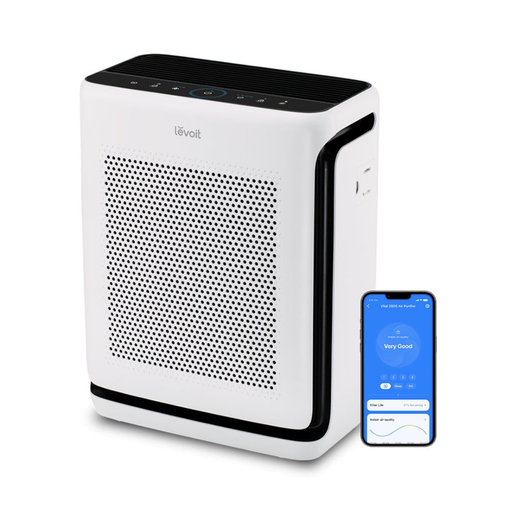
Why it suits this type of user : Its stated airflow rate of 425 m³/h, air quality sensor and smart features make it well suited to regular use in a living room or workspace.
Its automatic mode adjusts the fan speed according to readings from the integrated sensor, so there is no need to keep changing the speed manually.
VeSync app, real-time monitoring, voice control and a stated noise level of 23 to 54 dB.
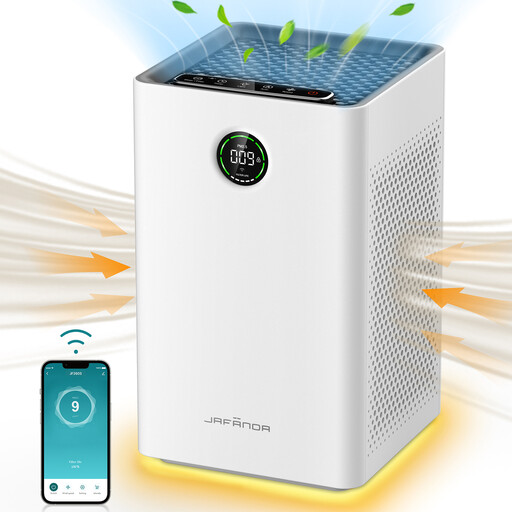
Why it suits this type of user : It combines an H13 filter and activated carbon with app or voice-assistant control, making it an appealing combination for homes exposed to odours and particles.
The different coverage levels are linked to the number of air changes, making it easier to compare performance on a more meaningful basis.
Stated CADR of 260 m³/h, PM2.5 sensor, 23 dB night mode and 300 g activated carbon layer.
We have brought together a comprehensive, real-time updated selection of products that meet these criteria, as well as European safety requirements.
Place the purifier on a stable surface, leaving around 30 cm of clear space around the air inlets and outlets. Keep it away from curtains, enclosed furniture, damp areas and radiators. In a bedroom, night mode will generally reduce noise; also remember to switch off or dim the indicator lights if the appliance allows it.
If you live with pets, vacuum the floors regularly and clean the pre-filter when the instructions permit it. An air purifier does not replace ventilation, cleaning or maintenance of your ventilation system. Also avoid running the appliance without a filter correctly installed.
It depends on the room’s volume, the appliance’s airflow rate and the air quality. Running it for longer at a low speed helps limit noise, while a higher speed may be useful after an activity that generates particles or odours. Refer to the instructions and adjust the setting to the area actually being treated.
The frequency depends on usage, the amount of dust, whether you have pets and indoor pollution levels. Manufacturers often state a lifespan of six to nine months, but the replacement indicator and the filter’s actual condition should take priority. A heavily clogged filter or a noticeable drop in airflow are good signs that it needs checking.
Consumption depends on the appliance’s power rating and how long it runs. Compact 12 to 23 W models can remain relatively energy-efficient at a comparable speed, while high-airflow appliances sometimes reach 32 to 50 W, depending on the model. Compare the rated power and use the timer or automatic mode when it suits your habits.