Sporty travellers
You’re looking for a snack to enjoy around your training and want to know how much protein your portion contains, rather than relying on the word ‘protein’ on the packaging.


For a sports snack to enjoy at the airport, start by comparing the protein per 100 g, then work out how that figure relates to the portion you plan to eat. If you want a dry snack you can eat without utensils, a bag of whole almonds is a better fit than almond butter. Check the exact ingredients and salt content too, as well as your airline’s rules if you’re taking the product into the cabin.
You’re looking for a snack to enjoy around your training and want to know how much protein your portion contains, rather than relying on the word ‘protein’ on the packaging.
You want almonds that are easy to carry and eat without any preparation. If you’re saving them for the flight, check your airline’s rules too.
You want to tell plain or no-added-salt almonds apart from salted, smoked or flavoured varieties, and check the ingredients on the specific product before choosing.
When choosing almonds to eat at the airport, start with what matters most to you: how much you’ll actually eat, how easy they are to carry, or the ingredients in the recipe.
| What to consider | What to check | Who it matters to |
|---|---|---|
| Protein and portion size | Compare the protein per 100 g, then check how much you plan to have in your snack. Look at the energy and fat per 100 g too. | If protein is a priority for your sports snack, you’ll need to relate the label figures to what you’ll actually eat. Around 50 % of consumers put this check first. |
| Convenience on the go | Check the bag size and whether you can divide up the contents. If you’re taking it into the cabin, check your airline’s rules. | Between journeys, you may prefer a dry snack that doesn’t need utensils. This is the top priority for around 30 % of consumers. |
| Ingredients and salt | Read the ingredients list, salt content and allergen information on the exact pack. | If you’re looking for a particular recipe, the flavour on the front of the pack won’t tell you what’s in it. Around 20 % of consumers make checking the label their first priority. |
A figure per 100 g doesn’t necessarily reflect how much you’ll eat. Carrefour’s listing for VRACBIO roasted almonds gives 22 g of protein per 100 g. That figure applies to this specific product, not all almonds.
Compare nutritional values on the same basis, then factor in the portion you plan to have.
Auchan offers, among other options, unsalted, salted and smoked almonds. So check the ingredients and salt content of each product individually.
If you prefer a no-added-salt recipe, check for that claim and read the ingredients list on the pack you choose.
The Nu3 almond butter listed by Monoprix Courses contains 23 g of protein per 100 g, but its spreadable texture makes it less suited to eating on the go.
If you want something you can eat without utensils, look for whole almonds instead. If you plan to take almond butter into the cabin, check your airline’s rules.
Anses classifies almonds as tree nuts. A mix may also contain other ingredients or carry a precautionary ‘may contain traces’ statement.
If you have an almond allergy, don’t choose almonds. Before buying another product, read the ingredients list and any ‘may contain traces’ statements.
A useful benchmark for the nutritional values of a specific roasted almond product.
A product to consider when comparing the ingredients in roasted almonds.
A retailer where you can compare almond recipes by seasoning.
A useful benchmark for almond butter, which is different from a snack of whole almonds.
These two bags of flavoured almonds are worth considering for a snack at the airport. If you’re looking for a plain or no-added-salt recipe, check the ingredients before choosing.
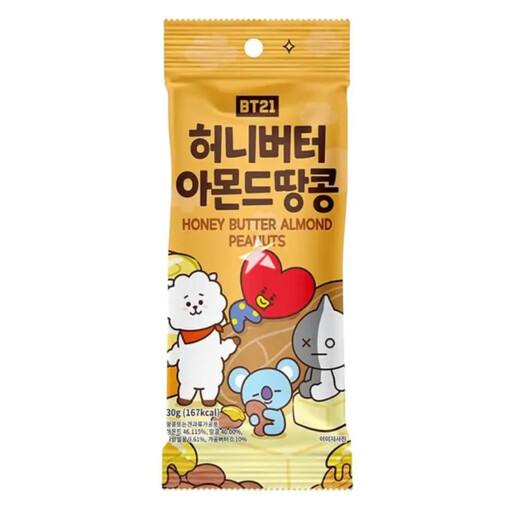 Image unavailable
This 30 g bag is worth considering if you’re after a small, flavoured almond snack to eat on the go. The honey and butter recipe isn’t plain, so check the ingredients, allergens and nutritional information on the product listing.
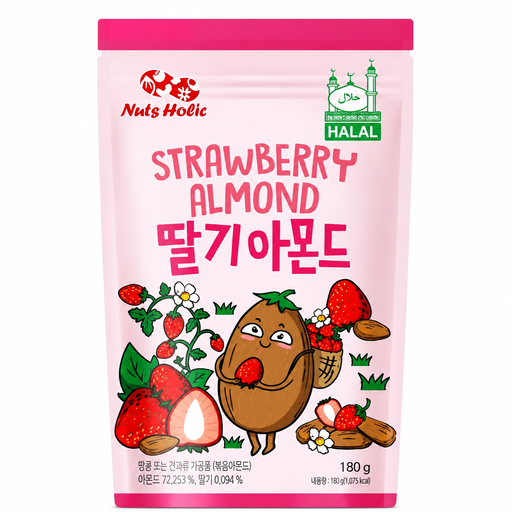 Image unavailable
This 180 g bag is worth considering if you’d like to take strawberry-flavoured almonds with you. Before choosing it for a snack at the airport, check how much you plan to eat, as well as the product’s ingredients, allergens and nutritional information.
First, check the protein per 100 g on each label, then work out how much that means for the portion you plan to eat. Carrefour’s listing for VRACBIO roasted almonds gives 22 g per 100 g, while Monoprix Courses lists Nu3 almond butter at 23 g per 100 g. These figures are for different products and formats.
The protein per 100 g doesn’t tell you on its own how much a bag contributes to your meal. Check how much you’ll actually eat and the full nutritional information, rather than estimating your intake from the word ‘protein’ alone.
Check the rules for your journey before taking the product into the cabin. France’s Ministry for Ecological Transition explains that airlines may have stricter rules than the general regulations. For an international flight, check the rules in your destination country too.
As Anses points out, almonds are tree nuts. If you have an almond allergy, don’t choose almonds. For any other product you’re considering, read the ingredients list, declared allergens and any ‘may contain traces’ statements.