
Livraison le jour même ou le lendemain

Qualité garantie

Débloquez vos offres de bienvenue: Livraison GRATUITE | Jusqu'à -80 % | 30 jours d'essai gratuits à JoyPlus
Téléchargez l'application
An air humidifier can improve comfort in a bedroom, home office or living room when the indoor air feels too dry. The problem is that product specifications often mix maximum run time, noise levels measured under very specific conditions and features that are mainly decorative. In practice, you could end up with a device that is not powerful enough, difficult to clean or poorly suited to the room.
Before placing your order, it is therefore best to distinguish genuinely useful features from marketing claims.
A 5 or 6 L tank does not guarantee the same operating time at every setting. Run time depends on the mist output, the selected power level and the automatic mode. A larger capacity means fewer refills, but it also takes up more space and requires more time to clean.
An air humidifier described as quiet enough for a bedroom may be rated at 16, 25 or 28 dB. These figures generally correspond to the quietest setting. Noise levels may increase at maximum output, when alerts sound or when vibrations are transferred to the furniture. For a bedroom, check for a night mode, the option to switch off the lighting and good overall stability.
Ultrasonic mist can encourage mineral deposits when the water is very hard. Cleaning too infrequently can also lead to unpleasant odours and affect the device’s operation. As for the aroma function, this does not mean you should pour oil directly into the tank: some models have a dedicated tray or pad, while others prohibit this practice altogether.
For a small bedroom or home office, a 2 to 3 L tank may be sufficient if you are happy to refill it regularly. For a living room or extended overnight use, a large-capacity humidifier with a 4 to 6 L tank offers greater convenience. 10 L models are generally intended for larger spaces and should be placed on a stable floor.
Output is measured in millilitres per hour. As a guide, the models featured here offer approximately 200 to 450 ml/h, depending on the selected mode. This figure should be considered alongside the area stated by the manufacturer: a device designed for a large room has different requirements from a model placed on a bedside table.
Choose an air humidifier with automatic shut-off when the water level becomes too low. This feature does not replace supervision, but it prevents the device from continuing to run empty. Also check for a removable tank, a sufficiently wide opening and easy access to the diffuser.
In a child’s bedroom, place the device away from the bed, electrical sockets and toys. A baby humidifier is not a medical device: it should be used in accordance with the instructions, out of the child’s reach, with extra care taken over essential oils and stagnant water.
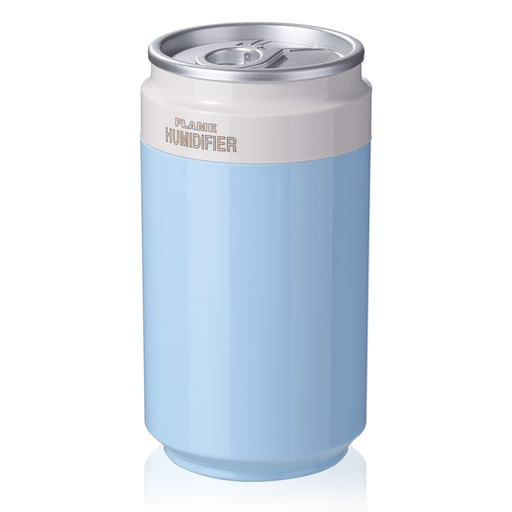
Why this choice suits this profile : Its USB power supply and 260 ml tank are suitable for a desk, car or small personal space, while taking up very little room.
The two mist modes include automatic shut-off after 4 or 6 hours. However, it is not the right choice for humidifying a large living room.
USB power supply, 7-colour lighting, continuous or intermittent operation and dry-run protection.
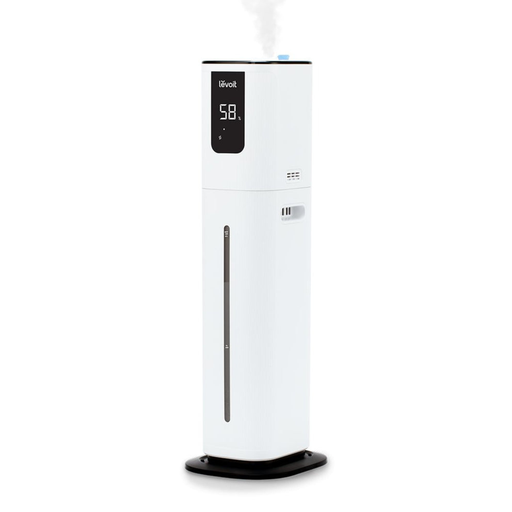
Why this choice suits this profile : This connected model is designed for spacious homes and users who want to schedule operation through an app or using voice commands.
With its 10 L capacity, it must be placed on a stable floor. The connected app does not remove the need to clean this large tank regularly.
10 L tank, stated operating noise of under 28 dB, coverage of up to approximately 55 m², VeSync app and automatic modes.
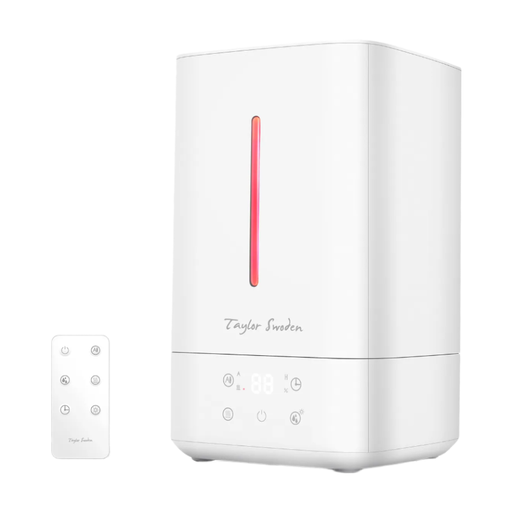
Why this choice suits this profile : Users who switch between different settings can choose between cool and warm mist, then adjust one of the three mist output levels.
The 5 L tank reduces the need for frequent refills. The 12-hour shut-off and protection against insufficient water levels help keep operation safe.
Stated output of up to 350 ml/h in cool-mist mode and 450 ml/h in warm-mist mode, remote control included and 7-colour lighting.
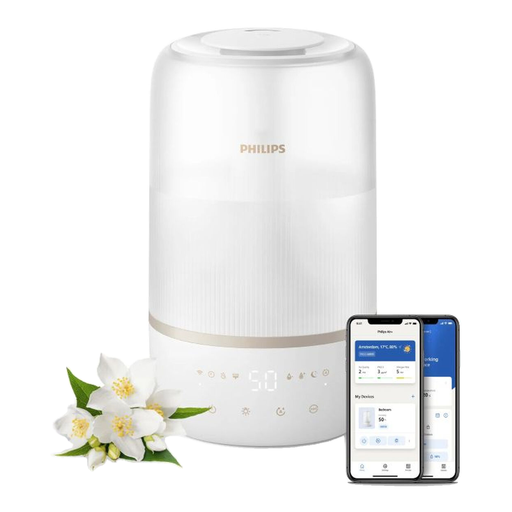
Why this choice suits this profile : Its humidity sensor, settings from 40 to 70 % and compatibility with the Air+ app will appeal to anyone who wants to automate operation.
The stated noise level is 34 dB(A) on standby, but higher speeds may produce a different result. With its 3 L capacity, the tank should be chosen according to the size of the room.
Stated output of 275 ml/h, run time of up to 32 hours, timer adjustable from 1 to 12 hours and a separate aromatherapy tray.
We have put together a complete, real-time updated selection of products that meet these demanding criteria and European safety standards.
Consumption mainly depends on the device’s power and how long it is used. Ultrasonic models with a power rating between 19,6 and 28 W generally use less electricity than warm-mist devices, whose power can reach 150 W according to the product specifications. To estimate the cost, multiply the power in kilowatts by the number of hours of use, then by the price per kilowatt-hour specified in your electricity tariff.
Models with a sensor often offer thresholds of 40, 50, 60 % or more. Start with a moderate setting and watch for condensation on windows or surfaces. Excessively high humidity can encourage water marks and damage certain materials. Ventilate the room regularly and follow the recommendations in the instructions.
The time between refills depends on the tank capacity and the selected output. The device’s lifespan mainly depends on maintenance, water quality and the replacement of any filters or cartridges. Regular cleaning, observing the maximum fill level and unplugging the device before handling it all help keep it working properly.