Someone living alone or a couple cooking small quantities
You want to prepare or reheat a small portion regularly without using a large oven cavity. However, the basket’s usable size needs to suit the food and containers you use.


For frequent small-batch cooking in a basket, a single-drawer air fryer could be a good fit. Two compartments are better suited to finishing two dishes at the same time. If you regularly use oven dishes or tins, first check whether a mini oven or your existing oven already meets your needs. Que Choisir found that some small recipes tested in air fryers used less energy than in a 19 L mini oven, but this result does not apply to every appliance or dish.
You want to prepare or reheat a small portion regularly without using a large oven cavity. However, the basket’s usable size needs to suit the food and containers you use.
If your side dish and main course need different cooking times, two synchronisable compartments can help you avoid cooking them one after the other. Check how much space is available in each one.
For quiches, gratins, cakes or cooking on a rack, the shape of the cavity and the modes offered by a mini oven may matter more than the stated capacity of a basket.
Start with the dishes you make most often: the quantity and shape will help you choose between a single basket, two compartments and an oven cavity. Then consider the space required, cleaning and energy-consumption measurements for comparable recipes.
| What matters | What to check before buying | Who this matters to |
|---|---|---|
| Cooking time and energy use for small portions | Compare the same recipe and quantity, taking the total cooking time into account rather than just the stated power. | If I often prepare a small portion, I want to know whether changing appliances will really affect how I usually cook. Around 36% of consumers would prioritise cooking time and energy use. |
| Cooking two dishes at once | Check the dimensions of each drawer and whether it has a synchronisation function; the total capacity doesn’t tell you how much space each zone offers. | When serving a side dish and main course with different cooking times together, I’d rather avoid cooking them in two batches. This would be a priority for around 29% of consumers. |
| Dishes, tins and cooking modes | Measure your containers and check the usable dimensions and modes offered by the model you’re considering. | My quiches or cakes need to fit in their tins, even if I’m only cooking a small quantity. Around 21% of consumers would put this compatibility at the heart of their choice. |
| Space and cleaning | Check the appliance’s footprint, how much clearance it needs and the cleaning instructions for removable parts. | In a kitchen with limited worktop space, I want to be able to set up, clean and store the appliance without hassle. This would be the main consideration for around 14% of consumers. |
Two compartments don’t make one large cavity: according to Philips, the NA352/04 divides its 9 L between a 6 L basket and a 3 L one. So a dish that fits the total capacity won’t necessarily fit in either drawer.
Measure your bulkiest food or container, then compare it with the internal dimensions of each compartment.
Que Choisir’s tests show that energy use varies depending on the recipe and the appliances being compared. A result for a small dish won’t predict the result for a larger one.
Look for measurements based on a quantity and recipe similar to yours, and keep using your oven for dishes that need its larger cavity.
An air fryer also uses circulating hot air. If your current oven already accommodates the dishes you usually make, the main differences to consider are the size of the cavity and how you organise your cooking.
Ask yourself whether you make small portions often enough, or need to cook two dishes separately, to justify adding another appliance.
You’ll also need to find a place for it on the worktop or in a cupboard.
Que Choisir describes air fryers as potentially bulky and a little noisy. These factors matter when you use the appliance regularly in a small kitchen.
Check the space available, the clearance required in the instructions and how to wash the removable parts of the model you choose.
Its dual-basket air fryers let you compare different ways of dividing up the cooking space.
The brand’s range includes the Optimo OX444810 mini oven, which is worth considering if your dishes need oven dishes, tins or a rack.
A brand of air fryers to consider by comparing the specifications and results for the particular format you’re interested in.
These two single-basket appliances are suited to preparing small quantities. Compare their capacity with your usual portions and check how much room they need; their inclusion here doesn’t mean they’ll use less energy than your oven.
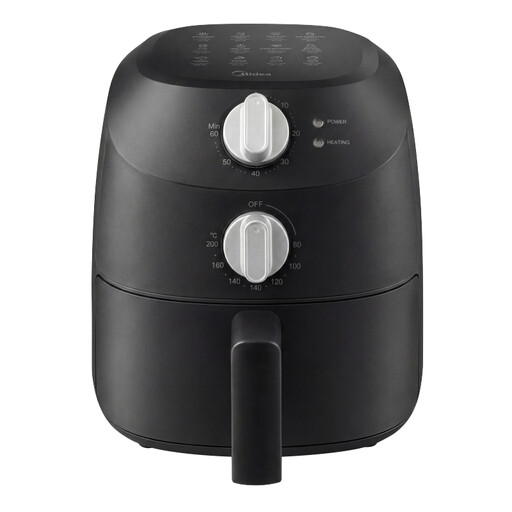 Image unavailable
For preparing a small quantity in a single basket. Stated capacity of 2 L, power of 1 150 W, 60-minute timer and non-stick basket. Check which parts are dishwasher-safe, and how much clearance the appliance needs.
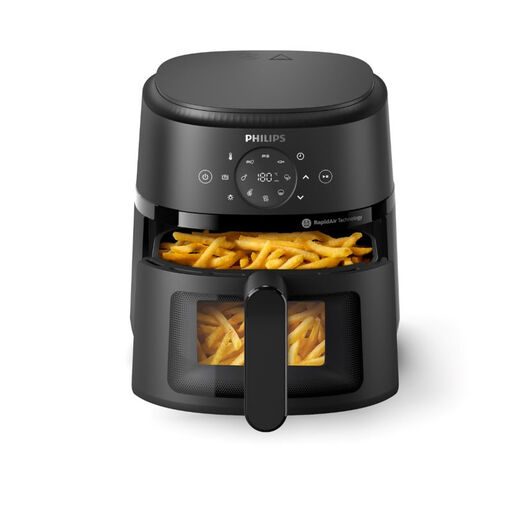 Image unavailable
For small dishes in a single basket, with a stated capacity of 3.2 L. The set-up instructions for this model require at least 100 mm of clearance on all sides, so make sure you have enough room before choosing a spot for it.
No. The comparison depends on the appliances, the quantity and the recipe. For a small quiche, Que Choisir measured an average of 36% less electricity used by the air fryers tested than by a 19 L mini oven. This result doesn’t mean every cooking task will use less energy.
Choose based on how many dishes you need to cook at once, then check the usable size of each basket. According to Philips, the NA352/04 divides its 9 L between two drawers of 6 L and 3 L: this total doesn’t guarantee that a single dish will fit in either one.
Check the instructions to see which parts are removable and how to wash them, then compare the noise level of the model you’re interested in. Que Choisir’s testing protocol assesses cleaning, storage and noise measured at 0,50 m, among other things; these factors vary from one appliance to another.
In France, the statutory guarantee of conformity applies when a private individual buys new, second-hand or refurbished goods from a professional seller. The Ministry of the Economy explains that it covers, among other things, a product that doesn’t match the seller’s description or the usual expected use. This is different from asking to return an item simply because you’ve changed your mind.