First, check how well your washing machine spins and how well the room is ventilated. According to ADEME, drying laundry indoors adds a lot of moisture to your home. If an airer isn’t suitable for your home, a condenser tumble dryer can avoid the need for an external vent, provided you have enough space and a way to manage the water. A dehumidifier may also help once you’ve measured the humidity, but as Qualitel points out, persistent damp means you need to investigate the cause.
Who are these options for?
People in a small home without a dedicated drying room
If you dry laundry in a living room or bedroom, check whether the room can be ventilated properly or has an extractor. ADEME recommends drying laundry indoors in a large, well-ventilated room or one with mechanical ventilation extraction.
Households that use an airer regularly
A suitable spin cycle can reduce the amount of water left in your laundry. If you’re also considering a tumble dryer, check its capacity, the energy consumption shown on the label, noise level and maintenance requirements.
People dealing with persistent damp
Frequent condensation, stains or deteriorating materials are signs that you should investigate the cause before relying on a portable appliance. Qualitel recommends checking factors such as ventilation, water ingress and insulation.
What should you check before choosing?
Start by considering how much water is left in your laundry and where it dries. Then look at the installation and maintenance requirements of any appliance you’re considering.
| Priority |
What to check |
What you need |
| Spin cycle and airer |
Check the washing machine’s spin-drying efficiency on its energy label. For an airer, ADEME recommends using a large, well-ventilated room or one with mechanical ventilation extraction. |
I can continue using an airer if I have a space that meets these conditions. Otherwise, I’ll need to consider another way to dry laundry regularly. |
| Tumble dryer installation |
The European Commission distinguishes between vented models, which need an external air outlet, and condenser models, which don’t. Check the dimensions, door clearance and water-management requirements in the manual for the model you choose. |
Without an external air outlet, I’m looking for a condenser model that will genuinely fit in my home. |
| Energy use and maintenance |
Compare the energy labels of models suited to a similar load. Also check the instructions for the filters and condenser: Electrolux says that a blocked condenser can increase energy consumption and damage the appliance. |
If I use the tumble dryer often, I want to be able to compare its stated energy consumption and carry out the maintenance set out in its manual. |
| Humidity in your home |
Measure humidity with a hygrometer, as Qualitel recommends. If condensation or damage persists, check the air flow, ventilation and other possible causes before relying on a dehumidifier. |
I want to manage moisture from laundry without masking a long-term problem in my home. |
What pitfalls should you avoid?
-
Choosing a vented tumble dryer without an external outlet
According to the European Commission, this type of appliance expels moist air outside, so it needs a suitable vent.
Check whether this is possible in your home before choosing a type of appliance. If you don’t have an external air outlet, look at condenser models and check their other installation requirements.
-
Relying on a dehumidifier to deal with persistent damp
Qualitel says that poor ventilation, water ingress or inadequate insulation can contribute to damp in the home. A portable appliance won’t fix these underlying causes.
Measure the humidity and check the air flow and ventilation. If the signs persist, have the cause investigated.
A dehumidifier also uses electricity, and you’ll need to manage the water it collects. Using one shouldn’t delay investigating a persistent cause.
-
Comparing energy labels without checking the exact model
An energy rating alone doesn’t tell you whether the capacity suits your laundry or what installation requirements the appliance has.
For similar uses, compare the energy information for the models you’re considering, then check their capacity, noise level and dimensions.
-
Neglecting the filters and condenser
Electrolux says that a condenser blocked with fluff can increase energy consumption and damage the tumble dryer.
Before buying, check the manual to find out how accessible the filters are and what maintenance the model needs.
A guide to tumble dryer brands
These model examples can help you identify the features to compare; they don’t represent every range from these brands.
Bosch
The WQG2450SFR heat pump tumble dryer is an example of the features Bosch lists for a specific model.
- Bosch lists a maximum capacity of 9 kg, a noise level of 64 dB and a self-cleaning condenser for the WQG2450SFR.
- Check the dimensions and installation requirements on the product page for the model you’re considering.
Miele
Miele describes the TWD640WP as a 9 kg heat pump tumble dryer.
- Its product information mentions a condensation water container and an integrated kit for draining the water.
- Check which collection or drainage set-up is right for your chosen location.
Electrolux
Electrolux describes the EW7HI395BN as a 9 kg heat pump tumble dryer.
- For this model, the brand lists an energy rating of C, 106 kWh/100 cycles and a condensation efficiency class of B.
- For delicate fabrics, follow the care labels on your clothes and check which programmes the model offers.
Heat pump tumble dryers on Joybuy
These three heat pump tumble dryers are options if you want to rely less on an airer. For each one, check the available space, installation requirements and how the water is collected or drained.
 Image unavailable
Hotpoint CHD84MWBSEE, heat pump, 8 kg
This tumble dryer offers an alternative to drying laundry on an indoor airer. The product title lists an 8 kg capacity and a C energy rating; the description says a drain hose can be connected. Before planning its installation, check what’s included, the dimensions and the energy information.
View on Joybuy
 Image unavailable
Comfee CD08EHP05W-HR, heat pump, 8 kg
This model is worth considering if you’d rather not leave laundry on an airer. The product title lists an 8 kg capacity and a D energy rating. Check the energy information and manual for the dimensions, water-management requirements and installation instructions.
View on Joybuy
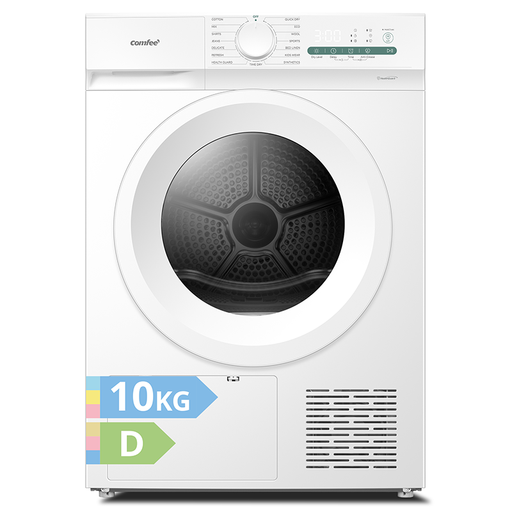 Image unavailable
Comfee CD10EHP05W-HR, heat pump, D rating
This tumble dryer is another option if you want to reduce how often you use an airer. Confirm the capacity before buying: the descriptions list 8 kg in one place and 10 kg in another. Also check the dimensions, energy information and how water is managed on the model you receive.
View on Joybuy
Frequently asked questions
Does a condenser tumble dryer need an external air outlet?
No. The European Commission explains that a condenser tumble dryer doesn’t need to vent air outside, unlike a vented model. However, check the space you’ll need and how the condensed water is collected or drained for the model you choose.
How can you compare the energy use of two tumble dryers?
Compare their energy information for similar capacities and uses, rather than relying on the technology name alone. Maintenance matters too: Electrolux says that a blocked condenser can increase the energy use of the appliance in question.
Do the condenser and filters need maintenance?
Yes. Follow the instructions for your model. Electrolux warns that a condenser clogged with fluff can increase energy consumption and damage the appliance. Check the manual to see which parts you can access and how to clean them.
Can a dehumidifier replace ventilation?
No. Qualitel recommends measuring humidity with a hygrometer and checking factors such as air flow, ventilation and possible leaks, depending on the situation. A dehumidifier can help manage moisture from laundry, but it won’t fix a persistent underlying cause in your home.
When should you keep using an airer to dry laundry indoors?
An airer is still an option if the room is suitable for indoor drying: ADEME recommends a large, well-ventilated room or one with mechanical ventilation extraction. Also check how well your washing machine spins, as any water left in the laundry will need to evaporate afterwards.


