If you want to reduce airborne particles in a particular room, consider a filter-based air purifier and check its clean air delivery rate, noise level and compatible filters. According to ADEME, reducing emissions at source and keeping the air fresh should remain priorities. An air purifier can complement these measures, but it won’t fix a faulty ventilation system. For odours or gases, check which pollutant the filter is designed to target rather than assuming that particle filtration will do the same job.
Who is this guide for?
People concerned about airborne particles
Whether it’s a bedroom, home office or living room, you’re looking for a purifier with filtration and an airflow rate suited to the room you use. ADEME notes that its effectiveness in real-world conditions also depends on the room’s layout and how it’s used.
Households affected by odours or occasional emissions
You’ll need to distinguish particles from gaseous emissions and check that the filter is designed to address the issue in question. ADEME recommends reducing emissions at source first, particularly those linked to activities in the home.
People unsure about their ventilation
You’re considering an air purifier because fresh air doesn’t seem to circulate easily. It can complement other steps, but it can’t replace checking or repairing the ventilation system. ANIL highlights the importance of having properly maintained openings and ventilation systems in a rented home.
Which criteria should you check first?
Start by working out whether the issue calls for action at source or attention to the ventilation. If additional filtration would meet your needs, compare purifiers for the room and the speed settings you’ll actually use.
| What to consider | What to check | Who is this important for? |
|---|
| Sources and ventilation |
Identify possible sources of emissions and check the condition of grilles, vents and other ventilation features before relying on an appliance. |
If the ventilation seems faulty or emissions persist, I want to address the cause rather than mask the problem with an air purifier. Around 36% of consumers put this need first. |
| Particle filtration |
Compare the stated filtration performance, clean air delivery rate (CADR) in m³/h and intended room, taking into account the speed setting you’ll use. |
For dust or pollen in a particular room, I’m looking for suitable particle filtration and won’t rely on the maximum room size alone. This is the top priority for around 29% of consumers. |
| Odours and gases |
Identify the likely source, then check which pollutant the purifier targets, which filter it uses and how often it needs replacing. |
If odours or occasional emissions are bothering me, I want to know what the appliance is designed to tackle, while also reducing the source. Around 21% of consumers put this first. |
| Everyday use |
Check the noise level at the speed you plan to use, the reference number for compatible filters, their availability and energy consumption in each mode. |
If I’ll be spending a lot of time in the room or using it at night, I need a noise level I can live with and filters I can maintain. This is the priority for around 14% of consumers. |
Mistakes to avoid
-
Assuming air purification replaces ventilation
An air purifier treats the air that passes through it; it doesn’t stop an active source of emissions or restore air circulation. ADEME recommends reducing sources and ventilating before considering additional air treatment.
Reduce emissions where possible, air the room when conditions are suitable and have any ventilation that seems faulty checked.
-
Choosing based only on the stated room size
According to ADEME, an air purifier’s effect on particles in real-world conditions also depends on the room’s volume and layout, and how it’s used. The stated room size alone doesn’t tell you the airflow rate at a setting you’ll be comfortable using.
Compare the CADR or stated airflow rate in m³/h, noise levels at each speed and where you plan to place the purifier in the room.
If the noise makes you turn the speed down or switch the purifier off, you won’t be using it at the setting you based your choice on.
-
Confusing broad claims with a filter’s specific purpose
A particle filter won’t automatically meet the same needs as a filter designed for certain gases. ANSES and ADEME also highlight limitations in the real-world evidence on the effectiveness and safety of some technologies, including photocatalysis.
Identify the likely source and check the exact conditions associated with the filter or technology, rather than choosing based on a promise to treat every pollutant.
-
Forgetting about replacement filters
How long a filter lasts depends on the conditions of use and air quality, as Philips explains for its Series 600 filters.
Before buying, check the compatible reference number for your chosen model, whether the filter is available and what maintenance it requires.
Periodic filter replacement is part of the maintenance to plan for.
Brands to know
Rowenta
The range includes domestic filter-based air purifiers. Check the airflow and noise specifications for each model.
- Rowenta states that the Pure Air Compact has a CADR of 200 m³/h.
- The stated room size for this model doesn’t remove the need to check your room’s layout and the speed setting you’ll use.
Philips
Filter reference numbers listed by series make it easier to check whether a replacement filter is compatible before choosing an appliance.
- Philips says that filter FY0611/30 is compatible with Series 600 air purifiers.
- Philips says its stated lifespan of up to one year depends on use and air quality.
Dyson
Some models combine air purification with comfort features. Their usefulness depends on your room and which features you actually need.
- For the Big+Quiet Formaldehyde BP04, Dyson states noise levels of 38 dBA in Quiet mode and 56 dBA at maximum.
- These figures apply to the BP04. Check the noise level at the setting you plan to use, and don’t confuse its features with repairing a ventilation system.
Air purifiers to compare on Joybuy
These filter-based air purifiers are intended to provide additional particle treatment in a room. To compare them, check their stated specifications against your room, then confirm which filters are compatible. None can replace tackling a source of pollution or fixing faulty ventilation.
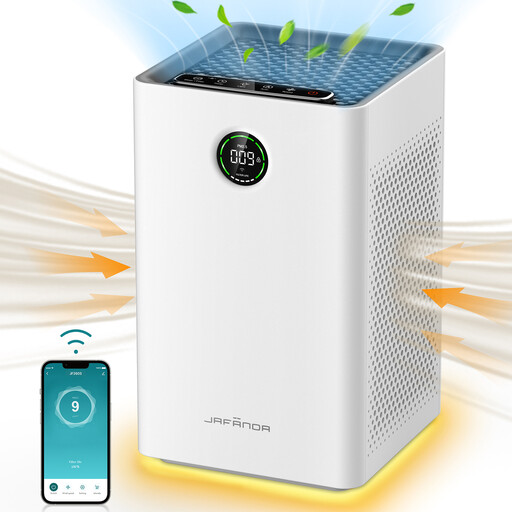 Image unavailable
Jafända H13 air purifier with activated carbon, up to 1,190 ft²
Worth considering if you’re looking for particle filtration in a room whose size you can compare with the stated usage conditions.
The product description lists an H13 filter with activated carbon, Wi-Fi and Alexa control, and a Sleep mode rated at 23 dB.
Check the airflow rate at your intended setting and the reference number for the replacement filter.
View on Joybuy
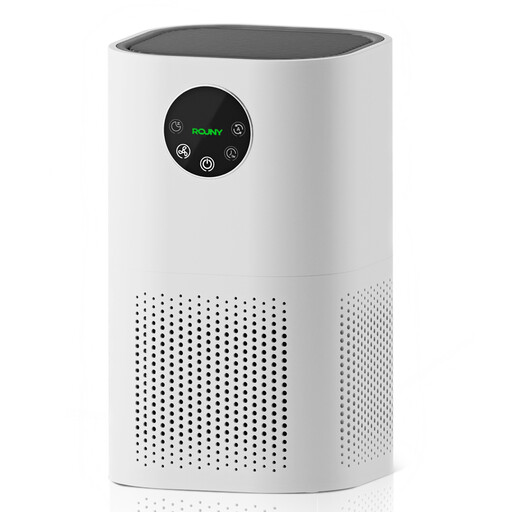 Image unavailable
ROUNY AP-T1 H13 air purifier, CADR 150 m³/h
Worth considering for a room where particle filtration matters, provided the stated coverage suits the way you plan to use it.
The product claims to cover 20 to 50 m² and features a Sleep mode rated at ≤25 dB, an air quality display and four speed settings.
Check which speed and conditions the stated room size applies to, as well as the reference number for compatible filters.
View on Joybuy
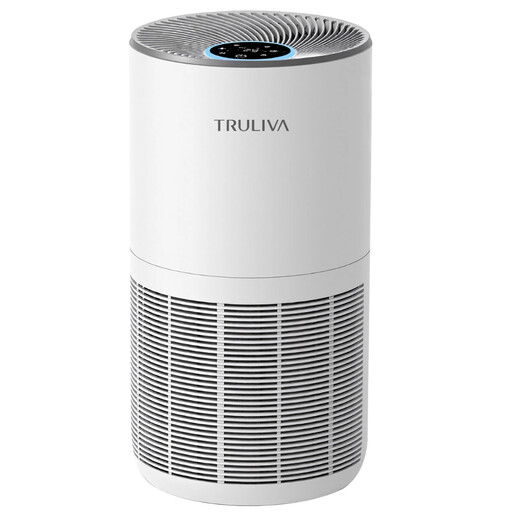 Image unavailable
TRULIVA H13 HEPA air purifier, CADR 450 m³/h
Worth considering if the stated airflow rate is an important factor for the room you want to treat.
The product description mentions a 24-hour timer.
Before using it at night, check the noise level at your intended speed and how to replace the filter.
View on Joybuy
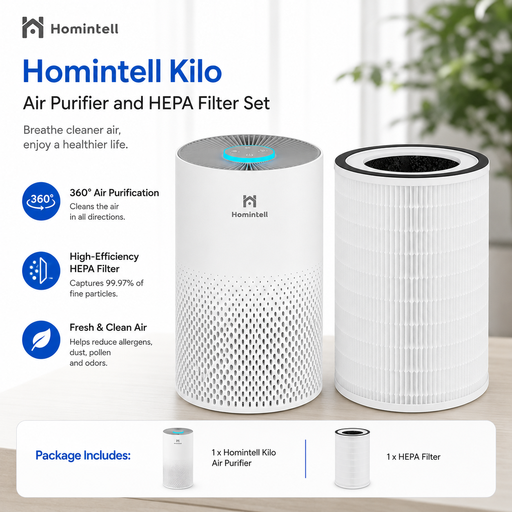 Image unavailable
Homintell Kilo air purifier with extra HEPA and carbon filter
Worth considering for a small room if you want to compare a purifier supplied with an extra filter.
The product description states a CADR of 150 m³/h, three speed settings and an 8-hour timer.
Check the room size that applies to this variant and exactly what’s included in the filter pack before choosing.
View on Joybuy
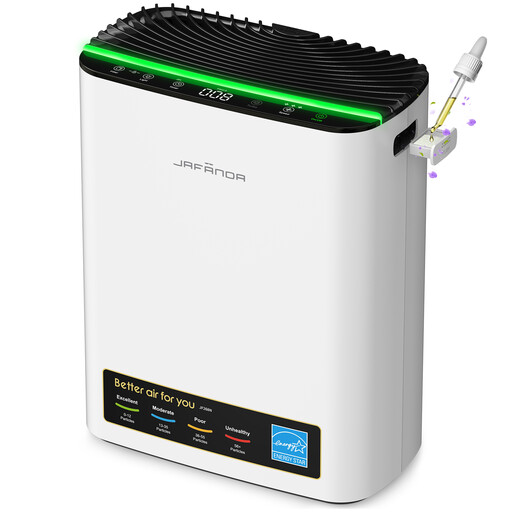 Image unavailable
Jafända HEPA air purifier, up to 1,226 ft²
Worth considering if you want particle filtration alongside a PM2.5 display in the room you use.
The product claims a Sleep mode rated at 20 dB and a maximum coverage area of 1,226 ft².
Compare the conditions for this stated coverage with your room and check the reference number for the replacement filter.
View on Joybuy
Frequently asked questions
Can an air purifier replace a mechanical ventilation system or opening the windows?
No. An air purifier doesn’t restore the air circulation provided by a working ventilation system. ADEME recommends reducing emissions at source and keeping the air fresh first; air purification can complement these measures in a particular room.
What should I choose if dust or pollen is my main concern?
Look for a particle-filtering purifier with a stated airflow rate suited to the room and the setting you’ll use. According to ADEME, its real-world effect on particles also depends on the room’s layout, where the purifier is placed and the openings in the room.
Is a HEPA filter enough for odours and all gases?
No. Particle filtration alone doesn’t show that a purifier can tackle every gas or odour. First identify the source, then check which pollutant the purifier targets, what type of filter it uses and the conditions under which its effectiveness is claimed.
Should I choose an ionisation or photocatalysis feature?
Don’t assume it’s equivalent to filtration based on a general claim. ANSES says the available evidence doesn’t demonstrate the effectiveness and safety of several air-treatment technologies in real-world conditions; ADEME also raises concerns about photocatalysis.
What should I do if I rent a home and the ventilation seems faulty?
Report the problem to your landlord rather than relying on an air purifier to restore ventilation. ANIL notes that, in a decent home, openings and any ventilation features must be in good condition and allow moisture to be removed appropriately under normal living conditions. Describe the signs you’ve noticed to help them assess the situation.


