
Livraison le jour même ou le lendemain

Qualité garantie

Débloquez vos offres de bienvenue: Livraison GRATUITE | Jusqu'à -80 % | 30 jours d'essai gratuits à JoyPlus
Téléchargez l'application
Dust, pollen, cooking smells, pet hair or persistent dampness can quickly make a home less pleasant. However, choosing an air purifier for the home isn't simply about picking the model with the largest coverage area. Start by identifying the problem you need to tackle, then focus on the features that will genuinely make a difference.
A purifier fitted with a filter captures certain particles suspended in the air. In contrast, a home deodoriser, an electric fragrance diffuser or an aerosol spray mainly affects how you perceive odours. These products do not address the same need.
A home fragrance can make a room more pleasant, but it won't tackle dust, pollen or fine particles. Similarly, an anti-odour product is no substitute for good ventilation or cleaning the source of the problem: the bin, impregnated fabrics, a litter tray or a poorly maintained drain.
The actual area covered depends on the airflow rate, ceiling height, room layout and the number of air changes you want. A square metre rating is only truly useful when it comes with the CADR – in other words, the clean air delivery rate of the appliance.
A model advertised as suitable for a large room may run more slowly in an open-plan living area, a kitchen-diner or a heavily used space. In a UK home, also remember to check the noise level in night mode and the availability of replacement filters.
A clogged filter reduces airflow and can increase electricity consumption. Before placing your order, check:
A high-efficiency HEPA filter is generally not designed to be washed or reused. If in doubt, the manufacturer's recommendations are what count.
A HEPA air purifier primarily targets particles in the air: dust, pollen, smoke or pet dander. The mention of an H13 filter corresponds to a filtration class defined by a technical standard, but it is not enough to assess the overall effectiveness of the appliance. The airflow rate and the system's airtightness also play a crucial role.
Activated carbon often complements the filtration to help reduce certain odours and gaseous compounds. It does not make the air completely free of pollutants and does not remove the need to ventilate your home regularly.
Expressed in m³/h, the CADR allows you to compare the performance of two appliances more concretely. The TRULIVA KJ450, for example, has a CADR of 450 m³/h and a stated coverage area of 32 to 55 m². The Jafanda JF260S, meanwhile, indicates 260 m³/h, with several air change levels depending on the room size.
To make the right choice, measure your main room and take open doors into account. In a bedroom, a low noise level and a night mode can prove more useful than maximum airflow.
A moisture absorber works without electricity and collects excess water using crystals. It can be suitable for a cupboard, a well-ventilated bathroom, a cellar or a small room. However, it will not solve the problem at its source: an infiltration, a leak or faulty ventilation.
The Rubson products shown below claim coverage of up to 10 or 20 m², depending on the model. Both the crystals and the collected water must be kept out of reach of children and pets.
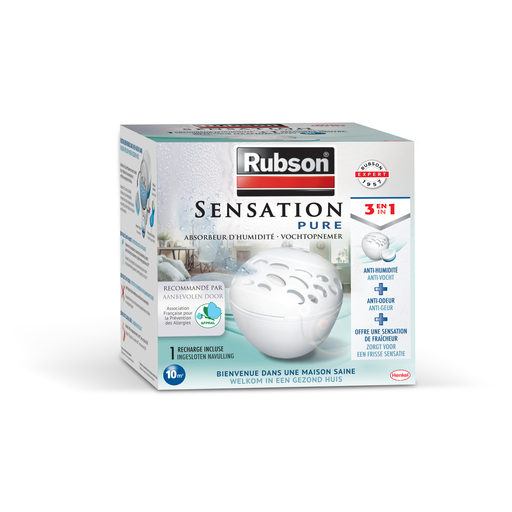
Why this choice suits this profile: A plug-free solution for a small room, a dressing area or a bedroom up to 10 m², when humidity and musty smells are the priority.
It does not claim to filter particles like a HEPA appliance: its role is clearly limited to humidity, odours and condensation.
Silent operation without electricity, with a 300 g refill stated to last around two months in a 10 m² room.
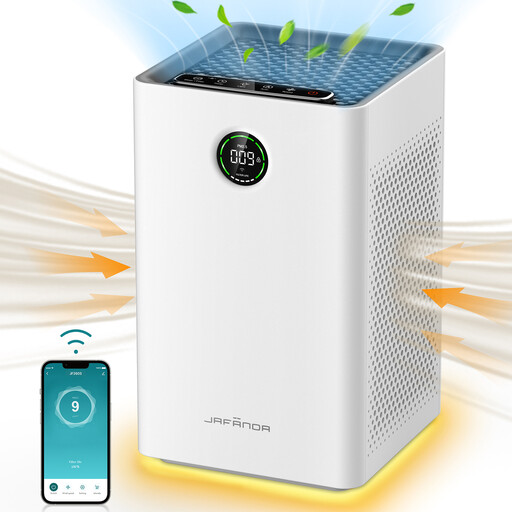
Why this choice suits this profile: This model is for those who want to monitor air quality, check the PM2.5 fine particle level and control the appliance via an app or compatible voice command.
The product page states a CADR of 260 m³/h: a concrete figure that lets you compare the coverage promise against your home's actual layout.
Three-stage filtration with HEPA H13 and activated carbon, PM2.5 sensor, night mode stated at 23 dB and a filter rated for 3,000 hours.
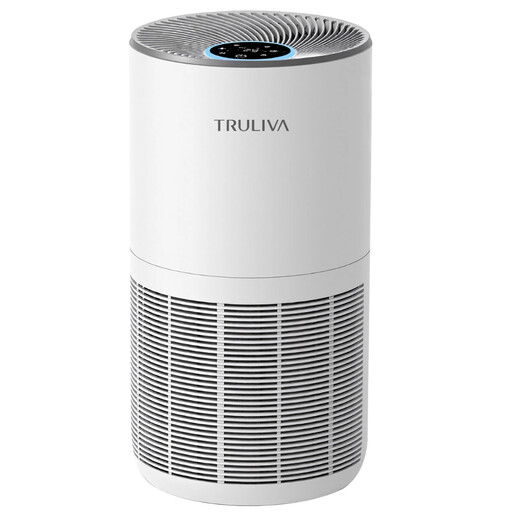
Why this choice suits this profile: With its stated airflow of 450 m³/h and 360° air intake, this model is designed for regular use in a living room, office or space where pets live.
The product page distinguishes between the pre-filter, H13 filter and activated carbon, rather than relying on the mere mention of HEPA as a sufficient argument.
PM2.5 display, 24-hour timer, child lock, night mode and filtration stated against dust, pollen, smoke and pet dander.
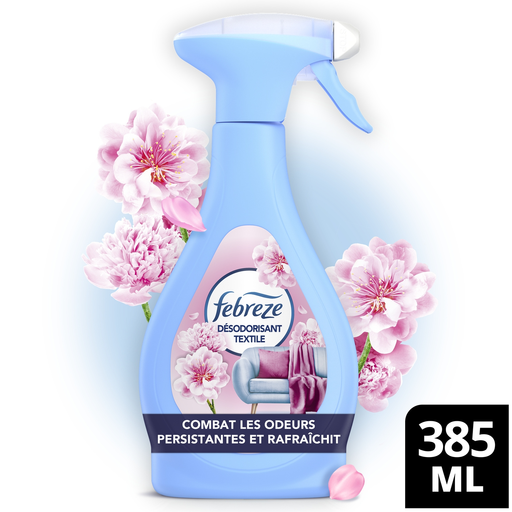
Why this choice suits this profile: This fabric deodoriser is suitable for curtains, rugs, cushions and other fabrics that are difficult to wash between cleans.
It does not present itself as an air purifier: it is used on fabrics and requires a patch test on an inconspicuous area first.
385 ml format, use on fabrics that are not washed daily and freshness stated to last up to 24 hours according to the product page.
We have compiled a comprehensive, real-time selection of products that meet these strict selection criteria and European safety requirements.
Install it on a stable surface, leaving enough space around the grilles. In a bedroom, keep it away from curtains and the bed. In a living room, place it in the living area without hiding it behind furniture.
The cost depends on the appliance's power, the number of hours of use and the price of the filters. Check its wattage, the available modes and the stated replacement frequency. Continuous operation at a low speed can consume less than an appliance regularly used at full power, but it all depends on the model.
Follow the appliance's indicator or the instructions in the manual. A drop in airflow, a persistent odour or a visibly dirty filter can indicate that a replacement is needed. Never wash a HEPA or composite filter unless the manufacturer's documentation explicitly allows it.