
Livraison le jour même ou le lendemain

Qualité garantie

Débloquez vos offres de bienvenue: Livraison GRATUITE | Jusqu'à -80 % | 30 jours d'essai gratuits à JoyPlus
Téléchargez l'application
An air purifier can reduce the presence of dust, pollen, smoke and certain odours in a room. But you need to choose a device that suits the room size and your intended use. A bedroom, an open-plan living room or a home with several pets all have different requirements.
Before you reach for your card, keep an eye out for three common pitfalls:
To trap fine particles, a HEPA air purifier remains a common solution. Models equipped with a HEPA H13 filter are designed to capture a significant proportion of particles, under the conditions defined by the manufacturer. However, it's important to distinguish between the different parts of the system:
An air purifier with an activated carbon filter can make sense in an open-plan kitchen, a home with pets or a room exposed to smoke. However, carbon does not replace effective ventilation. Its performance depends on the amount used and on regular filter replacement.
CADR, expressed in m³/h, measures the volume of air filtered over a given time. It's often a more useful indicator than the maximum room size quoted. To give you a rough idea:
Some product pages still mention room sizes in square feet: convert them to square metres before comparing devices. Ceiling height, an open-plan layout and how long you run the purifier also affect real-world performance.
For an air purifier intended for a bedroom, look at the noise level in night mode, but also whether you can turn off the indicator lights. Timers of 2, 4, 8 or 24 hours can stop the device running longer than necessary.
A particle or PM2.5 sensor allows the airflow to adjust automatically. A smart air purifier usually adds app-based monitoring, remote scheduling and, sometimes, voice assistant compatibility. Handy for controlling the device without getting up, but these features aren't essential for basic use.
Also consider the price and availability of replacement filters. A cheap device to buy can end up costing a lot if its cartridge needs frequent changing.
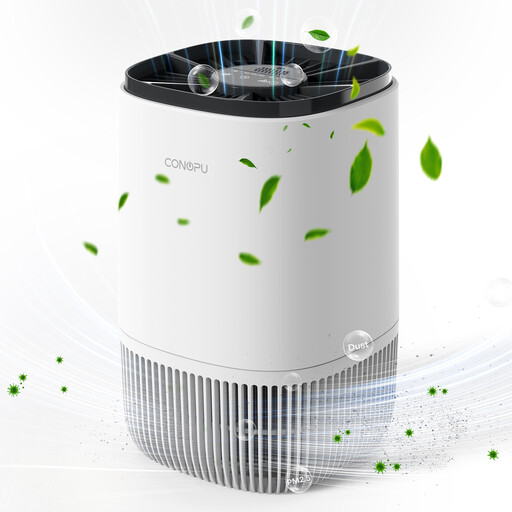
Why this choice suits this profile: Compact and simple to use, this model is a good option for a first setup in a bedroom, office or small room.
The product page mentions an H13 filter and a three-stage system. Still, check the actual suitable room size before placing it in a large living room.
Pre-filter, HEPA filter and activated carbon; three modes and an easy-to-move design.
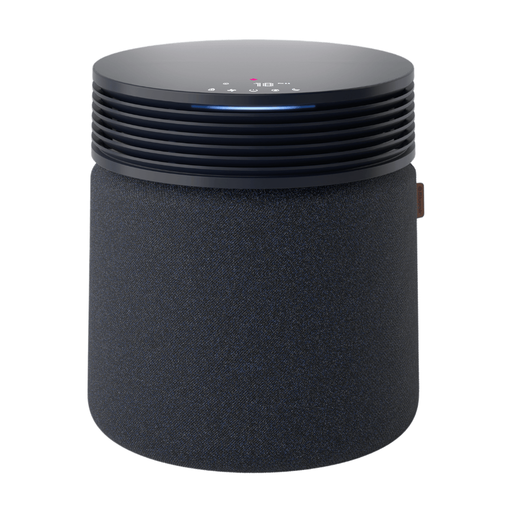
Why this choice suits this profile: With a claimed flow rate of over 700 m³/h, an app and automatic mode, it's aimed at large rooms and users who want to monitor air quality in detail.
The product page separates the flow rate from the covered area based on the air change rate used. That's a useful detail to avoid relying solely on a flattering room size figure.
App, voice control compatible with certain assistants and air quality sensors.
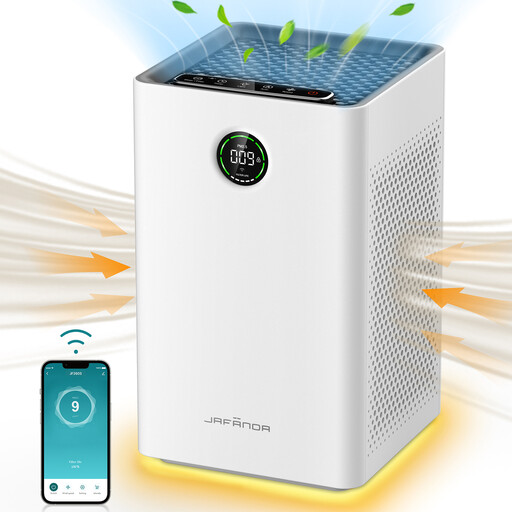
Why this choice suits this profile: It's designed for households looking to reduce odours, particles and pet hair in a living space.
Its claimed flow rate of 260 m³/h is linked to several air change frequencies. Use the one that matches your room size rather than the maximum value on its own.
H13 filter with activated carbon, PM2.5 sensor, app and night mode claimed at 23 dB.
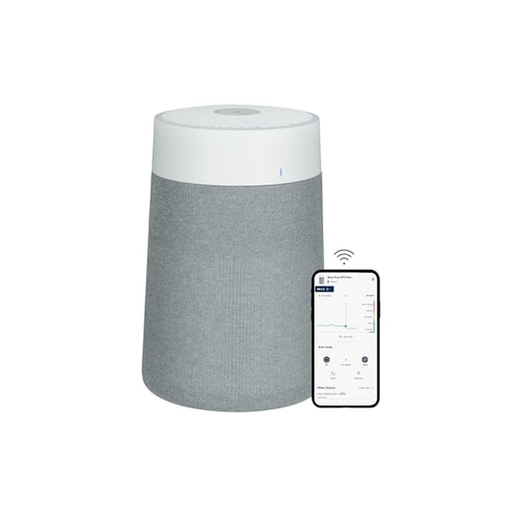
Why this choice suits this profile: Its size fits easily into a bedroom, child's room or office where noise and scheduling are important considerations.
The stated noise levels range from 19 to 48 dB depending on the setting: night mode is clearly distinguished from full-power operation.
Claimed CADR of 212 m³/h, app, scheduling, child lock and filter included.
We've compiled a comprehensive, real-time updated selection of products that meet these demanding criteria, while also taking European safety regulations into account.
Place the device on a stable surface and leave enough space around the air intakes and outlets. Keep it away from curtains, furniture pushed against the wall, moisture and heat sources. Before using it for the first time, always remove the packaging that protects the filter.
To maintain good airflow:
An air purifier does not replace ventilating your home or removing the source of pollution. The information about filtration and allergen reduction on product pages is provided by the manufacturers and does not constitute a medical guarantee.
Position it away from walls and the bed, making sure not to block the grilles. A clear space helps air circulate. For a more comfortable night's sleep, activate night mode and turn off the indicator lights if the device allows it.
It depends on its power, how long it runs and the price of replacement filters. To work it out, check the wattage, look at your electricity tariff and factor in how often the cartridge needs changing. Automatic mode can also reduce the time spent running at high speed.
The lifespan varies depending on the model, how often you use it, the amount of dust and smoke, and whether you have pets. Follow the replacement indicator and the recommendations in the manual. A clogged filter can reduce airflow and make the device noisier.