
Livraison le jour même ou le lendemain

Qualité garantie

Débloquez vos offres de bienvenue: Livraison GRATUITE | Jusqu'à -80 % | 30 jours d'essai gratuits à JoyPlus
Téléchargez l'application
Breathing healthier air at home has become a major concern. Whether it's to soothe allergies, eliminate bad odours, or simply improve your well-being, the air purifier has established itself as a powerful ally. However, faced with a market flooded with marketing promises, it's difficult to know where to turn. Some devices prove to be disappointing, incorrectly sized, or turn into financial drains with ongoing use.
Before you commit, it's best to know the most common pitfalls so you can avoid them:
air purifier filter are purchasing criteria that should never be overlooked.This guide breaks down the essential technical criteria for you to make an informed choice that is perfectly suited to your actual needs.
To objectively evaluate an air purifier, three key indicators should capture your attention. They allow you to compare devices on a factual basis, far from the marketing jargon.
The CADR, or Clean Air Delivery Rate, is the number one performance indicator. Expressed in cubic metres per hour (m?/h), it indicates the volume of air the device can effectively process in one hour.
large room air purifier (a 50 m? living room with a 2.5 m ceiling height, i.e., 125 m?), you will need a device with a CADR of at least 250 to 375 m?/h.A CADR that is undersized for your room will render your device almost useless.
Most high-performance air purifiers rely on a three-stage filtration system. Each stage has a specific role:
pet dander, and dust. Its role is to protect the subsequent filters and extend their lifespan.allergy air purifier.Since it is meant to run continuously, an air purifier's noise level is a crucial comfort criterion.
quiet air purifier is therefore essential. Favour models equipped with a night mode that operates below 30 dB, the equivalent of a whisper.Wi-Fi connected air purifier allows for remote control via a mobile app and custom scheduling.Here are a few models that meet specific needs, taking into account performance and the pitfalls to avoid.
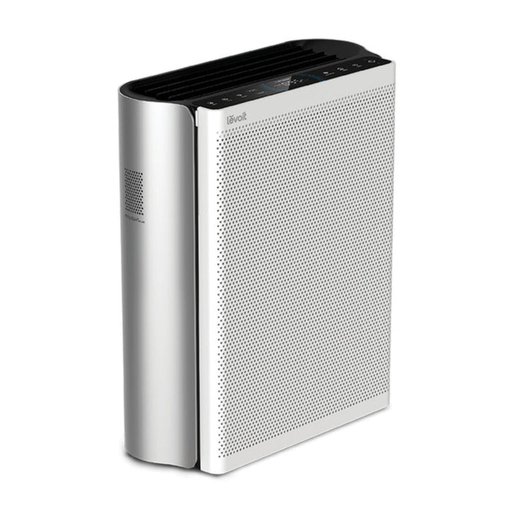
Why it stands out: Perfect for families and large volumes like open-plan living rooms and kitchens. Its power ensures consistent purification where the whole family gathers.
With a CADR of 612 m?/h, there are no empty promises. It's built to effectively purify areas up to 130 m?, a power level in line with modern large living spaces. Say goodbye to the undersized appliance trap!
3-stage filtration with a washable pre-filter to keep running costs in check. PM1.0, PM2.5, and PM10 particle sensors for a highly accurate automatic mode.
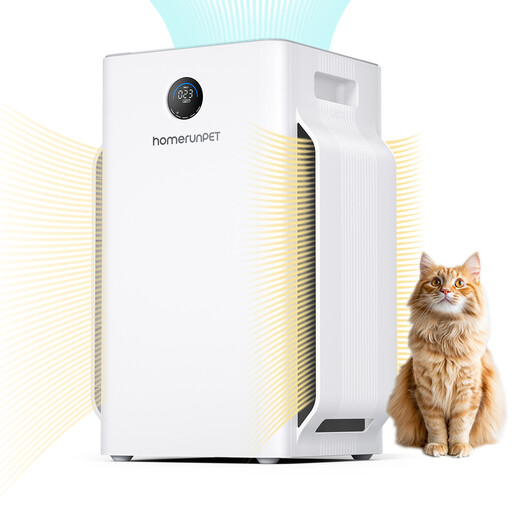
Why it stands out: Specially designed for homes with cats and dogs, it tackles hair, dander, and stubborn odours. Its pet-safe design is a bonus for our four-legged friends.
No generic filter here. Its dual odour control system with activated carbon and an optional deodorising filter tackles pet odours head-on, where a standard filter would fall short.
True HEPA filter to capture pet allergens. Ultra-quiet night mode (25 dB) to preserve the sleep of the entire household, pets included.
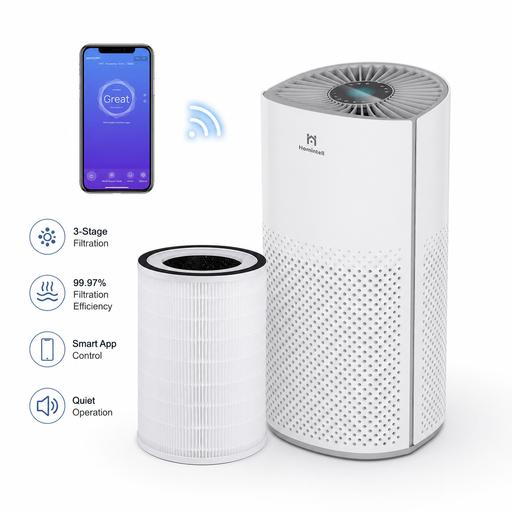
Why it stands out: The ideal companion for a bedroom or office. It combines effective purification for a medium-sized room with smart features for maximum comfort, without ever disturbing sleep or concentration.
It knocks out the noise problem with a sleep mode at 20 dB—near-absolute silence. Its 200 m?/h CADR is clearly stated for rooms up to 25 m?, a realistic and honest promise.
Control via Wi-Fi app for management at your fingertips. 3-stage filtration with an H13 HEPA filter and a visual air quality indicator.
Discover our full selection of products that meet our strict selection criteria and current safety standards.
The lifespan of an air purifier filter depends on the model, your usage frequency, and the ambient pollution level. As a general rule, expect to replace the HEPA filter and activated carbon filter every 6 to 12 months. Fortunately, most recent models include an indicator light that alerts you when the time has come, making maintenance much simpler. The pre-filters are often washable and reusable.
For maximum efficiency, place your purifier in an unobstructed area where air can circulate freely. Above all, don't wedge it against a wall or behind furniture. Leave a clearance of at least 30 to 50 cm all around it. If its purpose is to clean the air in your bedroom, place it a few metres from your bed to directly benefit from its effects.
It all depends on the chosen fan speed. At full power, most devices are audible; it's unavoidable. However, a good quiet air purifier knows how to go unnoticed at low speeds. The night mode (or sleep mode) is designed precisely for this: it runs with minimal noise, often under 30 dB, which is ideal for peaceful nights.