
Livraison le jour même ou le lendemain

Qualité garantie

Débloquez vos offres de bienvenue: Livraison GRATUITE | Jusqu'à -80 % | 30 jours d'essai gratuits à JoyPlus
Téléchargez l'application
Dust that reappears within hours, cooking smells, pet hair or disturbed sleep caused by an appliance that is too noisy: an air purifier can meet a wide range of needs, provided you focus on the right criteria. Product pages often highlight a maximum coverage area or an impressive filtration rate, but these figures are not always enough to distinguish between two models.
Here are the key points to check to avoid buying an unsuitable appliance, followed by a selection of models for different types of users in France.
A claim of “up to 100 m²” may refer to just one air change per hour. That is not comparable with an appliance capable of treating a room’s air several times an hour. Expressed in m³/h, the CADR indicates the purified airflow rate. The larger the room, or the more exposed it is to particles, the more important this figure becomes.
For a bedroom or home office, a moderate airflow may be sufficient. In an open-plan living room connected to the kitchen, a room occupied by several people or a home with pets, it is generally better to choose a higher airflow rate and an automatic mode.
An HEPA air purifier can capture a large proportion of particles, depending on the filter class and the operating conditions specified by the manufacturer. However, you should also check whether it has a pre-filter, the airflow rate and whether replacement filters are readily available.
A HEPA filter does not replace ventilating your home and cannot tackle every source of indoor pollution. For smells and certain gaseous compounds, choose an air purifier with an activated carbon filter. The amount of carbon, which is rarely stated in technical specifications, can nevertheless vary considerably from one model to another.
An appliance that is quiet at its lowest speed can become noticeably louder at full power. Check the noise levels associated with the different modes rather than focusing only on the single figure highlighted on the product page.
The filter is an ongoing expense. Before ordering, check its reference, price and the stated replacement interval. An appliance that is cheap to buy may ultimately cost more if its filter is hard to find or needs replacing frequently.
Measure the main room and take its ceiling height into account. For a large volume, compare appliances based on their CADR in m³/h, rather than solely on the coverage area stated in marketing materials. Figures given in square feet should be converted into square metres to make comparisons easier in France.
An air purifier intended for a bedroom does not necessarily need the same performance as a model designed for a living room or open-plan space. Automatic mode can be convenient, but its effectiveness depends directly on the quality of the sensor and its position.
In a bedroom, choose a night mode with reduced lighting and a low noise level. A connected air purifier may appeal to people who want to schedule the appliance, view data in an app or use a compatible voice assistant.
Always place the appliance on a stable surface and leave enough space around the air inlets and outlets. Avoid damp rooms, positioning it near a radiator and locations where curtains or furniture could obstruct airflow.
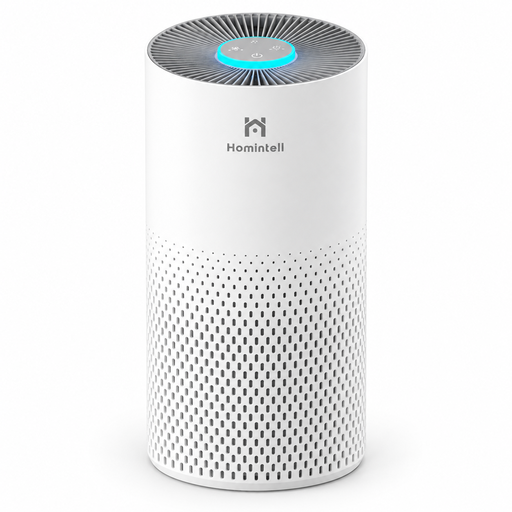
Why it suits this user profile : its compact design, touch controls and 2-, 4- or 8-hour timer make it particularly easy to use in a small room.
The product page mentions three-stage filtration and a revised coverage area of up to 16 m². This is a useful reminder that it is not intended to treat a large living room.
Pre-filter, HEPA and activated carbon, PM2.5 sensor, automatic mode and air-quality indicator.

Why it suits this user profile : designed for large spaces, it combines app control, voice control and real-time sensors.
Its stated airflow rate of more than 700 m³/h is assessed against several coverage and air-change scenarios. The comparison therefore does not rely on a simple coverage claim.
HEPASilent technology, night mode, multi-stage filtration and app-based monitoring.
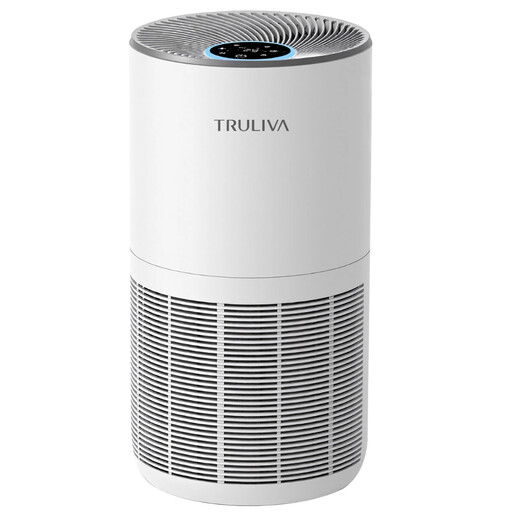
Why it suits this user profile : with a stated CADR of 450 m³/h and 360° air intake, it is suitable for a living room, open-plan space or household with pets.
The product page distinguishes between airflow, the stated coverage area of 32 to 55 m² and the maximum noise level, which can reach 66 dB(A). Maximum power should therefore not be confused with night mode.
H13 filter, activated carbon, PM2.5 display, child lock and 24-hour timer.
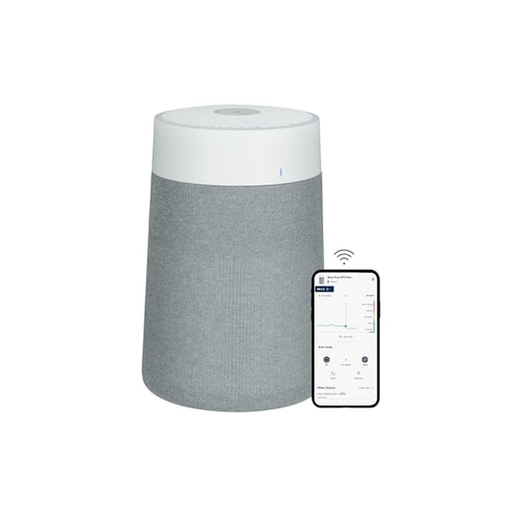
Why it suits this user profile : its size makes it suitable for a bedroom or home office, while its stated night mode from 19 dB and remote scheduling features support comfortable everyday use.
The product page distinguishes between the minimum noise level and the stated maximum of 48 dB, and explains the coverage conditions based on operating time.
Stated CADR of 212 m³/h, Blueair app, air-quality monitoring, scheduling and Alexa compatibility.
We have put together a comprehensive, real-time updated list of products that meet these exacting selection criteria and European safety standards.
An air purifier can only work properly if its inlets and outlets remain unobstructed. Follow the clearance recommended in the instructions, dust the grilles regularly and do not use the appliance in a bathroom or near a water source.
The pre-filter can sometimes be cleaned, depending on the manufacturer’s instructions. However, a HEPA or composite filter must never be washed or reused unless explicitly stated. Make a note of the filter installation date so that you can plan its replacement in good time.
To limit electricity consumption, use automatic mode if the sensor is accurate enough for your needs, or schedule operating periods. The rated power, expressed in watts, can be used to estimate running costs, but actual consumption depends on the selected mode and the number of hours the appliance is used each day.
Look for an appliance with a pre-filter and HEPA filter, an airflow rate suited to the room volume and replacement filters that are easy to find. For smells, choose a model with an activated carbon layer. These appliances help filter certain particles in the air, but they do not replace cleaning or good ventilation.
Place it on a stable surface, away from walls, curtains and furniture. Avoid tucking it into a corner. At night, select a quiet mode and turn off the lighting if the appliance offers this function.
The budget includes electricity and filter replacements. To estimate it, multiply the power in watts by the number of hours of use, then by the kilowatt-hour price stated in your contract. Next, add the cost of the filters, taking into account the replacement frequency specified in the instructions.