
Livraison le jour même ou le lendemain

Qualité garantie

Débloquez vos offres de bienvenue: Livraison GRATUITE | Jusqu'à -80 % | 30 jours d'essai gratuits à JoyPlus
Téléchargez l'application
Dust on furniture, spring pollen, cooking smells, a dog or cat at home: an air purifier can complement your home's daily ventilation. However, you need to choose a model suited to the room, your preferred noise level and the pollutants you want to reduce.
Disappointing purchases often come down to three common pitfalls:
CADR, or clean air delivery rate, is expressed in m³/h. It is a much more useful indicator when comparing several appliances than a simple statement such as ‘for a large room’.
In a bedroom or home office, moderate airflow may be sufficient if the appliance runs for several hours. By contrast, an open-plan lounge, a large living space or an area exposed to smoke will generally benefit from higher airflow. You should also leave enough space around the air inlets and outlets, as recommended in the instructions.
Some manufacturers calculate the covered area based on just one air change per hour, while others refer to faster purification. Always compare the conditions used.
A HEPA air purifier is designed to capture airborne particles such as dust, pollen and certain particles produced by smoke. The HEPA H13 designation is a technical specification that should be checked on the product page, but it is not enough on its own to assess the appliance’s overall performance.
For an air purifier intended for allergy relief or dust reduction, look for at least:
Stated performance figures should be understood as measurements obtained in a specific configuration. For example, a product page may mention the capture of 99.97% of particles up to 0.3 microns, or even up to 0.1 microns depending on the technology used and the test conditions.
A quiet air purifier for a bedroom should be assessed in night mode, but also when the power increases. A noise level of 20 to 25 dB on the lowest setting may fade into the background while you sleep, whereas operation above 50 dB at high speed will be noticeably louder.
The filter is a recurring expense that is easy to overlook. Before placing your order, check:
A mobile app, PM2.5 sensor or voice control can make the appliance more convenient to use. However, these features can never compensate for an appliance that is undersized for the room.
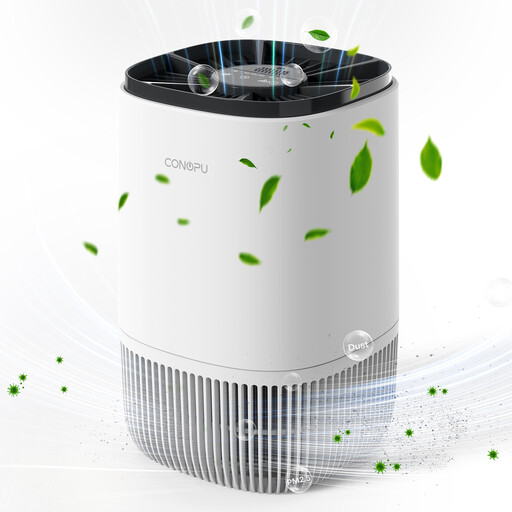
Why this choice suits this profile : Measuring 170 × 170 × 260 mm and with a stated power consumption of 5 W, it is easy to install in a bedroom, home office or small room.
The product details state that it has a pre-filter, HEPA filter and activated carbon layer. You should still check the area it is genuinely suitable for before buying.
Stated H13-class filter, three modes, 24-hour timer and replaceable filter.
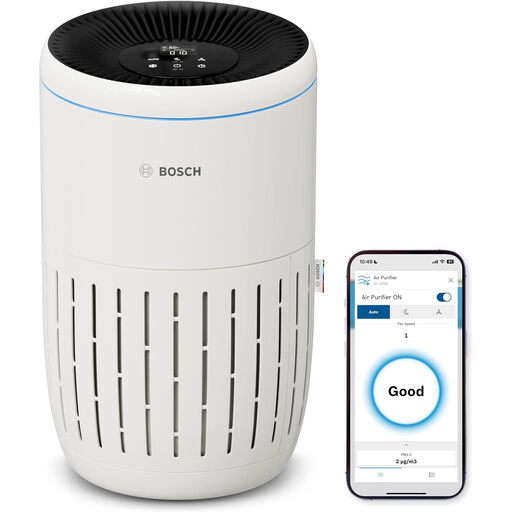
Why this choice suits this profile : It is aimed at households that want to monitor air quality and control the appliance from its display, an app or a compatible voice system.
The stated coverage area is presented alongside a precise CADR of 180 m³/h, allowing for a more objective comparison than a simple coverage claim.
Three-stage filtration, air-quality sensor, automatic mode, quiet mode and connected control.
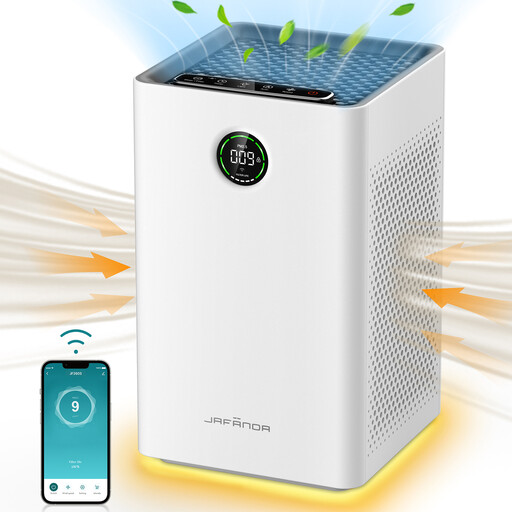
Why this choice suits this profile : With a stated airflow of 260 m³/h, it is suitable for people looking for an air purifier for a large room, with connected monitoring and overnight operation.
The product details distinguish between several floor areas depending on the air-change rate. This is useful information to avoid overestimating the stated coverage.
H13 HEPA filter with activated carbon, PM2.5 sensor, mobile app, voice control and night mode rated at 23 dB.
We have put together a complete, real-time updated selection of products that meet these demanding criteria while complying with European safety regulations.
Place the appliance on a stable surface, away from curtains, furniture and heat sources. The air inlets and outlets must remain unobstructed. In a bedroom, activate night mode before going to bed; in a living space, automatic mode can reduce the need for adjustments if the appliance has a sensor.
Always unplug the air purifier before moving it, cleaning it or replacing its filter. Do not use water or household cleaning products on the main unit. In a home with pets, regularly remove any fur that has accumulated on the pre-filter. The main filter should be replaced according to the indicator or the instructions, and not washed if it is not designed for this.
It can help reduce certain airborne particles, particularly dust and pollen, provided that its filtration system and airflow are suitable. It does not replace ventilation, cleaning or advice from a healthcare professional. When choosing an air purifier for allergies, prioritise a clearly identified HEPA filter and airflow suited to the room’s volume.
Consumption depends on the appliance’s power, how many hours it is used and the selected mode. A low-power model will generally limit electricity consumption, while a more powerful appliance will use more energy when operating at high speed. Remember to factor in the price and replacement frequency of the filters as well.
Monitor the indicator or app when available, but also check the filter’s condition, airflow and whether persistent odours have appeared. Service life varies according to the amount of dust, the presence of smoke or pets, and how long the appliance runs. Use only a reference compatible with your model.