
Livraison le jour même ou le lendemain

Qualité garantie

Débloquez vos offres de bienvenue: Livraison GRATUITE | Jusqu'à -80 % | 30 jours d'essai gratuits à JoyPlus
Téléchargez l'application
Breathing cleaner air at home has become a priority, whether to soothe seasonal allergies, neutralise pet odours, or simply for everyday comfort. The air purifier market has exploded, and with it, a host of sometimes misleading marketing promises. Before you invest, it's crucial to know how to avoid the most common pitfalls to make a choice that's truly tailored to your needs.
As expert editors, our mission is to help you see things more clearly. Let's analyse the criteria that truly matter and the mistakes to avoid.
Navigating the hundreds of available models can quickly become a headache. Many devices boast appealing features that, in practice, prove disappointing. Here are the three most frequent pitfalls.
To avoid these disappointments, focus on objective data. Three technical indicators are fundamental for evaluating the real performance of a home air purifier.
The CADR, or Clean Air Delivery Rate, is the most reliable performance metric. Expressed in cubic metres per hour (m?/h), it indicates the volume of clean air the device can actually deliver. For optimal efficiency, it's recommended that the CADR allows for the air in the room to be cycled at least 3 to 5 times per hour.
The term "HEPA" is often misused. A true HEPA filter must meet specific standards, such as the European standard EN 1822-1, which classifies filters according to their filtration efficiency.
anti-pollen action and for a pet air purifier worthy of the name.A silent air purifier is non-negotiable for nighttime use. Always check the noise level (in decibels, dB) indicated for the lowest setting, often called "sleep mode".
bedroom air purifier.Every household has specific needs. Here are three options that cater to distinct user profiles, all selected based on the objective criteria we've just discussed.
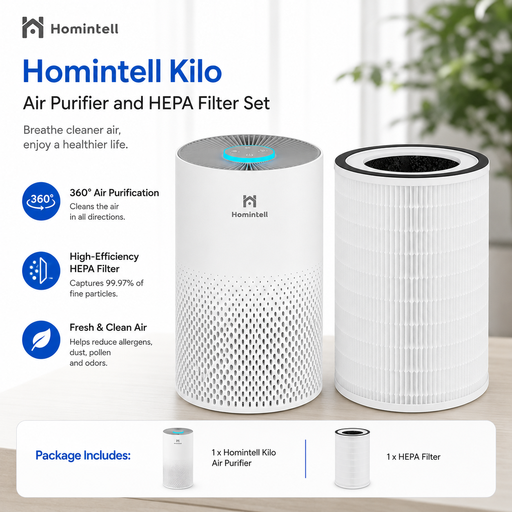
Why it's a great choice: Perfect for a student's room, an office, or a small room up to 18 m?, it offers a complete and compact purification solution, ideal for a smart first purchase.
It advertises a realistic coverage area (≤ 18 m?) consistent with its CADR of 150 m?/h, thus avoiding the over-promising trap. Its three speeds allow you to adjust the ventilation (and therefore the noise) to your needs.
Triple-layer filtration (pre-filter, HEPA, activated carbon) for comprehensive action. The 7-colour ambient light is a nice bonus for creating a relaxing atmosphere.
Why it's a great choice: Perfect for living rooms or master bedrooms (up to 50 m?), it is especially recommended for allergy sufferers or pet owners thanks to its high-quality filtration.
It tackles the noise pitfall head-on with a sleep mode at ≤25 dB, ensuring near-total silence. Its HEPA H13 filter corresponds to a certified standard, not just a marketing term.
The real-time air quality indicator (via a colour code) allows you to tangibly see its effectiveness. The H13 filtration captures up to 99.97% of pollutants.

Why it's a great choice: For those looking for more than just a purifier, this mobile air conditioner manages a room's overall comfort: it cools, dehumidifies, and ventilates, all while providing air filtration.
It doesn't position itself as a specialised HEPA purifier, but as a versatile air treatment device. Its washable filter helps avoid the trap of costly consumables, even if its filtration level doesn't match that of an H13 HEPA filter.
Its 4-in-1 versatility (cooling, air dehumidifier, ventilation, sleep mode) makes it a complete solution for tackling hot, humid summers while cleaning the ambient air.
We have curated a complete selection of products that meet these demanding selection criteria and current safety standards.
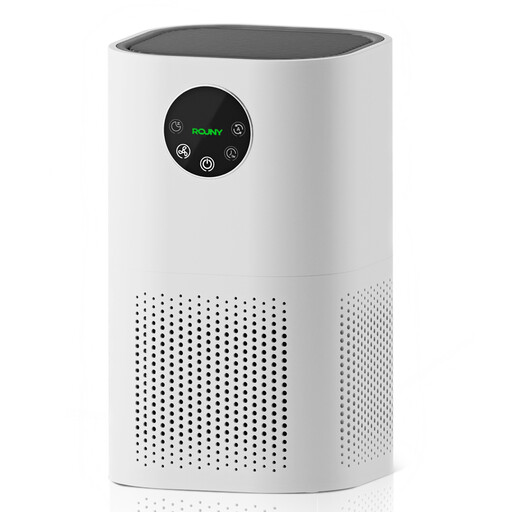
The lifespan of a HEPA filter depends on the frequency of use and the pollution level in your home. As a general rule, replacement is recommended every 6 to 12 months. Most modern devices, like the ROUNY purifier, include an indicator light that alerts you when it's time to change the filter.
Noise varies greatly from one model to another. For a bedroom or living room, absolutely prioritise a silent air purifier with a sleep mode. A noise level below 30 dB is recommended to avoid disturbing your sleep. This crucial information is always mentioned on the technical specifications.
It's technically possible, but completely counterproductive. An air purifier works in a closed loop: it draws in ambient air, filters it, and then releases it back into the room. Opening the windows continuously lets in polluted outside air, which negates its benefits and forces it to run constantly for nothing. For optimal results, it must be used in a closed room.