Priorities before buying
For an indoor air problem after renovation work or a persistent odour, start by identifying your actual needs, then compare only the features that matter for the model you are considering.
| Priority |
What to check |
Your needs |
| Source and pollutant |
Identify whether the problem involves particles, VOCs, an odour, humidity or ventilation. Check what a potential sensor actually measures. |
I want to avoid choosing a technology without knowing which problem it can address. An odour alone does not identify the pollutant or its level. |
| Airing and ventilation |
Keep air inlets and extraction vents clear. Check that the mechanical ventilation system is working and that the appliance does not obstruct air circulation. |
I want to renew the air and limit exposure first, rather than replace airing with an appliance. |
| Performance data |
Compare the airflow rate, intended room, testing conditions and pollutants tested. A HEPA filter or an airflow rate stated for particles does not prove equivalent effectiveness against gases or odours. |
I want to compare data that applies to my room, not just a general promise of “cleaner” air or eliminated odours. |
| Filter maintenance |
Note the filter reference, compatible models, expected replacement frequency and availability at the time of purchase. |
I want to be able to maintain the appliance over time without discovering afterwards that the filter is incompatible. |
Options available on Joybuy
Joybuy standalone filtration options to compare as a supplement to action at source, airing and ventilation.
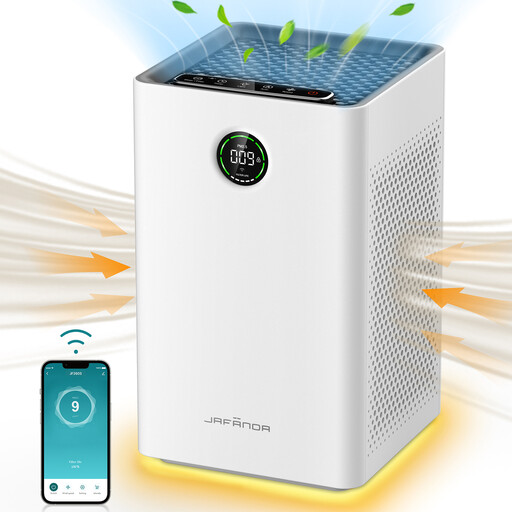 Image unavailable
Jafända H13 air purifier with activated carbon
For a specific room, the stated CADR of 260 m³/h and air renewal guidance allow you to compare capacity.
H13 filter, stated 300 g activated carbon, PM2.5 sensor and sleep mode at 23 dB. For odours or VOCs, check the pollutant tested, the protocol and how long the activated carbon remains effective.
Joybuy
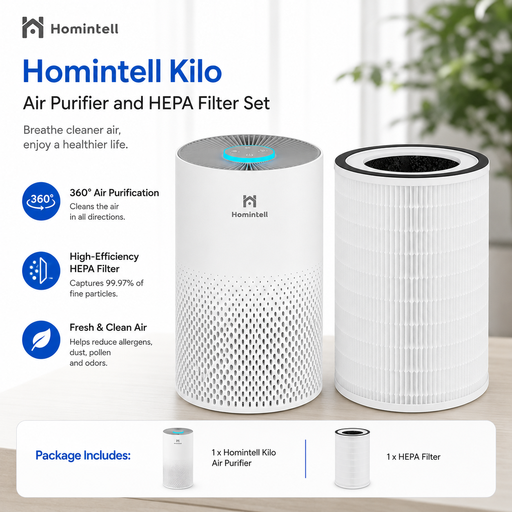 Image unavailable
Homintell Kilo, 150 m³/h CADR with replacement filter
This model is presented for a small room of up to 18 m², with a stated CADR of 150 m³/h.
HEPA and carbon filtration, three speeds, an 8-hour timer and a replacement filter included. For odours or VOCs, check the carbon medium, target pollutant and testing conditions.
Joybuy
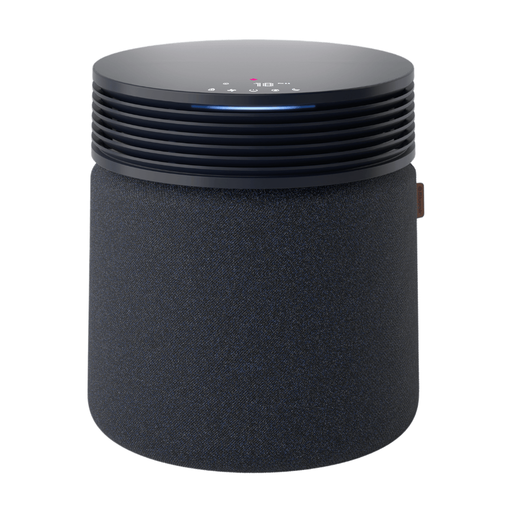 Image unavailable
Blueair Blue Signature Large
For a large room and a need to compare particle performance, the product states a CADR above 700 m³/h, with a corresponding room size based on a 30-minute period.
Automatic mode, night mode and filter alert; filter replacement is stated to be required approximately every 6 to 9 months. Do not infer from these figures proven effectiveness against odours, gases or VOCs.
Joybuy
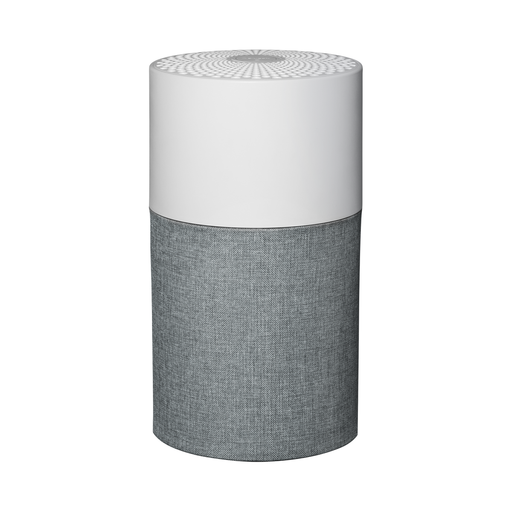 Image unavailable
Blueair Blue Pure 511
This compact format is presented for a bedroom, home office or small room affected by dust and smoke.
HEPASilent technology, with stated noise levels from 24 dB on the low setting to 49 dB on the high setting. Check separately for any needs relating to odours, gases or VOCs.
Joybuy
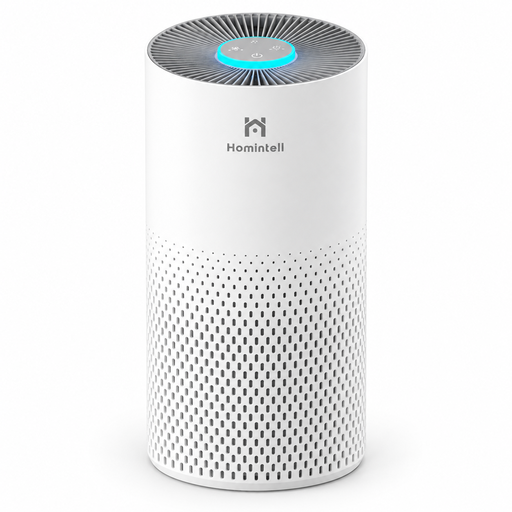 Image unavailable
Homintell with HEPA and carbon filters
The product states that it is suitable for a small room of up to 16 m², after treating the source and airing the room.
Pre-filter, HEPA filter, carbon filter, three speeds and an 8-hour timer. The product information gives contradictory CADR figures of 130 and 150 m³/h: check the exact figure before buying.
Joybuy
Frequently asked questions
After renovation work, should you buy an air purifier before airing the room?
No. ADEME puts reducing emissions at source, airing and ventilation first. It specifically recommends opening the windows wide for 5 to 10 minutes a day; an appliance can then be considered as a supplement for a clearly defined need.
Is a HEPA filter enough to deal with the smell of paint or adhesive?
Not necessarily. An odour after renovation work may be linked to VOCs released by paints, varnishes, adhesives or materials; check the data relating to gases, the adsorbent medium, how long it remains effective and the testing protocol separately.
Are ozone, ionisation, plasma or photocatalysis technologies proven for use in the home?
Anses states that the available data cannot demonstrate their effectiveness or safety under real-life conditions of use. Do not choose an appliance based solely on a promise to destroy pollutants or odours.
How often should ventilation systems and filters be maintained?
ADEME recommends not switching off the mechanical ventilation system, not blocking air inlets or vents, and cleaning the removable parts of vents every quarter. For an air purifier, follow the model’s instructions and check the compatible reference before buying.
Is the “emissions into indoor air” label compulsory in France?
Yes, for the relevant construction and decorating products sold in France since 1 September 2013. The label classifies VOC emissions from A+ to C; on its own, it does not measure exposure when the product is opened or applied.


