
Livraison le jour même ou le lendemain

Qualité garantie

Débloquez vos offres de bienvenue: Livraison GRATUITE | Jusqu'à -80 % | 30 jours d'essai gratuits à JoyPlus
Téléchargez l'application
Air that is too dry can quickly become uncomfortable in everyday life. Conversely, excessive humidity encourages condensation, unpleasant smells and the gradual deterioration of walls, furniture and surfaces. Choosing an air humidifier and dehumidifier therefore involves more than simply comparing a tank capacity in litres or the noise level stated on the product page.
Some marketing claims should be viewed with a degree of caution. The stated runtime, for example, depends on the selected output and the size of the room. Similarly, a dehumidifier’s capacity is generally measured under specific temperature and humidity conditions, which may not reflect those found in a typical home.
A 5 or 6-litre tank does not guarantee several days of use. With a humidifier, runtime varies according to the selected mist output. With a dehumidifier, a relatively small tank can fill within a few hours in a particularly damp cellar or utility room.
Check each of the following separately:
Decibel levels, coverage area and litres extracted per day are only genuinely comparable when the measurement conditions are similar. A unit advertised as extracting 20 L/day may have a noticeably lower capacity in a cool room. For a household dehumidifier, also check the minimum operating temperature and whether it has automatic defrosting.
When choosing a quiet air humidifier, the noise level in night mode is more useful than the maximum figure shown. In a bedroom, the appliance’s position, vibrations and the sound of water can also make a real difference.
An appliance that is easy to fill but awkward to clean can quickly become a chore. A humidifier should be emptied and cleaned regularly to limit mineral deposits and residue in the tank. With dehumidifiers, a clogged filter reduces airflow and appliance performance.
In a bathroom, cellar or room used for drying laundry, choose a dehumidifier with continuous drainage when a gravity-fed connection is possible. This will save you from emptying the tank several times a day.
The stated coverage area should be treated as a guideline, not a guarantee of results. An open-plan, poorly insulated or very damp room will require more capacity than a closed bedroom of the same size.
For better indoor humidity control, an adjustable target and built-in sensor are particularly useful. Some models allow you to set a target humidity level, while others are limited to several output settings. An independent hygrometer can provide a useful reference, bearing in mind that readings vary depending on the sensor’s location.
An ultrasonic humidifier produces a fine mist and generally uses a moderate amount of electricity. However, it requires clean water and regular checks for limescale deposits. Evaporative models, such as the Philips NanoCloud, release virtually invisible moisture and may be better suited to those who want to avoid white marks on furniture.
If you plan to use essential oils, check that the appliance has a dedicated compartment. Never pour them directly into the tank when the instructions prohibit it. This precaution is particularly important for an aromatherapy humidifier installed in a bedroom or near children.
In a bedroom, home office or child’s bedroom, look for a night mode, automatic shut-off and a stable base. Do not direct the mist towards a wall, piece of furniture or electronic device. With a compressor dehumidifier using R290, observe the required clearance distances and keep the appliance upright, as stated in the instructions.

Why it suits this profile: Its design is suitable for treating a room of around 16 m², such as a bathroom, bedroom or small utility room.
Manual emptying is not the only option: a hose enables continuous drainage. Automatic shut-off also reduces the risk of overflow.
Stated extraction of up to 10 L/day, humidity adjustment from 35 to 85 %, automatic defrosting and a stated noise level of up to 44.5 dB.
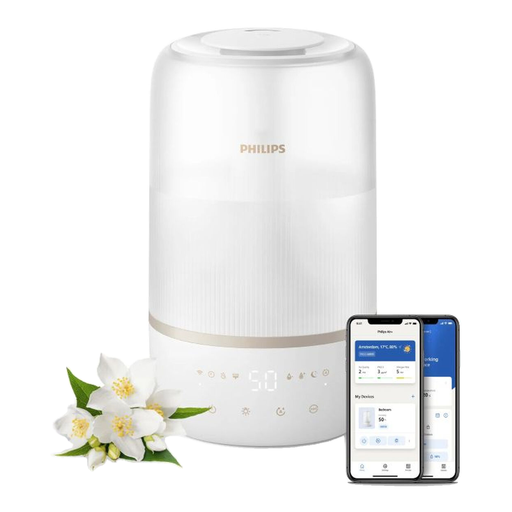
Why it suits this profile: It is designed for users who want to programme the appliance and monitor humidity levels from an app as part of a connected home.
NanoCloud evaporative technology is designed to produce no visible mist. However, you will need to allow for maintenance and replacement of the anti-limescale cartridge.
Stated output of 275 ml/h, 3 L tank, humidity adjustment from 40 to 70 %, night mode at 34 dB and control via the Air+ app.
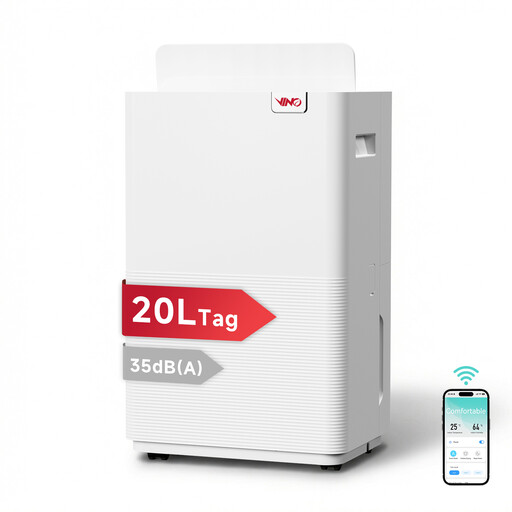
Why it suits this profile: Its stated output makes it suitable for rooms of up to 40 m², very damp homes and drying laundry in rainy weather.
It combines a 2.5 L tank with a continuous drainage system. The drying mode, child lock and full-tank shut-off are well suited to extended use.
Stated capacity of up to 20 L/day at 30 °C and 80 % relative humidity, Wi-Fi control, 24-hour programming and a stated night-mode noise level of 35 dB.
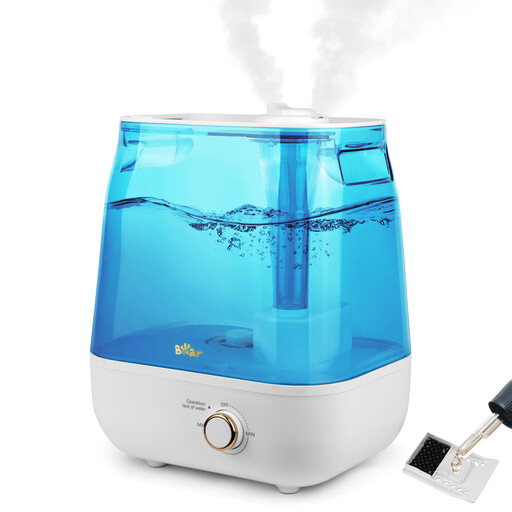
Why it suits this profile: Top filling, simple controls and quiet operation make it well suited to everyday use in a bedroom.
Automatic shut-off when the water level is too low helps prevent oversights. The removable tank and wide opening make regular cleaning easier.
6 L tank, stated noise level of 28 dB, 360° adjustable nozzles and an aromatherapy tray separate from the tank.
We have put together a complete selection, updated in real time, of products that meet these demanding criteria and European safety standards.
A level between 40 and 60% relative humidity is generally accepted as a useful guide for maintaining indoor comfort. Take the reading in the room concerned and avoid placing the sensor directly in front of the mist or dry-air outlet.
It depends on the appliance’s electrical power, how long it runs and the tariff charged by your supplier. To estimate the cost, multiply the power in kilowatts by the number of hours of use, then by the price per kilowatt-hour. A timer or automatic mode can reduce unnecessary running time.
Empty the tanks regularly, clean surfaces that come into contact with water and maintain the filters in accordance with the instructions. Always unplug the appliance before cleaning it. With a dehumidifier fitted with continuous drainage, also check the hose: it should remain securely attached, without sharp bends or blockages.