
Livraison le jour même ou le lendemain

Qualité garantie

Débloquez vos offres de bienvenue: Livraison GRATUITE | Jusqu'à -80 % | 30 jours d'essai gratuits à JoyPlus
Téléchargez l'application
An air humidifier can improve comfort when indoor air feels too dry, particularly in a heated bedroom, an office or a poorly ventilated room. However, product descriptions often mix theoretical run times, maximum room coverage and decorative features. To avoid a disappointing purchase, it’s better to compare a few concrete specifications rather than relying solely on claims like “ultra-powerful” or “whisper-quiet”.
A stated run time of several dozen hours usually corresponds to the lowest mist setting. At a higher setting, the tank naturally empties more quickly. So you need to consider the tank capacity, the mist output and the room size together.
A large tank means fewer refills, but it still requires regular cleaning. Stagnant water, mineral deposits and residue in the nozzles can quickly affect performance. A wide top opening, removable parts or easy access make maintenance much simpler.
This can damage some appliances. Oils should only be placed in a dedicated tray or diffuser if the instruction manual allows it. In a child’s or baby’s room, extra caution is needed: check the manufacturer’s guidelines and keep both the appliance and oils out of reach.
For a small bedroom or office, a 3 to 4 litre tank may be sufficient, depending on how long you want it to run. In a living room or large space, a 5 to 10 litre capacity reduces the frequency of refills, but also increases the appliance’s size and weight.
Expressed in ml/h, the output indicates how much mist is produced. The ROUNY MOS W3, for example, claims up to 350 ml/h with its 4-litre tank. The Philips HU1510/04 states 275 ml/h and a coverage area of up to 41 m². These figures give a rough guide: ceiling height, insulation, ventilation and open doors also affect the result.
An ultrasonic humidifier produces cool mist through high-frequency vibrations. This technology is often preferred for bedrooms, with many models offering a noise level below 40 dB. The LEVOIT M101S claims less than 28 dB, while the ROUNY MOS W3 reaches up to 38 dB(A).
Cool mist avoids heating the water, but the appliance still needs to be placed on a stable, moisture-resistant surface. Point the outlet away from walls, furniture, electrical sockets and electronic devices to minimise condensation.
A simple rotary knob is enough to adjust the output gradually. A smart-controlled humidifier usually adds a humidity sensor, programmable timers or app control. These features can be convenient, but check the Wi-Fi network compatibility, the permissions the app requests and whether manual controls are still available.
A night light, essential oil diffuser or adjustable nozzle can make daily use more pleasant. However, they don’t replace regular maintenance or good room ventilation.
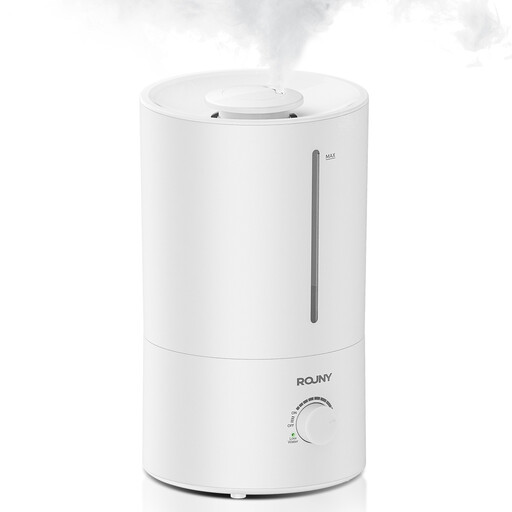
Why this choice suits this profile: Its rotary knob and top-fill design make it quick and easy to use in a bedroom, office or small living room.
The 4-litre capacity and gradual adjustment let you fine-tune the run time to the output you choose, rather than relying on a single automatic mode.
Claimed output up to 350 ml/h, 360° adjustable nozzle and claimed noise level up to 38 dB(A).
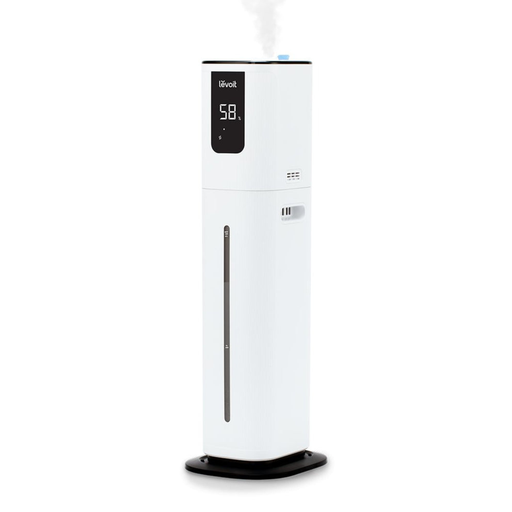
Why this choice suits this profile: Its large format is designed for households that want to programme the appliance and monitor humidity levels from an app.
The product page distinguishes the maximum 100-hour run time from low-output operation, making comparison more transparent.
10-litre tank, claimed coverage up to around 55 m², VeSync app and voice control compatibility.
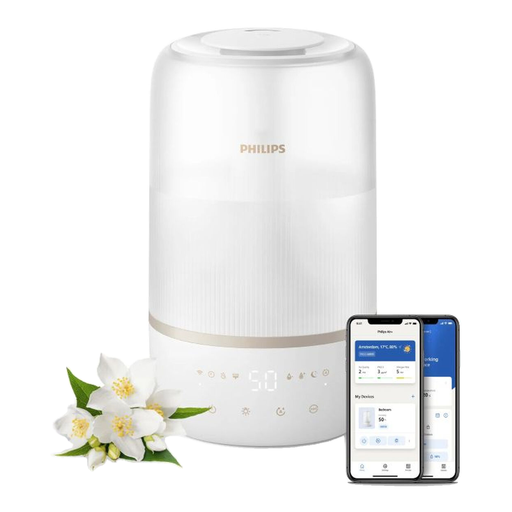
Why this choice suits this profile: It’s aimed at those who want precise humidity control, a timer and remote operation in a relatively compact design.
The sensor and adjustable levels from 40 % to 70 % prevent the appliance from running constantly at full power without regard for the chosen humidity level.
3-litre tank, claimed run time up to 32 hours, noise level of 34 dB(A) and Air+ app.
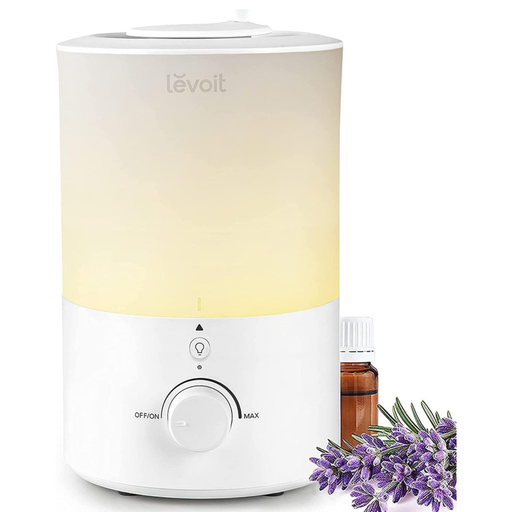
Why this choice suits this profile: Its night light, adjustable nozzles and aromatherapy compartment meet the needs of a family bedroom, provided you follow the instructions.
The manufacturer includes a separate compartment for oils, as well as an automatic shut-off when the water level is too low.
3-litre tank, claimed operation at 28 dB, dual 360° adjustable nozzles and timer.
We’ve put together a comprehensive, real-time updated list of products that meet these demanding selection criteria and European safety regulations.
A moderate setting is generally easier to manage than continuous operation at full power. If the appliance has a sensor, start with the level recommended in the manual and watch for condensation on windows or walls.
Power consumption depends on the wattage, run time and selected mode. For the same usage time, a 20 to 30 W appliance will use less than a more powerful heating model. To estimate the cost, multiply the power in kilowatts by the number of hours of use, then by the price per kilowatt-hour charged by your electricity supplier.
This mainly depends on maintenance, water quality and the replacement of filters or cartridges where applicable. Regular cleaning, respecting the maximum fill level and storing the appliance with an empty tank help reduce wear and the build-up of deposits.