Smaller households that often cook small portions
If you’d like to use your large oven less day to day, first check that the basket’s usable surface area and capacity are suitable for the portions you usually cook.


An air fryer can replace some oven cooking if you often prepare small portions that fit in its basket, but it won’t accommodate every dish or tin. If you want to cook two dishes with different settings, consider a dual-drawer model. If the shape of your dishes and the versatility of an oven matter more, compare it with a mini oven. A deep-fat fryer serves a different purpose: deep-frying.
If you’d like to use your large oven less day to day, first check that the basket’s usable surface area and capacity are suitable for the portions you usually cook.
Two compartments can save you from cooking in batches when dishes need different settings, provided each drawer is large enough for its portion.
If you use tins or have limited space, compare the internal and external dimensions of the air fryer and mini oven. Noise and cleaning matter too if you’ll be using the appliance regularly.
Start with the food you cook most often: small portions in a basket, meals with two components, dishes that need to go in the oven or deep-fried food. Then check that your chosen appliance will fit in your kitchen.
Consider it: for small portions you cook often that fit in a single basket.
Trade-off: the drawer’s shape may mean you still need your oven for tins or larger dishes.
Consider it: if two parts of a meal need different cooking times or temperatures.
Trade-off: capacity is split between the compartments, so their combined volume doesn’t tell you whether a large dish will fit.
Consider it: if your tins, racks or dishes need an oven cavity rather than a drawer.
Trade-off: check its dimensions and cooking functions before relying on it to take over the jobs you currently use your oven for.
Consider it: if your main need is deep-frying, rather than cooking small dishes with hot air.
Trade-off: hot oil and splashes call for care, as Que Choisir points out. You’ll also need to deal with the oil after use.
| Factor | What to check | Who is it for? |
|---|---|---|
| Small portions | Recommended quantity in the instructions and the basket’s usable dimensions, not just its stated capacity. | If I cook small amounts at a time, having to cook in several batches would defeat the point of avoiding my large oven. Around 25% of consumers say suitability for small portions is their top priority. |
| Two dishes | Settings for each zone, whether they can be synchronised and the size of each drawer. | To serve a main and a side together without cooking them one after the other, I’d choose two zones that suit each portion. This is the top priority for around 31% of consumers. |
| Dish size and shape | Internal width, depth and height; racks, accessories and functions that suit the dishes you usually cook. | If my tins and dishes won’t fit in a drawer, I want to keep an oven cavity that can accommodate them. This is the priority for around 19% of consumers. |
| Space and cleaning | External dimensions, clearance needed to open the drawers and parts that the instructions say are washable. | An appliance that’s hard to keep within reach or clean may not get much use day to day. Around 25% of consumers say ease of use is their main concern. |
Capacity doesn’t tell you whether your food can be arranged properly or whether your dish will fit in the basket. Que Choisir advises against relying on the “XXL” label alone.
Compare the internal dimensions and the recommended quantity in the instructions with your usual portions. For four people, the 6 L mentioned by Que Choisir is a starting point, not a guarantee that it will suit every meal.
A basket that’s too small may mean cooking in several batches or continuing to use your oven for some dishes.
With a dual-compartment model, a large dish needs to fit in one of the drawers. Adding the two capacities together won’t solve that problem.
Measure the largest dish you plan to use and compare it with each compartment. If you often switch between separate small dishes and one larger dish, look at models with a removable divider too.
Even if you rarely use the second drawer, it still takes up worktop space.
Energy-use comparisons depend on factors including the recipe, the quantity and the appliances being compared. ADEME’s annual figures for electric ovens alone can’t tell you how much energy you’ll save cooking your portion.
To assess a claim, look for a comparison based on the same dish and similar quantities. First choose a cooking cavity that suits the way you actually cook.
An appliance may fit on your worktop but still not have enough clearance in front. Que Choisir also considers noise, cleaning and storage when evaluating air fryers.
Measure the space with the drawer open, check the instructions to see which parts are washable, and compare the available noise measurements for the models you’re considering.
The range includes models with separate compartments and flexible designs.
The brand offers both dual-drawer air fryers and mini ovens, two formats worth comparing based on the dishes you cook.
The range includes the Crispi FN101, among other models.
This dual-basket model is for households considering cooking two dishes in separate compartments. To see whether it could take over some of your oven cooking, compare the size of each basket with the dishes you usually use.
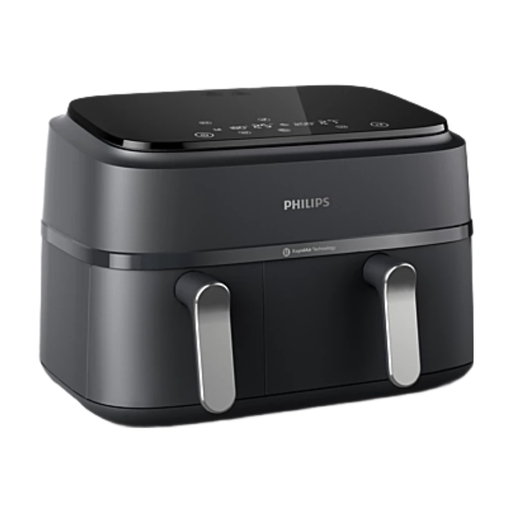 Image unavailable
The two baskets may suit households that want to cook a main and a side separately. The stated total capacity is 9 L. Before planning to use a tin or cook a large portion, check the usable dimensions of each basket and make sure you have enough space on your worktop.
No. A fair comparison needs to specify the appliances, quantities and dish being cooked. ADEME’s annual figures for electric ovens don’t tell you how much energy your meal would use in an air fryer.
Compare your usual portions and the dimensions of the dishes you use most often with the basket’s usable space. If you often cook in tins, on a rack or with several dishes, check whether a mini oven would be a better fit for those uses.
Not necessarily. Two drawers keep separate dishes apart, but each has its own dimensions. A flexible model such as the Philips NA156/60, which Philips says has a removable divider, offers another configuration. Even so, check that your dish will fit in the combined cavity.
Check the instructions for the exact model to find out which parts are removable and dishwasher-safe, then look into the availability of spare parts. The DGCCRF distinguishes between the statutory guarantee of conformity, the guarantee against hidden defects and any commercial warranty. A commercial warranty does not replace your statutory rights.