Which option is right for you?

If you’re concerned about odours and cleaning

If the thought of filtering and storing oil after cooking puts you off, an air fryer is worth considering. UFC-Que Choisir associates this type of appliance with fewer frying odours and easier cleaning, while noting that it can take up a lot of space. Check which parts of the model you’re considering are washable.

If your household often deep-fries food

If you regularly make chips or doughnuts in hot oil, an electric deep-fat fryer gives you a dedicated cooking bowl. Some models have a filtration system and removable parts, but you’ll still need to manage the oil and the odours.

If you only fry occasionally and don’t want a dedicated appliance

If you rarely deep-fry, a pan you can use on your hob may be enough, according to UFC-Que Choisir. Check that it’s compatible with your hob, and take care when handling the hot oil and disposing of it after use.

What sets these appliances apart?

Deep-frying pan for the hob

Worth considering: if you only fry occasionally, would rather not add another electrical appliance and have a compatible hob.

Bear in mind: your hob will be occupied while you cook, and hot oil needs careful handling.

Electric deep-fat fryer

Worth considering: if deep-fat frying is a regular part of your meals and you’d like a dedicated cooking bowl.

Bear in mind: even with a filter or removable parts, you’ll still need to manage used oil and odours.

Air fryer

Worth considering: if you prefer cooking crispy or roasted food with hot air rather than deep-frying it in oil.

Bear in mind: UFC-Que Choisir points out that these appliances can be bulky and a little noisy.

FactorWhat to checkWho it matters to
Odours and cleaning Check which parts of the air fryer are removable and washable. For a deep-fat fryer, look at how easily you can access the bowl and filter the oil. I want to cook often without odours or greasy cleaning putting me off using the appliance. Around 30% of consumers prioritise this.
Deep-fat frying Check the stated food capacity, temperature control and the model’s oil-filtering options. If I regularly cook food in hot oil, I need to be able to manage both the cooking and the oil between uses. Around 30% of consumers prioritise this type of cooking.
Space and occasional use Measure your storage space. For a deep-frying pan, check that it’s compatible with your hob; for an air fryer, allow the clearance specified in the instructions. I rarely deep-fry and would rather not have a dedicated appliance taking up space in my kitchen all the time. This is the main consideration for around 20% of consumers.
Useful portions Compare the basket’s cooking surface and the amount of food specified for the model. Don’t assume that the volume of oil or the bowl capacity tells you how much food you can cook in one go. To feed my household without cooking multiple batches, I need a capacity that suits the food I prepare. Around 20% of consumers make this their priority.

Mistakes to avoid

  • Assuming stated capacity tells you how much you can cook

    A large capacity doesn’t, by itself, tell you how much food will fit in one batch. UFC-Que Choisir distinguishes, for example, between an electric deep-fat fryer’s maximum capacity and the amount used in its tests.

    Start with your usual portions, then check the basket’s cooking surface, the stated food capacity and whether you might need to cook in several batches.

  • Expecting a filter to get rid of odours

    According to UFC-Que Choisir, odours can escape from a deep-fat fryer when the basket goes into or comes out of the oil, even if the appliance has a filter.

    If odours are a deciding factor for you, compare air-frying too. Don’t assume a filter guarantees odour-free frying.

  • Forgetting what happens to the oil after cooking

    A deep-fat fryer needs to be cleared of food residue, and you’ll need to dispose of the used oil responsibly. ADEME advises against pouring it down the sink, flushing it down the toilet or releasing it into the environment.

    Before you buy, find out where you can dispose of it locally and plan to let the oil cool before putting it in a suitable container.

    Filtering the oil, storing it in a container and possibly taking it to a collection point also take time and space.

  • Choosing a deep-frying pan without checking your hob

    You won’t be able to use a deep-frying pan that isn’t compatible with your hob. For example, De Buyer says its La Lyonnaise range isn’t suitable for induction hobs.

    Before ordering, check the material and confirm that the specific product is compatible with your type of hob.

Brands to consider, model by model

De Buyer

An option if you’d rather use a deep-frying pan on your hob than buy a dedicated electrical appliance.

  • De Buyer’s La Lyonnaise range includes deep-frying pans and baskets.
  • The manufacturer says this range isn’t suitable for induction hobs; you’ll also need to manage a pan of hot oil.

Tefal

Electric deep-fat fryers to consider if you regularly cook food in hot oil.

  • For the Filtra Pro 4 L, Tefal lists a filtering sieve and a capacity of up to 1.3 kg of chips.
  • These features apply to the model mentioned; they won’t get rid of odours or remove the need to manage the oil.

Moulinex

Air fryers in different sizes, so you can choose one to suit your portions and available space.

  • Moulinex says the Easy Fry Essential 3,5 L has a dishwasher-safe basket and lists a capacity of 7,5 L for the Easy Fry Compact.
  • Stated capacity alone won’t tell you how much food you can actually cook or how much worktop space you’ll need.

Philips

Air fryers with a single basket or two, depending on whether you want one cooking compartment or to prepare separate dishes.

  • Philips describes one 9 L model as having a 6 L basket and a 3 L basket.
  • These capacities apply to this model. Check its dimensions and the portions it can handle before choosing a dual-basket design.

Appliances to compare on Joybuy

These models let you compare several air fryers with an electric deep-fat fryer. To choose between the two cooking methods, consider how their features suit your portions, the level of cleaning you’re happy with and the space you have available.
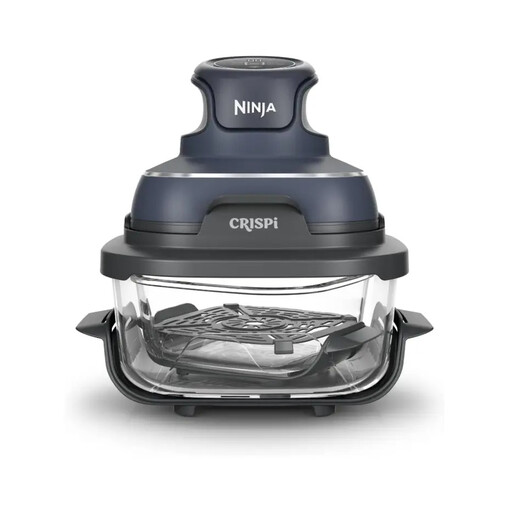
Ninja FN101EUGY Crispi air fryer

Ninja FN101EUGY Crispi Air Fryer

Worth considering if you’d rather cook with hot air than deep-fry food in oil. Check that it can handle your usual portions and that you have enough space for it. Take care when handling hot containers.

View on Joybuy
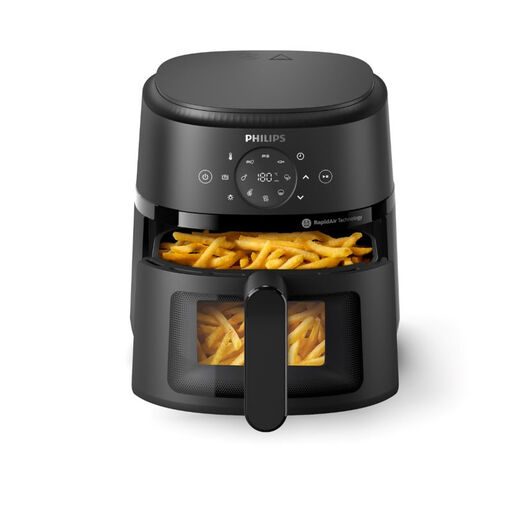
Philips NA210/00 Airfryer 2000 Series, 3,2 L air fryer

Philips NA210/00 Airfryer 2000 Series, 3,2 L

Worth a look if you’re after a 3,2 L air fryer. Compare the basket’s cooking surface with your usual portions, and allow enough clearance around the appliance.

View on Joybuy
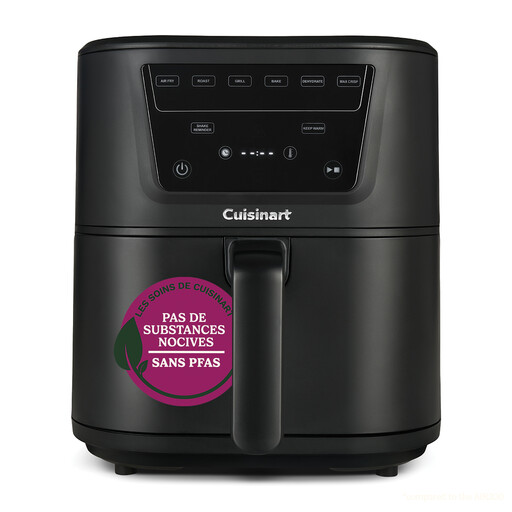
Cuisinart Compact Max AFS8OBLE air fryer, 7,6 L

Cuisinart Compact Max AFS8OBLE, 7,6 L

Worth comparing if you cook larger portions. The stated 7,6 L capacity doesn’t tell you how much food you can cook on its own, so check the cooking surface and the appliance’s dimensions too.

View on Joybuy
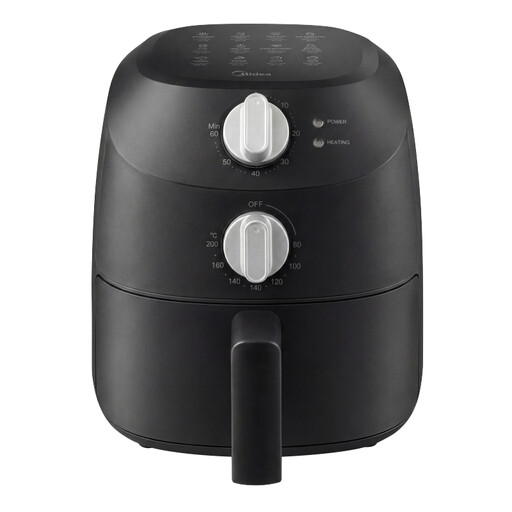
Midea air fryer, 2 L, 1 150 W, black

Midea Air Fryer 2 L, 1 150 W, black

Worth considering for smaller portions, as long as the basket suits the food you usually cook. The product name lists a 60-minute timer and a dishwasher-safe non-stick basket; check the dimensions and allow enough space for installation too.

View on Joybuy
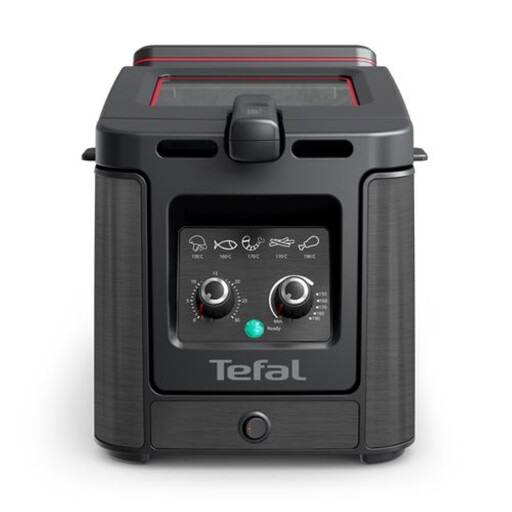
Tefal Clear Duo deep-fat fryer, 3,5 L

Tefal Clear Duo, 3,5 L deep-fat fryer

Worth comparing if you prefer deep-fat frying. The bowl is listed as 3,5 L, and the product name mentions an anti-fog viewing window. Check that it can handle the amount of food you usually cook, and find out how to clean the filter. A filter doesn’t guarantee odour-free frying.

View on Joybuy

Frequently asked questions

What air fryer capacity should you choose for your household?

Start with your usual portions, then compare the basket’s cooking surface and usable capacity. UFC-Que Choisir suggests 3 to 4 L for one or two people, 5 to 6 L for three or four, and 7 to 9 L or more for five or six. These capacities don’t guarantee that you’ll be able to cook the same amount of every type of food.

Will a filtered electric deep-fat fryer prevent odours?

No. A filter won’t make deep-fat frying odour-free. UFC-Que Choisir points out that how well a filter works can vary, and odours may escape when the basket goes into or comes out of the oil.

How should you dispose of used cooking oil in France?

Let it cool and check what collection options are available locally. ADEME advises against pouring used oil down the sink, flushing it down the toilet or releasing it into the environment. You can put it in a sealed container before taking it to a collection point, following your local authority’s instructions.

Can the CE marking help you choose between two appliances?

No. The CE marking isn’t a quality or safety rating. The DGCCRF explains that it represents the manufacturer’s declaration that the applicable requirements have been met, but it isn’t a certification mark. Compare the instructions and guidance on handling hot parts too.

Does a commercial warranty replace your statutory rights?

No. For purchases in France, the DGCCRF distinguishes between the statutory guarantee of conformity, the guarantee against hidden defects and any commercial warranty offered by the retailer or manufacturer. Read the terms of any commercial warranty, and don’t confuse it with your statutory rights.