Households serving a main and side dish together
If the two foods need different cooking times or temperatures, look for independent settings. A sync function can also be useful when both dishes need to be ready at the same time.


Choose according to the shape of your meal: a single basket works well for food that fits in one cooking area, while two independent zones are useful if your main and side dishes need different settings. For larger quantities or a dish that won’t fit in the drawers, compare the usable cooking area with your oven’s before adding another appliance. The stated capacity doesn’t guarantee that a whole meal will fit in one batch or cook evenly.
If the two foods need different cooking times or temperatures, look for independent settings. A sync function can also be useful when both dishes need to be ready at the same time.
To avoid cooking in several batches, check the available width and cooking surface, as well as the shape of the dishes you want to prepare. As Que Choisir points out, usable capacity determines how much you can actually cook: the stated number of litres doesn’t tell you everything.
An air fryer needs space on your worktop and should offer something different from your oven. Ask yourself whether you often cook portions that fit its drawers well enough to justify adding another appliance.
Start with the foods you want to serve together: their quantity and shape determine how much space you need, while their cooking times will tell you whether two zones are worthwhile. Then compare the space the appliance takes up and how you plan to use it with your current oven.
| Factor | What to check | Who it matters to |
|---|---|---|
| Usable capacity | Check the internal width and the surface available for spreading food out without excessive overlap, rather than looking only at the total capacity in litres. | When I’m cooking several portions or a large dish, I want to avoid starting another batch because everything won’t fit in a single layer. Around 29% of consumers rank this usable capacity as their top priority. |
| Cooking two things at once | Check the settings for each zone and, if the food needs to be ready at the same time, whether there’s a function to synchronise the cooking times. | To serve a main and side dish together, I need to be able to adjust each cooking time without waiting for the first one to finish; this is the top priority for around 36% of consumers. |
| Space and how it complements your oven | Measure the available space, including the clearance needed, then compare what you plan to cook with what your oven can already do. | In a small kitchen that already has an oven, I want to know whether I’ll use the appliance often enough to justify giving it worktop space. Avoiding duplication comes ahead of other factors for around 21% of consumers. |
| Cleaning and noise | Check which parts need cleaning and how to care for them; if your kitchen is open-plan, look for noise measurements taken under comparable conditions. | If I’m cooking near my living space, fan noise and cleaning up after a meal affect my choice. For around 14% of consumers, everyday convenience is the main priority. |
A large stated capacity doesn’t mean a wide dish will fit in the basket or that you can spread out several portions. Que Choisir highlights the difference between stated capacity and how much you can actually cook.
Compare the internal dimensions and cooking surface with the shape of the dishes you usually prepare.
Two compartments let you separate different foods, but their combined capacity doesn’t necessarily give you one large, continuous cooking area.
If one large dish is your priority, check the width of each drawer, whether there’s a removable divider and how much room your oven offers.
Results reported by Que Choisir vary depending on the food and the appliances being compared: the difference found for a small quiche doesn’t tell you what to expect when cooking a whole family meal.
Assess whether an air fryer is right for you based on the quantities and recipes you’ll cook most often, rather than applying a single advertised figure to every meal.
Fan noise can matter in an open-plan kitchen, while a large appliance needs an accessible spot with the clearance specified in its instructions.
Measure the available space, check the installation instructions and, if noise is a deciding factor, look for a test carried out under comparable conditions.
The configurations below illustrate different compartment and layout options; they don’t show that one brand cooks better than another.
Worth considering if you alternate between cooking two separate dishes and preparing a meal that needs more space in one continuous area.
Offers a removable divider on one model and stacked baskets on another range, showing that layout matters just as much as total capacity.
The vertical two-basket design may suit households looking to keep dishes separate while making the most of worktop width.
These appliances may suit meals where you’re considering cooking two dishes, need a large stated capacity or want a configurable zone. For one large dish, compare the internal surface of each configuration with your oven rather than adding together the capacities of the compartments.
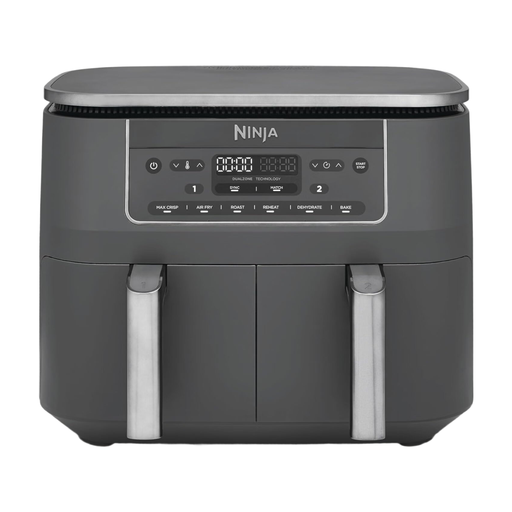 Image unavailable
Worth considering if you want to divide two dishes between separate drawers. The stated total capacity is 7.6 L; check the space available in each drawer and whether there’s a sync function if both dishes need to finish at the same time.
The product name lists six cooking modes and dishwasher-safe baskets.
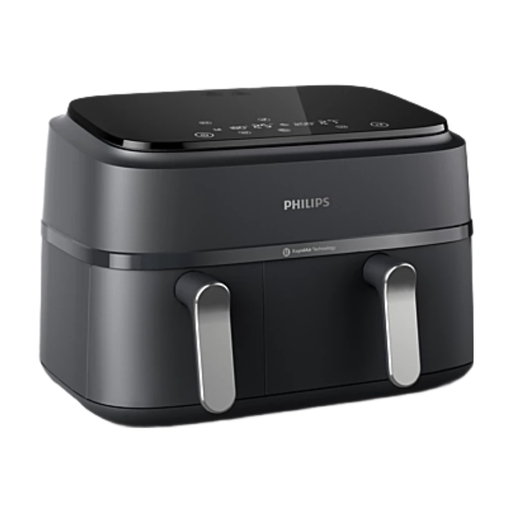 Image unavailable
Worth considering for cooking a main and side dish in two baskets. The stated total capacity is 9 L; check the size of each basket against the portions you plan to cook.
If you want to serve both dishes together, check the settings and sync function available on this model.
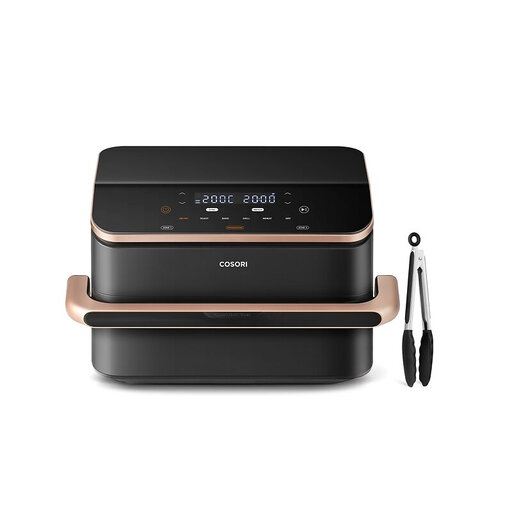 Image unavailable
Worth considering if you alternate between cooking one larger dish and preparing two separate dishes. The stated capacity is 10 L; check the internal surface available in each configuration before deciding whether your dish will fit.
If you want two dishes to finish cooking at the same time, check for a sync function; also read the cleaning instructions for the removable parts.
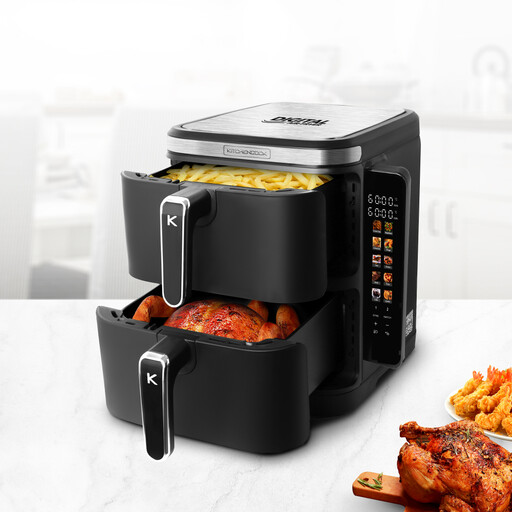 Image unavailable
This vertical design is worth considering if you want to cook two dishes in stacked compartments. The stated total capacity is 12 L; check the external dimensions and usable space in each compartment, particularly if you’re cooking wide dishes.
The product name lists ten pre-set programmes. Check separately that it offers the settings and sync function you need for your meal.
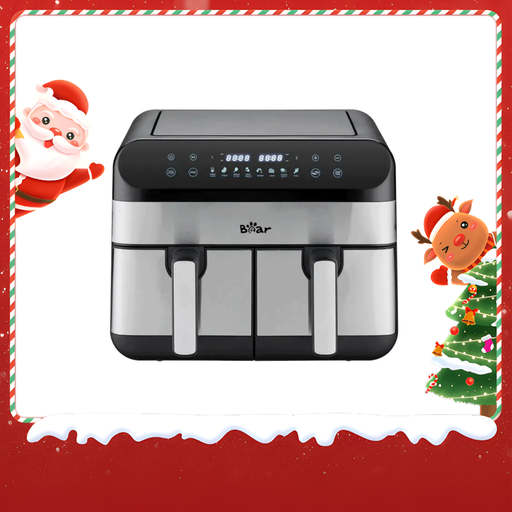 Image unavailable
Worth considering when two foods need different temperatures. The product name lists a total capacity of 9 L and independent temperature controls; check the surface area of each basket against your portions.
The stated power is 2,400 W and eight programmes are listed. Check the appliance dimensions and cleaning instructions if these factors will influence your choice.
It depends on the number of portions, as well as their shape and the space available in the basket. Que Choisir suggests 5 to 6 L for 3 to 4 people and 7 to 9 L for 5 to 6 people as a guide; however, check the internal dimensions before assuming your dish or all your portions will fit at once.
No: two drawers are most useful when different parts of the meal need different temperatures or cooking times. For one large dish, compare the cooking surface of a large single zone, a configurable basket and your oven instead; if you need both dishes to finish at the same time, check for a sync function too.
No, the difference depends on the recipe, quantity and appliances being compared. In Que Choisir’s tests, air fryers used an average of 36% less electricity than a mini oven when cooking a small quiche of the same size, while some models used more energy for chicken drumsticks; this result won’t predict what will happen with all your meals.
First, check that your usual dishes fit in the cooking space without needing several batches. Then read the instructions for clearance around the appliance and how to care for its parts; in an open-plan kitchen, also consider the fan noise highlighted by Que Choisir.