Who this comparison is for

People bothered by smells in open-plan kitchens

You are mainly looking to reduce unpleasant smells when preparing crispy food at home. An air fryer is worth considering first, but its fan may be noticeable in a small home or open-plan kitchen. Que Choisir points to both reduced smells and the possible noise produced by these appliances.

Households that want to keep immersion cooking

You regularly prepare chips, breaded food or doughnuts and are happy to manage a bath of oil. Take cleaning, smells and the local disposal option for used oil into account; ADEME states that it must not be poured down the drains or released into the environment.

Buyers who care about cleaning and footprint

You want to compare cleaning, storage, space occupied, noise and actual cooking performance rather than relying on a marketing promise. Que Choisir’s test protocols examine these criteria and highlight varying results between air fryers.

Buying priorities

Air fryer

Consider it if: you prefer cooking with circulating hot air and want to reduce the smells associated with frying.

Be prepared for: an appliance that may be bulky and audible, with cooking results that vary according to the model and load. Que Choisir highlights this in its guides and tests.

Electric deep fryer

Consider it if: you want chips, breaded food or doughnuts cooked by immersion.

Be prepared for: managing a bath of oil, cleaning it and checking the smell levels for each appliance. Que Choisir’s protocol covers cooking, cleaning, safety and smells, among other criteria.

Oil fryer

Consider it if: you prefer the traditional method of cooking in oil.

Be prepared for: cooling the oil, storing it in a sealed container and taking it to a local disposal point. According to ADEME, it must not be poured down the sink, flushed down the toilet or released into the environment.

Priority What to check Your needs
Cooking smells Compare the cooking method, cleaning requirements and tests covering smells. A filter or a claim of reduced smells does not mean there will be no smell at all. I want to cook crispy food without the smell of frying taking over the kitchen. Que Choisir presents the air fryer as one way to reduce smells, without guaranteeing that they will disappear.
Cooking and crispiness Check results with foods similar to those you usually prepare, the quantity tested, evenness and crispiness. With an electric deep fryer, also examine temperature stability. My usual portions need to cook evenly, even when the basket is well filled. Que Choisir’s tests show that air fryer performance differs between models.
Noise and space Check the dimensions, storage requirements and a noise measurement taken in comparable conditions. Noise at 0,50 m is specifically measured in Que Choisir’s air fryer protocol. In an open-plan kitchen, I would rather not have a fan become more bothersome than the smells I am trying to reduce.
Cleaning and oil Check which parts can be removed, the cleaning instructions and, for immersion cooking, the local disposal route for cooled oil. I want maintenance to fit around my cooking routine. For used oil, ADEME recommends using a sealed container and then the collection option available locally.

Mistakes to avoid

  • Choosing an air fryer solely because it promises fewer smells

    Reduced smells are often cited as an advantage of this type of appliance, but that does not guarantee an odour-free kitchen. The fan noise may also be noticeable in an open-plan room.

    Before buying, look for tests covering noise, cleaning and cooking, then consider where the appliance will actually be positioned.

  • Assuming every quantity will cook in the same way

    Results can vary depending on the model, load and position of the food in the basket. Que Choisir tests have highlighted differences in browning between food placed at the top and at the bottom.

    Compare tests carried out with foods you normally prepare and with a quantity close to your usual amount, particularly when cooking several portions.

  • Forgetting about oil management

    An oil fryer or electric deep fryer means dealing with used oil after cooking. ADEME states that it must not be poured down drains or released into the environment.

    Before using one regularly, find out where your nearest collection facility is and keep a sealed container ready for cooled oil.

  • Comparing only the programmes and stated capacity

    Everyday use also depends on cleaning, storage, visibility, programming, handling and cooking results.

    Measure your available space, define your usual portions and choose an appliance assessed for ergonomics, noise, cleaning and cooking performance.

Brand overview

Brand information is not currently available for this section.

Joybuy products

Joybuy options for oil-filled electric deep fryers aimed at people who want to keep immersion cooking while taking smells, cleaning and oil management into account.
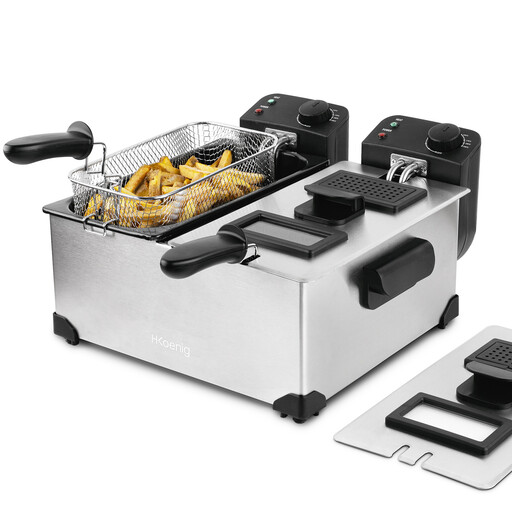
Hkoenig DFX600 2 × 3 L double-basket deep fryer

Hkoenig DFX600 double-basket deep fryer 2 × 3 L

For cooking two separate preparations by immersion.

Two 3 L baskets, two independent thermostats up to 190 °C, removable baskets and filters for smells and fumes, as stated in the product description.

Check the available space and noise levels for an open-plan kitchen. This deep fryer uses oil: allow it to cool, keep it in a sealed container and arrange disposal through a local facility.

Joybuy
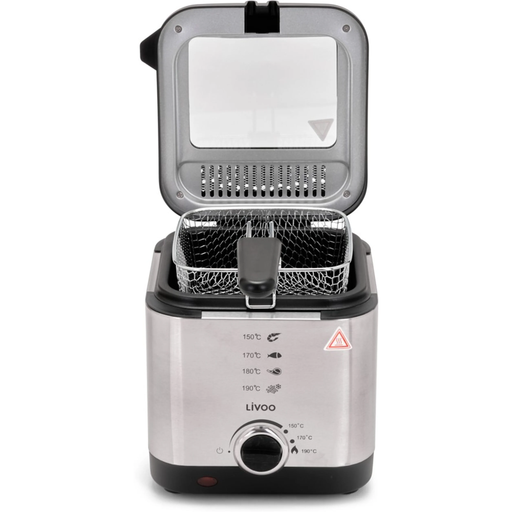
Livoo DOC240 1.5 L grey deep fryer

Livoo DOC240 1.5 L grey deep fryer

For preparing small portions of chips by immersion.

Stated capacity of 1.5 L of oil, up to 400 g of chips, thermostat up to 190 °C, removable basket, lid with odour filter and non-stick bowl.

Check the cleaning instructions for the fixed bowl and the noise level if the appliance will be used in an open-plan kitchen. The oil must be cooled, stored in a sealed container and then disposed of through the local solution.

Joybuy

Frequently asked questions

Does an air fryer eliminate all cooking smells?

No. Que Choisir lists reduced smells as one possible benefit of hot-air cooking, without demonstrating that smells disappear completely. Also compare cleaning requirements and how you intend to use the appliance in an open-plan kitchen.

How can you check an air fryer’s noise level before buying?

Look for a test that gives a noise measurement while the appliance is running, particularly at 0,50 m when this method is specified. This is especially useful in an open-plan kitchen or small space; Que Choisir notes that the ventilation needed for convection can be audible.

What should you compare between two air fryers?

Compare results with foods similar to those you prepare, the optimum and maximum quantities tested, evenness, crispiness, cleaning, storage, noise and safety. Performance can vary considerably from one model to another, according to Que Choisir.

What should you do with used deep-fryer oil?

Allow it to cool, pour it into a sealed bottle or container, then use the disposal option available in your area, such as a recycling centre or dedicated collection point. ADEME advises against pouring it down the sink, flushing it down the toilet or releasing it into the environment.

Does an electric deep fryer guarantee fewer smells than an oil fryer?

No general conclusion can replace checking the specific model. Que Choisir’s protocol for electric deep fryers includes smells among its assessment criteria, so check this point for each appliance.