
Livraison le jour même ou le lendemain

Qualité garantie

Débloquez vos offres de bienvenue: Livraison GRATUITE | Jusqu'à -80 % | 30 jours d'essai gratuits à JoyPlus
Téléchargez l'application
By Joybuy, Your Product Expert | Last Updated: 27 August 2026
Condensation on the windows, a stubborn musty smell, the appearance of mould… These are tell-tale signs that your home is too humid. An air dehumidifier is often the most effective solution for restoring a healthy, comfortable home environment. But be warned: the market is flooded with models, some with misleading marketing claims. The result is often an unsuitable purchase and inevitable disappointment.
To ensure you don't regret your investment, here are the pitfalls to be aware of before you decide:
To make the right choice, forget the marketing jargon and focus on these three essential criteria that truly address your needs.
Expressed in litres per 24 hours (L/day), this indicates the volume of water the unit can extract from the air. But be careful, this figure must always be considered in relation to the room's size and its humidity level.
The captured water is stored in a tank that needs to be emptied regularly.
Beyond raw performance, a few options can be a real game-changer in your daily life.
No endless lists here. We've selected three models that each meet a specific need while sidestepping the common pitfalls.

Why we love it: Perfect for anyone seeking an effective electric solution for a single room (up to 16 m?) like a bathroom or office, without splurging on an oversized model.
Its 10 L/day capacity is honestly matched with a small area (16 m?), avoiding the trap of unrealistic marketing promises. It's a true electric dehumidifier, whose efficiency is in a different league from a simple chemical absorber.
It includes an adjustable hygrostat and a continuous drainage option, features usually reserved for more expensive models. Its compact size and castors make it very easy to move from one room to another.
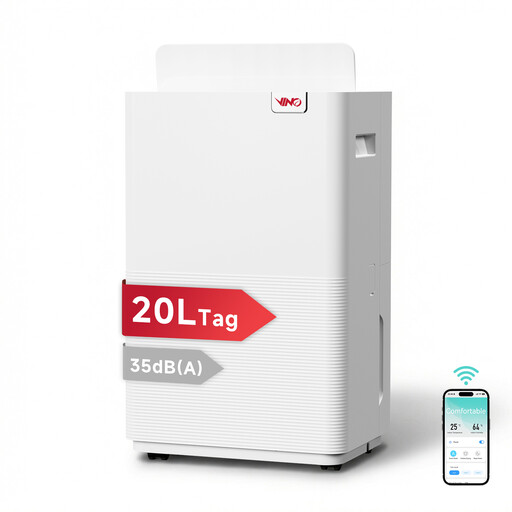
Why we love it: For those who want a powerful solution for their home (up to 40 m?) and also demand good acoustic comfort and modern features like a laundry dry mode or remote control.
It tackles the noise trap with a night mode rated at only 35 dB, a remarkably low figure for a 20 L/day compressor unit. This means it can genuinely be used in a living room or bedroom without being disruptive.
Its standout feature: control via a WiFi app to schedule everything remotely. It also integrates an air purification function and a dedicated drying mode, making it a true anti-humidity Swiss Army knife.
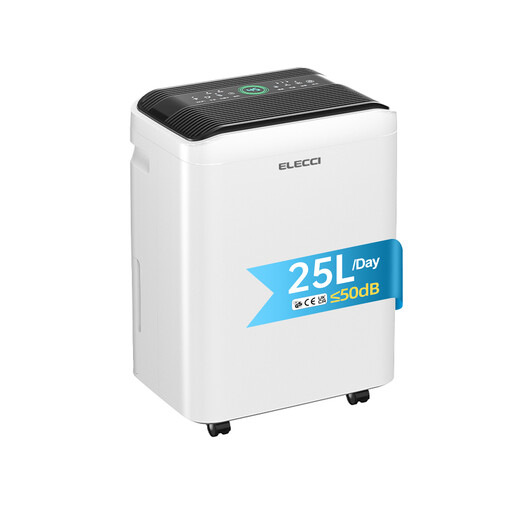
Why we love it: Built for the toughest jobs. Its high extraction capacity is perfect for treating a cellar, garage, or basement plagued by persistent dampness.
It doesn't just offer a high capacity (25 L/day): it pairs it with a very large 4.8 L tank and continuous drainage. This eliminates the chore of emptying the tank, the deal-breaking flaw of powerful units with small containers.
The auto-defrost function is essential for a cellar where temperatures can drop, ensuring uninterrupted operation. The colour-coded humidity indicator lets you check the level at a glance.
Explore our full selection of products, all vetted by our experts for their effectiveness and safety compliance.
A moisture absorber (like Unibond) uses chemical salts to passively capture moisture. It's silent and uses no electricity, but its action is very slow and limited to tiny volumes (wardrobe, car). Its main drawback is the cost of refills, which quickly adds up. In contrast, an electric dehumidifier uses a compressor to actively condense moisture from the air. It is infinitely more powerful, faster, and suitable for treating an entire room.
Consumption depends on its power (in Watts) and its operating time. A 200W model running for 8 hours a day will consume 1.6 kWh. Thanks to the hygrostat, the unit only runs when necessary, which greatly optimises consumption. By comparison, a standard tumble dryer consumes between 2 and 5 kWh per cycle. Using a dehumidifier's 'laundry dry' mode therefore proves to be much more economical.
Absolutely: they are called portable air conditioners. By their nature, all air conditioners dehumidify the air as they cool it. Some models, like the Humhold 9000 BTU, even offer a dedicated and highly effective dehumidification mode (up to 28 L/day). This makes them an excellent 2-in-1 solution for summer, when you want to combat both heat and humidity.