
Livraison le jour même ou le lendemain

Qualité garantie

Débloquez vos offres de bienvenue: Livraison GRATUITE | Jusqu'à -80 % | 30 jours d'essai gratuits à JoyPlus
Téléchargez l'application
Persistent condensation on windows, a stubborn musty smell, mould spots in the corners… These are unmistakable signs that your home is too humid. An air dehumidifier is often the ideal solution for restoring a healthy and comfortable environment. But faced with an overwhelming number of options and sometimes vague marketing claims, it's easy to make the wrong choice.
As a product expert at Joybuy, my mission is to help you cut through the noise. Here are the most common pitfalls to avoid so you don't regret your purchase.
To avoid these pitfalls, focus on a few key criteria that will ensure the appliance is well-suited to your needs.
The first question to ask is about the technology.
The extraction capacity, expressed in litres per day (L/day), must be correlated with the room's surface area (m?) and the humidity level.
Certain options can make a real difference in usability.
To put theory into practice, here is our selection of models suited for different uses, chosen based on the criteria we've just discussed.
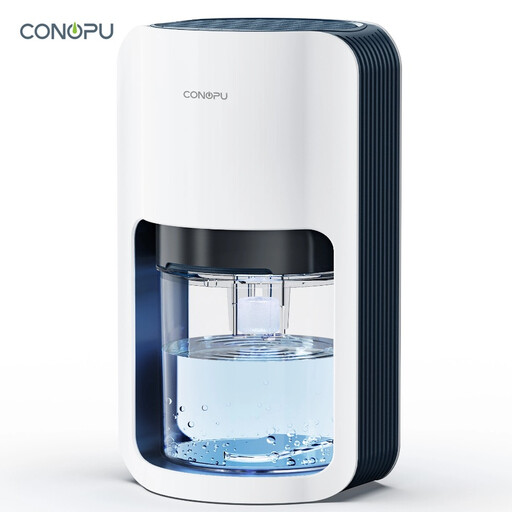
Why we recommend it: Ideal for those looking for a supplementary solution for a small room (10-15 m?), a bathroom without an extractor fan, or a walk-in wardrobe. Its semiconductor (Peltier) technology makes it compact and quieter than a compressor model.
It doesn't promise to treat an entire house. Its spec sheet is honest: its capacity and coverage area are clearly sized for targeted use. This avoids the pitfall of overstated performance.
Quiet operation (under 43 dB), auto-shutoff when the tank is full, and low energy consumption.
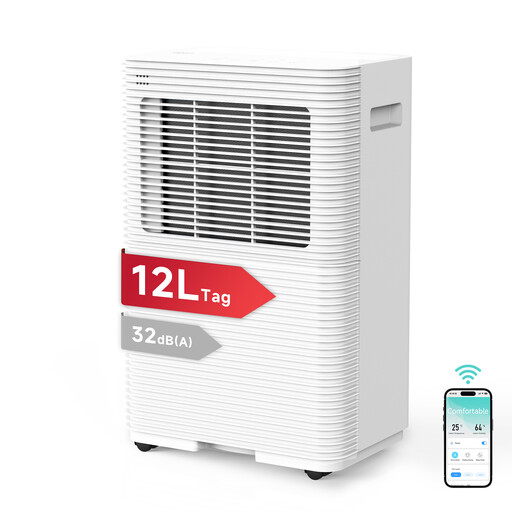
Why we recommend it: An excellent compromise for living spaces up to 24 m?. It offers a great balance of performance (12 L/day), modern features (Wi-Fi control), and user comfort, especially for nighttime use.
It tackles the myth of absolute silence by advertising a precise and reassuring value: 32 dB in night mode. This is a concrete figure that allows you to confidently consider it for a bedroom.
Smart dehumidifier for remote control, laundry dry function, and a particularly quiet night mode.
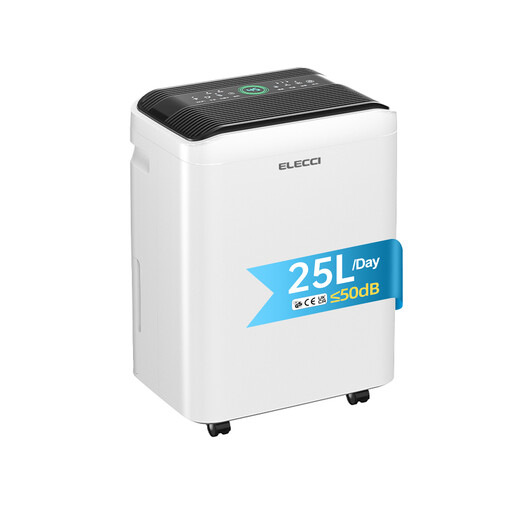
Why we recommend it: Built for tough jobs. Its large 25 L/day capacity makes it the perfect ally for large spaces (up to 50 m?) and areas where humidity is a real menace, like a cellar or basement.
It focuses on the essential features for intensive, autonomous use: a large tank (4.8 L), optional continuous drainage, and auto-defrost. This last point is crucial for ensuring consistent performance in a cool cellar, where other models would struggle.
High extraction capacity (25 L/day), large tank with continuous drainage option, and auto-defrost for low temperatures.
Discover our full selection of products, all tested and approved according to our performance and safety criteria.
Consumption depends on the device's power rating (in Watts) and its duration of use. Modern models, especially those using R290 refrigerant (which is more environmentally friendly), are designed to be more energy-efficient. A unit with a hygrostat that shuts off once the target humidity is reached will logically consume less than a unit running continuously. The nominal power rating is always indicated on the product sheet.
This is an essential distinction. An air dehumidifier is primarily designed to extract moisture. Its main air filter traps large particles like dust and pet hair, which helps to clean the air. However, it cannot replace a true, dedicated air purifier equipped with more advanced filters (like HEPA filters) designed to capture allergens, fine pollutants, and viruses. Some hybrid models exist, but it's crucial to check the type of filtration offered.
Not necessarily. The ideal approach is to use a model with a built-in hygrostat. You can set the desired humidity level (usually between 40% and 60%), and the device will manage its operation autonomously. Running it continuously is only useful in specific situations, such as drying laundry quickly ("Laundry Dry" mode) or dealing with a humidity spike after water damage.