
Livraison le jour même ou le lendemain

Qualité garantie

Débloquez vos offres de bienvenue: Livraison GRATUITE | Jusqu'à -80 % | 30 jours d'essai gratuits à JoyPlus
Téléchargez l'application
Persistent heat in a bedroom, dust lingering in the living room, humidity after a shower or poor ventilation in a home office – air comfort appliances address very different needs. Yet product descriptions often blur the lines between cooling, purification, air circulation and dehumidification.
Before buying a portable air conditioner, an air purifier or a pedestal fan, it’s worth looking at some concrete facts. A large coverage area doesn’t always guarantee even cooling, and a high-performance filter doesn’t replace the need for proper ventilation. Here are the criteria to examine closely to avoid unpleasant surprises.
A pedestal fan or a portable model simply moves the air around – it doesn’t produce cold. The airflow improves your comfort sensation, but it doesn’t actually lower the room’s temperature. To cool a living room or bedroom during a heatwave, you’re better off choosing a portable air conditioner with an exhaust hose.
The actual area covered depends on many factors: ceiling height, insulation quality, sun exposure, number of occupants and room layout. For a purifier, the CADR, expressed in m³/h, is a more relevant indicator than the surface area highlighted in marketing. For an air conditioner, the power in BTU or kW should be matched to the room’s volume and its heat gains.
A unit described as quiet can quickly become annoying when running at full power. Check its noise level in decibels, especially in silent night mode. Maintenance matters just as much: filters to clean or replace, a water tank to empty and an exhaust hose properly installed all have a direct impact on day-to-day comfort.
A ROUNY purifier boasts a CADR of 150 m³/h and a stated coverage of 20 to 50 m². The Jafanda JF260S claims a CADR of 260 m³/h, with several air change rates depending on the room size. These figures aren’t directly comparable: always check the recommended number of air changes for the room in question.
For air conditioners, power is another point of comparison. The Candy 12,000 BTU states 3.5 kW cooling for rooms up to 35 m², according to its product sheet. The Humhold 7,000 BTU delivers 2.0 kW and targets spaces up to 28 m². In both cases, you need a window compatible with the supplied kit and enough space around the unit.
A noise level of 25 dB in night mode can work well in a bedroom, but also check the level reached at maximum speed. Energy class A or A+ alone isn’t enough to estimate your electricity bill: usage time, the desired temperature and your home’s insulation all play a decisive role.
An 8- or 24-hour timer helps limit unnecessary running periods. Wi-Fi control, where available, also makes remote start-up and scheduling easier. However, it doesn’t replace proper installation, especially for an air conditioner with an exhaust hose.
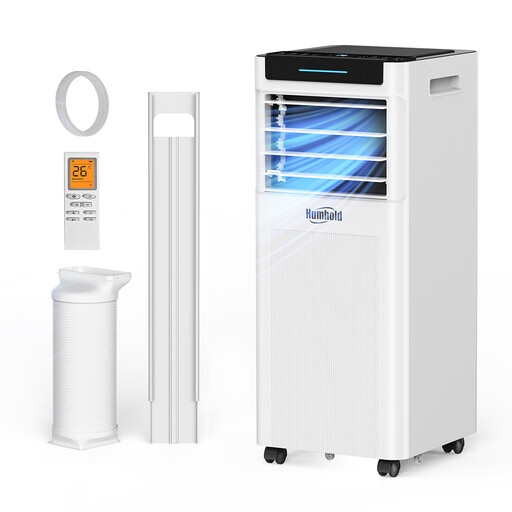
Why this choice suits this profile: This portable air conditioner combines cooling, ventilation and dehumidification in a 19.7 kg unit that’s easy to install in a bedroom, home office or small room.
The product sheet states a power of 2.0 kW, includes a window kit and a washable filter. This makes it easier to check whether its capabilities actually match your room size.
Night mode below 49 dB, 24-hour timer, R290 refrigerant and multidirectional castors.
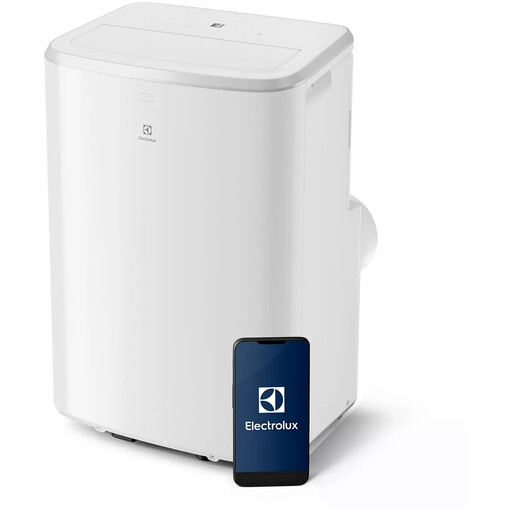
Why this choice suits this profile: This model is designed for those who want cooling, heating, ventilation and dehumidification all in one connected unit.
The product sheet specifies the airflow of 380 m³/h, the noise level of 64 dB and energy class A – useful benchmarks for comparing the unit without focusing solely on the BTU rating.
Wi-Fi connectivity, heating function, dehumidification up to 28 L/24 h and spare parts reportedly available for 15 years.
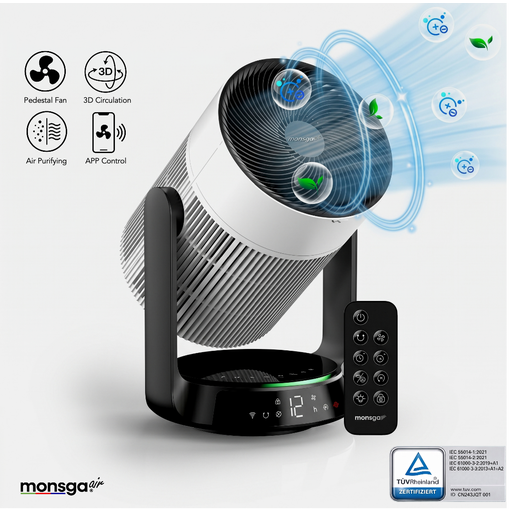
Why this choice suits this profile: This model combines air circulation and purification, ideal for a living room, home office or a room occupied for several hours a day.
Its stated CADR of 280 m³/h helps you distinguish the purification function from the simple cooling sensation produced by the fan.
Multidirectional oscillation, app control, remote control and night mode stated at 25 dB.
We’ve put together a comprehensive, real-time updated selection of products that meet these demanding criteria and European safety standards.
A fan can improve air circulation while keeping electricity consumption low. To actually lower the temperature, go for a portable air conditioner suited to the room’s volume, with the exhaust hose properly installed in the window. Also remember to check its noise level in night mode before buying.
Not necessarily. Depending on how the room is used, an automatic mode, a timer or a lower speed setting may be enough. Keep doors and windows closed during the purification phase, then ventilate regularly when outdoor conditions allow. The filter replacement frequency depends on the model and how intensively it’s used.
Choose a power rating suited to the room, use the timers and clean the filters following the manufacturer’s recommendations. With an air conditioner, avoid setting the temperature too far below the outdoor temperature. A fan or a less energy-hungry purifier can also supplement indoor cooling from time to time, rather than leaving the air conditioner running continuously.