
Livraison le jour même ou le lendemain

Qualité garantie

Débloquez vos offres de bienvenue: Livraison GRATUITE | Jusqu'à -80 % | 30 jours d'essai gratuits à JoyPlus
Téléchargez l'application
The air inside our homes is often more polluted than we think: it's stagnant and filled with dust or pollen, especially in the city. Between seasonal allergies, scorching summers, and the drive to cut energy waste, a versatile solution has become essential. This is where the air circulator purifier comes in: a 2-in-1 device designed to handle every season.
We've analysed the key criteria and selected the best models currently available to help you gain clarity and make the right choice.
The market is flooded with options, and it's easy to get lost. To ensure you don't make a mistake, here are the 3 criteria to examine closely.
Unlike a standard fan that only moves ambient air (and its pollutants) around, an air purifying fan traps them with a filtration system before redistributing the clean air.
To evaluate its effectiveness, the benchmark is the CADR (Clean Air Delivery Rate). Expressed in cubic metres per hour (m?/h), it measures the volume of air the device can process in one hour. A high CADR is crucial for an anti-allergy air purifier, guaranteeing the rapid filtration of pollen, pet dander, and other fine particles (PM2.5).
For a fan intended for a bedroom, silence isn't an option: it's the number one criterion. The noise level, expressed in decibels (dB), is therefore a crucial point. A device operating around 25-30 dB at its lowest speed is considered very discreet.
When it comes to your wallet, low energy consumption is obviously a major advantage. Models equipped with DC (direct current) motors are generally the champions of efficiency: they are more economical, leading to significant savings on your electricity bill, and often offer a wider range of speeds.
For consistent comfort throughout the room, air diffusion is key. 3D oscillation (horizontal and vertical) helps break up stagnant air pockets and distribute fresh or purified air much more effectively than conventional oscillation.
This feature makes the device an excellent companion to an air conditioner or heater. By accelerating air circulation, it helps reach the target temperature faster. The result: you use your air conditioner or radiators less, and your wallet will thank you. Finally, a smart fan connected via a mobile app offers unparalleled user convenience, allowing for remote control from your smartphone.
We have selected three devices that excel in their respective areas, whether your priority is purification, powerful circulation, or pure and simple cooling.
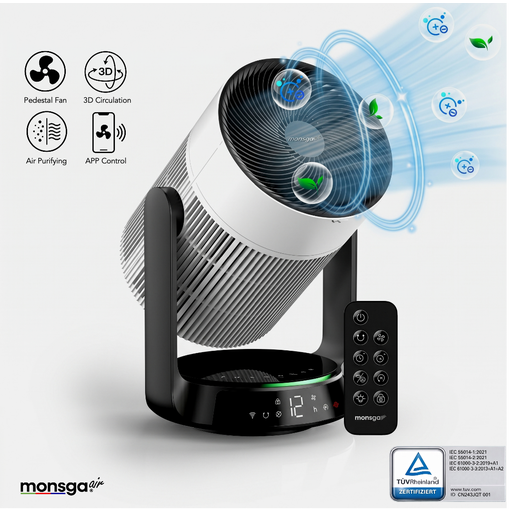
Why it stands out: This model perfectly embodies the air circulator purifier concept. It combines powerful ventilation with high-performance filtration, all in a design built for total room coverage. Its omnidirectional oscillation is its main asset for homogenising the air.
Key features:
Who is it for? This is the ideal device for those seeking a high-performance, all-in-one solution to improve air quality and thermal comfort, especially families, allergy sufferers, or home automation enthusiasts.
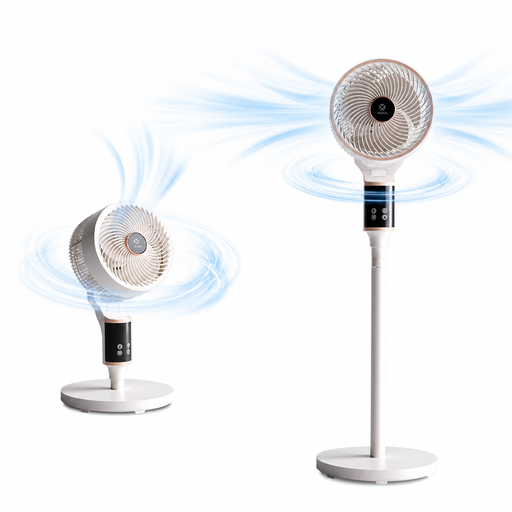
Why it stands out: The Woox MX0313 focuses on one mission: moving air with maximum efficiency. Its 3D oscillation (90° vertical and 90° horizontal) makes it a perfect companion to an air conditioner or heater, accelerating comfort and reducing energy bills.
Key features:
Who is it for? Ideal for those who already own a purifier and are primarily looking to optimise their heating/cooling system by circulating air effectively to eliminate hot or cold spots.
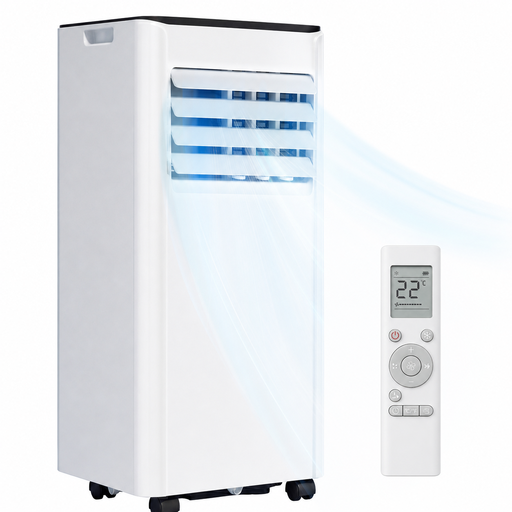
Why it stands out: There's no purification here, but this is a compelling solution for those whose absolute priority is powerful and rapid cooling. Its 4-in-1 versatility (cooling, fan, dehumidification, night mode) makes it a go-to ally during intense heat.
Key features:
Who is it for? It targets those living in poorly insulated or sun-exposed homes who are looking for a heavy-duty solution to survive summer heatwaves.
Does our selection not meet your needs? Want to compare other models? Take a look at our complete catalogue of fans and air treatment solutions to find the perfect device for you.
A conventional fan simply creates a directional airflow, providing a very localised cooling sensation. An air circulator, on the other hand, uses specially designed blades and a grille to generate a powerful vortex that moves all the air in the room. Its purpose is not to blow on you, but to homogenise the temperature and eliminate stagnant air zones.
Yes, and that's one of its major benefits, provided you choose the right one. A model equipped with a HEPA-type filter and a CADR sufficient for your room's size will effectively trap the majority of airborne allergens (pollen, dust mites, pet dander, mould) to sanitise your indoor environment.
Absolutely, and it's actually a very smart move! In winter, heat from radiators rises and stagnates at the ceiling. By running an air circulator, even at low speed, you force this warm air to circulate back down and distribute throughout the room. This greatly improves thermal comfort, often allowing you to lower the thermostat by a degree or two and achieve valuable heating savings.