
Livraison le jour même ou le lendemain

Qualité garantie

Débloquez vos offres de bienvenue: Livraison GRATUITE | Jusqu'à -80 % | 30 jours d'essai gratuits à JoyPlus
Téléchargez l'application
Choosing a CPU liquid cooling system can transform your computer's performance and acoustics. The problem? The market is flooded with a dizzying array of options and confusing marketing jargon. Our mission is to help you navigate the noise by breaking down the essential criteria for an informed choice and, most importantly, how to avoid the most common pitfalls.
Before diving into spec sheets, it's crucial to debunk a few common misconceptions that often lead to buyer's remorse.
To make the right choice, focus on these three fundamental parameters. They will determine the efficiency, compatibility, and acoustic comfort of your future system.
The radiator's size directly determines its heat dissipation capacity. The choice depends on your processor, the space in your case, and your intended use.
This is the ultimate deal-breaker: if the kit isn't compatible, it's getting sent right back. Recent processors use new sockets. You must verify that the spec sheet explicitly mentions AM5 compatibility for AMD Ryzen 7000 series CPUs and newer, or LGA 1700 / 1851 for the latest Intel processor generations. Manufacturers usually provide the necessary mounting hardware, but a quick double-check on the product page costs nothing and can save you a major headache.
The silence and efficiency of an AIO water cooler depend on the partnership between the pump and the fans.
To help you better understand how to apply these criteria, here is our selection of models, each tailored for a distinct user profile.
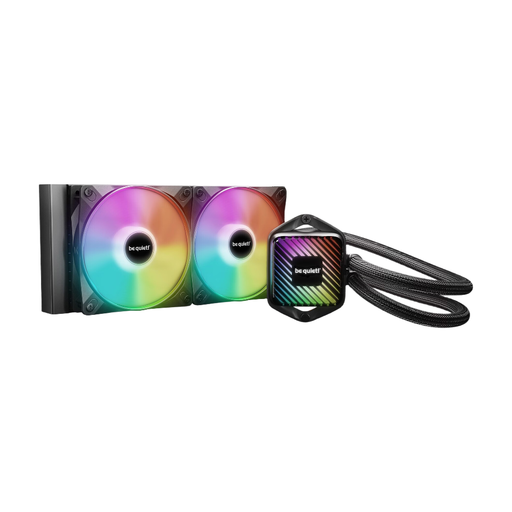
Why it's a great choice: Perfect for those who want to combine performance with a sleek aesthetic. Its ARGB lighting on the fans and water block, coupled with customizable films, offers a unique look without compromising on cooling.
Here, aesthetics don't come at the expense of performance. It features a PWM pump and Light Wings LX fans designed for efficiency and silence, thus avoiding the infamous "ARGB tax" where looks inflate the price without technical justification.
Extensive customization (ARGB, 10 included films) and a PWM pump/fan duo that ensures high-performance, discreet cooling.
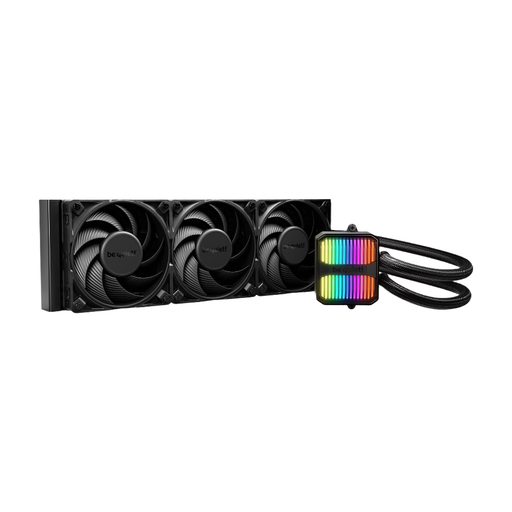
Why it's a great choice: Designed for content creators, streamers, or professionals for whom every decibel counts. This model aims for near-absolute silence, even when the processor is under heavy load.
It tackles the noise problem at its source with a 3-chamber PWM pump that limits turbulence and the renowned Silent Wings 4 fans, a benchmark for silence. Here, engineering does the talking, not the marketing sheet.
Exceptionally quiet operation, 6-pole 3-chamber PWM pump, and a refill port for improved longevity.
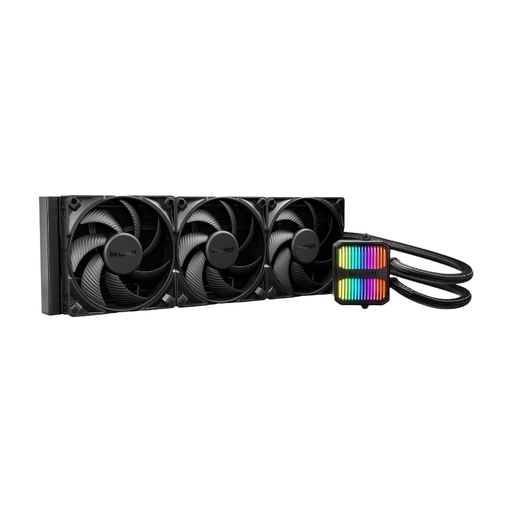
Why it's a great choice: For those who accept no compromises. Extreme overclocking, processors with massive TDPs, intensive computing... this beast is built to deliver outstanding cooling power thanks to its huge 420mm radiator.
Its XXL size isn't just for show: it's justified by top-tier performance. It's not just about being "big," but about leveraging that surface area with premium components (powerful pump, 140mm Silent Wings 4 fans) for a very real performance gain.
Extreme cooling potential, 3x 140mm Silent Wings 4 fans, and all the advantages of the Silent Loop 3 series (pump, silence).
Explore our full selection of cooling systems, all tested and approved by our editors according to the strictest criteria.
The lifespan of an AIO system is typically 5 to 7 years. The most common points of failure are the pump and the natural evaporation of the liquid through the micropores of the tubing. Some high-end models, like the be quiet! Silent Loop 3 series, include a refill port and a bottle of coolant, allowing you to give them a new lease on life with simple maintenance.
Installation has become significantly easier in recent years. Most kits come with clear instructions and mounting systems adapted to common sockets (Intel and AMD). The main difficulty remains ensuring the radiator fits in your case. A quick measurement before clicking "Buy" will save you a lot of trouble.
The choice depends on your priorities. An AIO water cooler generally offers better performance on the most power-hungry processors, a cleaner aesthetic around the socket, and easier access to RAM sticks. A good, large air cooler is often simpler, more reliable (zero risk of leaks), and can be just as quiet under moderate load. For the most powerful builds and a decidedly modern look, the AIO still has the edge.