
Livraison le jour même ou le lendemain

Qualité garantie

Débloquez vos offres de bienvenue: Livraison GRATUITE | Jusqu'à -80 % | 30 jours d'essai gratuits à JoyPlus
Téléchargez l'application
Choosing an AGIBOT X2 Ultra humanoid robot is not simply a matter of comparing its appearance, walking speed or an impressive demonstration video. For a business, laboratory, university or training centre, the real criteria lie elsewhere: software openness, environmental perception, maintenance and integration safety.
Commercial claims can nevertheless conceal limitations that are far from trivial. Here are the key points to check before requesting a quote or ordering a bionic humanoid robot for professional use.
Seeing a robot walk, wave or pick up an object is not enough to prove that it can operate without human intervention. You need to distinguish between:
If you are looking for a robot that can navigate independently, ask which functions are available as standard, under what lighting conditions and on which types of flooring. The presence of a LiDAR or RGB-D camera alone does not guarantee genuinely usable autonomy in every environment.
Different variants within the same range can offer very different capabilities. According to the information provided for the Lingxi X2 range, the Youth and Explorer versions do not support certain autonomous functions, while the Ultra edition can be customised.
Compatibility with secondary development must therefore be confirmed in writing. In particular, check whether a development environment is provided, which control interfaces are available, what documentation is supplied, whether OTA updates are supported and what rights apply to the use of collected data.
A professional humanoid robot is about more than its purchase price. You also need to plan for:
In France, the user business must also consider risk assessment, operator training and the compliance documents applicable both to the product and to its intended use.
The number of degrees of freedom, or DOF, corresponds to the number of motorised or controlled axes. A robot with 31 degrees of freedom offers more movement possibilities than a 20-DOF model. In return, its control system is more complex and its maintenance requirements may be greater.
The announced specifications for the AGIBOT X2 Ultra are as follows:
This configuration may be appealing for training, research into motion control or interaction demonstrations. However, it does not mean that the robot can handle any load or reproduce every human movement with the same degree of precision.
A robot equipped with LiDAR and an RGB-D camera combines several sources of data:
The AGIBOT X2 Ultra is advertised with 3D LiDAR, an RGB-D camera, an interactive RGB camera, front-facing stereo vision and rear vision. However, for a robot presented as capable of avoiding obstacles, ask about the detection range, response time, limitations caused by reflective surfaces and the emergency stop procedure.
The advertised battery has a capacity of approximately 500 Wh, with an estimated operating time of two hours at 0.5 m/s. Charging is said to take less than 1.5 hours, with a removable battery and direct power supply.
Autonomous charging requires a dedicated station. You should therefore check whether it is included, offered as an option or configured according to the site. An advertised runtime should not be interpreted as a guaranteed period of continuous operation: speed, movements, transported load, Wi-Fi and sensors all affect power consumption.
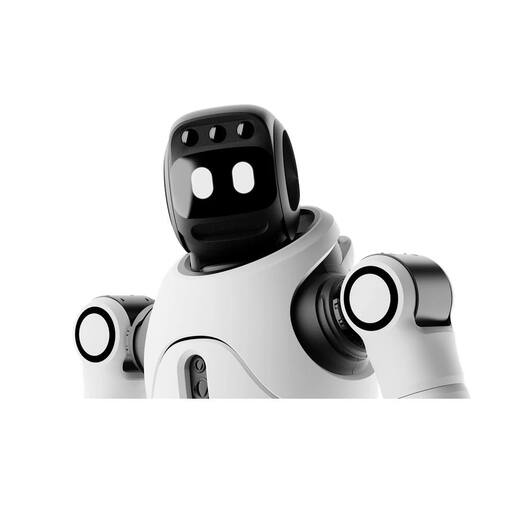
Why this choice suits this profile: This configuration is aimed at teams looking for an autonomous, customisable humanoid robot for research, integration or advanced training.
The product details clearly distinguish the Ultra edition and state that secondary development is supported on this version. However, autonomous charging functions require a dedicated station.
31 DOF, 3D LiDAR, RGB-D camera, Orin NX board advertised at 157 TOPS, Wi-Fi, Bluetooth and 4G/5G module.
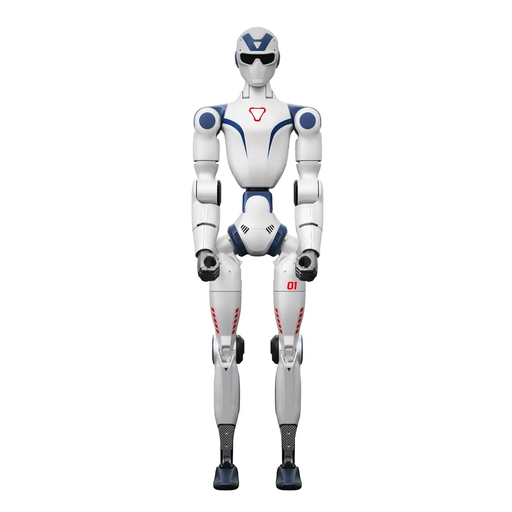
Why this choice suits this profile: With its monocular camera, 20 degrees of freedom and voice interaction, this model can provide an introduction to humanoid robots.
The product details make it easy to compare a simpler architecture with a configuration featuring several sensors and broader development support.
Monocular camera, 20 degrees of freedom and advertised voice interaction model.
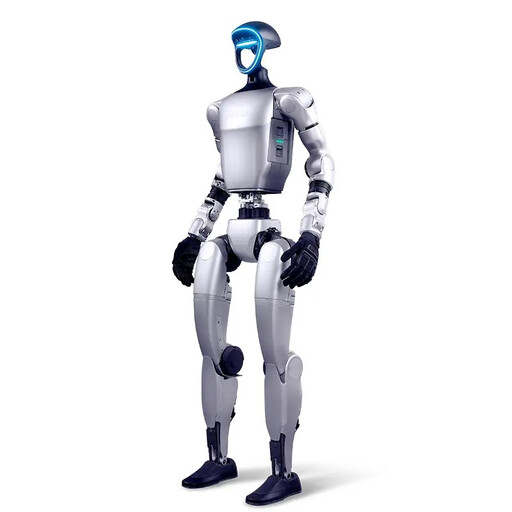
Why this choice suits this profile: It may appeal to organisations prioritising mobility, joints and optional hands for demonstrations or movement studies.
The product details specify that this version has neither an SDK/API nor support for secondary development. This is important to know if you want to avoid accidentally buying it for a software project.
Advertised sensors including depth camera and 3D LiDAR, removable battery and remote control included.
We have compiled a complete, real-time updated list of products that fully meet these demanding selection criteria and European safety regulations.
The product details mention autonomous navigation, preventive obstacle avoidance and autonomous task management for the relevant edition. These functions should be verified according to the environment, the software supplied and the configuration selected. A remote control is also included for supervised operation.
The advertised runtime is approximately two hours at a walking speed of 0.5 m/s. This figure is indicative: movements, transported load, sensors and communications can affect power consumption. A removable battery and direct charging are provided, while autonomous charging requires a dedicated station.
Yes. The product details for the Ultra edition state that secondary development is supported. Before buying, however, ask which interfaces are available, under what conditions the software can be accessed, what documentation is provided, which environments the robot is compatible with and how updates are managed. This information is essential for a university, laboratory or integrator wishing to programme the robot and adapt its movements to a specific scenario.