If you want to give someone a surprise to open every day, choose a calendar that clearly states the number of doors or chocolates it contains. A chocolate selection box, even a mixed one, won’t necessarily offer the same experience. To choose between calendars, start with the recipient’s tastes, then check the ingredients, allergens and nutritional information for the exact product. Nutri-Score is optional in France and doesn’t replace this information.
Who is each format for?
The choice between a selection box and a calendar depends first on how the gift will be enjoyed: opened throughout December or shared whenever you like.
For a daily treat
If you want the gift to be enjoyed in the run-up to Christmas, look for a calendar that clearly states the number of doors, days or chocolates. The total weight of a selection box alone won’t confirm that it’s designed for this daily ritual.
For trying a variety of flavours
A selection box could be a good choice for someone who enjoys trying different recipes. Compare the types of chocolate, fillings and biscuits listed, rather than relying on the way the box looks.
For someone who needs to avoid allergens
The ingredients for the exact product matter more than the format or brand. France’s DGCCRF reminds shoppers that allergenic ingredients must be highlighted in the ingredients list.
What should you check before choosing?
First, make sure the format suits the gift you have in mind, then check the ingredients for the exact product.
| What matters |
What to check |
Who might prioritise it? |
| The Advent ritual |
A clear count of the days, doors or chocolates; don’t try to work it out from the weight. |
If I’m giving someone a surprise to open every day, I want a calendar rather than a selection to share. Around 36% of consumers would make this ritual their priority. |
| Taste and variety |
The types of chocolate and recipes listed, including any fillings or biscuits. |
If the recipient enjoys trying different recipes, I look for flavours they’ll like. Variety would be the priority for around 29% of consumers. |
| Ingredients and allergens |
The ingredients list, highlighted allergens and any ‘may contain’ warnings for the exact product. |
If the gift is for someone who needs to avoid an ingredient, the box design isn’t enough for me. Around 21% of consumers would put these checks first. |
| Nutritional information |
Sugars and saturated fat per 100 g, along with the total weight and, if stated, the weight of each chocolate. |
To choose between two formats, I want to be able to compare their nutritional values rather than relying on Nutri-Score alone. Around 14% of consumers would put this comparison first. |
Mistakes to avoid
-
Confusing a selection box with a calendar
A selection box presented as a Christmas gift may be intended for sharing, with no provision for opening something each day. Its weight or festive design doesn’t confirm how many doors it has.
If the daily ritual matters to you, look for a clear count on the product you choose.
-
Assuming you know the allergens from the type of chocolate
Depending on the recipes, a selection may contain milk, nuts, soya or cereals. Two calendars from the same brand can have different ingredients.
Before giving the product, read the ingredients list and allergen information on the packaging for that exact product.
-
Taking the absence of Nutri-Score as a labelling problem
The DGCCRF says that displaying Nutri-Score is voluntary in France. Whether or not it appears, you should still check the nutrition declaration and ingredients.
To compare two products, use their values per 100 g and take the size of each box into account.
-
Assuming a seasonal calendar is in stock
A product page may still be visible even when the product is no longer available at your chosen store or for your selected collection option.
Check that the exact model is available before travelling or placing an order.
Brands and retailers to consider
These examples can help you compare calendar styles and product listings. Always check the ingredients for the product you choose.
Lindt
Lindt France features several chocolate Advent calendars, including mixed selections and LINDOR versions.
- The listed formats and recipes can help you find a selection to suit the recipient’s tastes.
- A wider variety may also mean more ingredients and allergens to check on the exact model.
Kinder (Ferrero)
Some Kinder calendars combine chocolate confectionery with biscuits.
- This may appeal to someone who already enjoys these different Kinder products.
- The listing for a chocolate and biscuit calendar highlights milk, hazelnuts and wheat. Check the ingredients for the particular version you’re giving.
Auchan
The retailer features listings for simple milk chocolate calendars as well as products from other brands.
- The listings checked give useful details such as weight, the number of days and nutritional values per 100 g.
- These details vary from one calendar to another, so compare the listings for the specific models you’re considering.
Carrefour
The retailer features a seasonal selection of calendars, including chocolate products from different brands.
- The products listed make it possible to compare the formats and stated ingredients.
- A listing may show that a product is unavailable, so check the product and store you’ve selected.
Advent calendars available on Joybuy
Both of these are chocolate Advent calendars: one features ONE PIECE, while the other has no licence mentioned in its name. If you’re looking for a selection box to share, check its contents separately.
 Image unavailable
ONE PIECE chocolate Advent calendar, 65 g
Worth considering if the recipient is a ONE PIECE fan and would prefer a calendar to a selection box to share. The stated weight is 65 g; check the packaging for the exact product’s number of doors, ingredients and allergens.
View on Joybuy
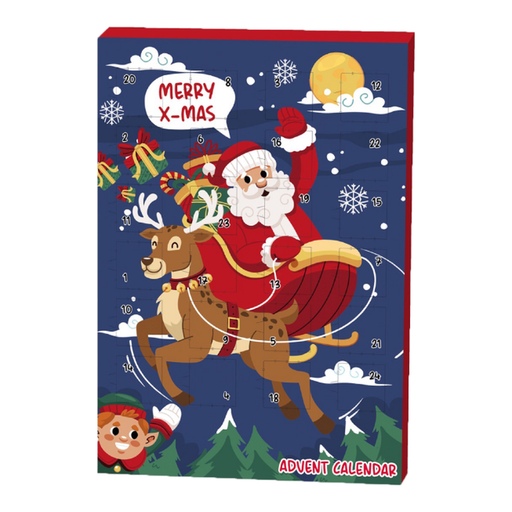 Image unavailable
Chocolate Advent calendar, 50 g
An option to consider if you’re looking for a chocolate Advent calendar without a particular licence. The stated weight is 50 g; before choosing, check the packaging for the number of doors, ingredients and allergens.
View on Joybuy
Frequently asked questions
Is Nutri-Score compulsory on chocolate Advent calendars in France?
No. The DGCCRF states that displaying Nutri-Score is voluntary. Its absence doesn’t exempt a pre-packed product from the labelling information required by law, including ingredients, highlighted allergens and a nutrition declaration.
Does the ‘sugar tax’ apply to boxes of chocolates?
No. The French rules published by Légifrance on this levy apply to non-alcoholic drinks, not solid chocolate. To compare calendars, look at the sugars listed in their nutritional information instead.
How do you choose a calendar for someone with an allergy?
Read the ingredients and highlighted allergens for the exact product, along with any applicable ‘may contain’ warnings. A brand name, photograph or the word ‘chocolate’ isn’t enough to confirm that a selection is suitable for the person concerned.
How should you store a chocolate Advent calendar?
Follow the storage instructions and date shown on the packaging. These details may vary depending on the product and its different recipes.
Should you choose dark chocolate rather than milk chocolate?
Not necessarily. France’s Ministry of the Economy distinguishes between these terms based on composition, but that alone won’t tell you which calendar the recipient will enjoy most. Take their tastes into account, then check the ingredients and allergens for the specific product.


