
Livraison le jour même ou le lendemain

Qualité garantie

Débloquez vos offres de bienvenue: Livraison GRATUITE | Jusqu'à -80 % | 30 jours d'essai gratuits à JoyPlus
Téléchargez l'application
An adult 26-inch mountain bike can be perfectly suited to daily commutes, country lanes and non-technical trails. Yet product listings often focus on the number of gears or the bike's sporty look, leaving far more important criteria in the background: frame size, actual weight and build quality.
Before buying a men's or women's off-road bike, take the time to spot the most common pitfalls and check the features that will have a real impact on your rides.
26-inch wheels are not automatically suitable for all body shapes. Your riding position also depends on the frame geometry, saddle height and top tube length. A bike that is too large will be less manoeuvrable when stationary and in tight spaces. Conversely, a model that is too small can force an uncomfortable position on longer distances.
So check the manufacturer's size recommendations and, where this information is available, the minimum and maximum saddle heights.
An 18-speed bike offers a gear range suited to many uses, but this number alone is not enough to judge the drivetrain. You also need to look at the ease of gear changes, derailleur maintenance and the spacing of the ratios.
For use in the UK, 18 speeds can work perfectly well in town, on hilly cycle paths and on dirt tracks. However, regular mountain riding may justify a different transmission, with shorter ratios for easier climbing.
A lightweight mountain bike is easier to carry up stairs, simpler to fit on a bike rack and requires less effort to get going again after stopping. However, be wary of listings that state the bike's weight without specifying whether pedals and accessories are included.
Most models ordered online require partial assembly. You will generally need to fit the handlebars, front wheel, pedals and saddle. Incorrect tightening or poorly adjusted brakes can compromise the bike's stability and control.
An aluminium mountain bike typically combines a reasonable weight with good corrosion resistance under normal maintenance. The Hiland H200 Plus has a stated weight of 15.54 kg and is built on an aluminium alloy frame.
Steel, as used on the Hiland Ridge, may appeal to cyclists who prioritise a robust construction and a often more accessible price. Its stated weight reaches 16.9 kg. This difference will be most noticeable when transporting the bike, but it should be weighed against your budget, how often you ride and the distances you cover.
A mountain bike with disc brakes uses a system independent of the rim. Models equipped with disc brakes at both front and rear allow progressive braking when everything is correctly adjusted. This does not remove the need to check the condition of the pads, wheel tightness and lever operation before each ride.
Don't take a promise of braking "in all weathers" as a guarantee of absolute safety. Rain, mud, ice, tyre condition and riding technique all influence stopping distance.
Front suspension can absorb vibrations on uneven paths and improve comfort over small bumps. It does not, however, turn a touring bike into a machine for technical descents. For everyday use, choose a system that is simple to adjust and easy to maintain.
Tyre width also affects grip and rolling efficiency. 2.125-inch tyres, like those stated on the Hiland Ridge, can offer more stability on trails. The trade-off is that they generally require a little more effort on tarmac than a narrower model.

Why this choice suits this profile: This off-road bike is aimed at urban journeys, occasional rides and local trails. It offers an 18-speed transmission and a front suspension fork.
The listing specifies the frame material, the stated weight of 16.9 kg, the presence of dual disc brakes and the tyre width, set at 2.125 inches.
High-tensile steel frame, 18 speeds, front suspension fork and double-wall alloy rims.
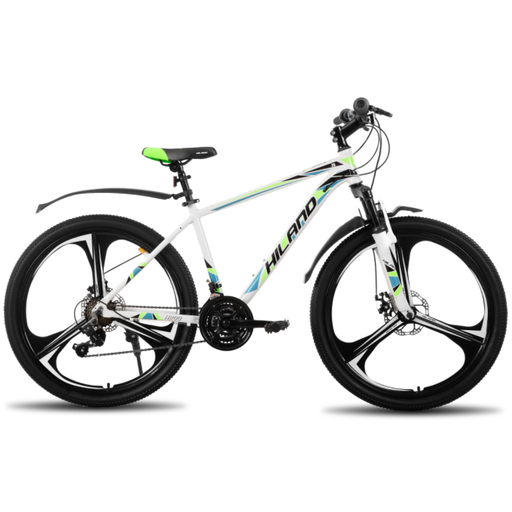
Why this choice suits this profile: Its aluminium frame and stated weight of 15.54 kg meet the expectations of cyclists who want to keep the load down when transporting and storing the bike.
The specifications detail the weight, frame, 18 speeds, suspension fork and dual disc brakes, rather than limiting itself to an aesthetic presentation.
Aluminium frame, 18 speeds, dual disc brakes, front suspension and three-spoke monobloc rims, according to the product listing.
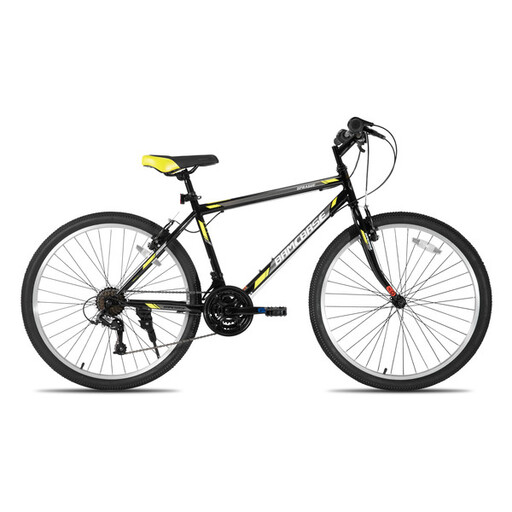
Why this choice suits this profile: This model is aimed at riders who want more ratios to switch between urban journeys, trails and hilly routes.
The listing clearly states the presence of V-brakes, not disc brakes. This detail prevents ordering different equipment from what you were looking for.
21-speed transmission, Hi-Ten steel frame, high-volume all-terrain tyres and adjustable foam saddle.
We have selected a complete list, updated in real time, of products that meet these strict criteria and the requirements of European safety regulations.
A mountain bike intended for riding in the UK needs regular maintenance, especially when used on damp or dusty trails.
The bike's lifespan depends on the weight carried, how often you ride, storage conditions and the replacement of wear parts. Brake pads or blocks, the chain, tyres and cables may need replacing long before the frame.
Yes, wheel diameter has nothing to do with the rider's gender. The choice should mainly consider height, standover height, the riding position you want, and the adjustments of the saddle and handlebars. The manufacturer's recommendations remain essential.
The budget depends on usage and the bike's condition. Routine maintenance includes cleaning, chain lubrication and checking tyre pressure. The cost rises when tyres, pads or cables need replacing. A visit to a workshop can also be useful after initial assembly or if braking lacks consistency.
For urban journeys, country lanes and occasional rides, 18 speeds offer a versatile gear range. 21 speeds allow you to fine-tune your pedalling further, but also add more components to adjust and maintain. The right choice depends mainly on the terrain in your area and how often you plan to ride.