
Livraison le jour même ou le lendemain

Qualité garantie

Débloquez vos offres de bienvenue: Livraison GRATUITE | Jusqu'à -80 % | 30 jours d'essai gratuits à JoyPlus
Téléchargez l'application
An adjustable weight bench lets you do bench presses, dumbbell exercises, shoulder strengthening and many other moves at home. Yet some models disappoint quickly. Not necessarily because of their price, but because their features are poorly understood or too generously interpreted.
Before buying a folding or multi-function bench, take the time to check three things: the actual maximum load capacity, the stability of the adjustment system, and the footprint once the bench is stored away.
The stated maximum load usually includes the user’s weight as well as that of the dumbbells or barbell. So a bench rated at 544 kg doesn’t mean it can – or should – safely handle that load in every configuration. The manual must specify the conditions of use and the limits for each position.
For home use, compare the total stated load with your actual training weight, while keeping a safety margin. Also check that the floor is perfectly level and that the bench stays firmly in place during movements.
An incline and decline bench may offer many angles, but safety depends mainly on the quality of the axles, pins and locking mechanism. Quick adjustment between sets is handy, provided the backrest and seat are properly locked before you start.
Examine the photos, product sheet and manual to make sure the locking system is clearly described. After assembly, regularly check the screws, pivot points and pins.
The word “folding” doesn’t guarantee the bench will store easily in your room. Measure your training area, the space needed to handle dumbbells, and the height available in a cupboard or against a wall.
A weight bench for home use also needs to stay stable enough when set up. A very lightweight model will be easier to move, but may feel less reassuring with heavy loads.
A powder-coated steel frame can improve the bench’s rigidity and protect its chassis. However, sturdiness doesn’t depend on the material alone. The width of the support, quality of the welds, shape of the feet and design of the joints all matter just as much.
For a professional or heavy-use bench, look for a detailed description of the frame and components. Claims like “ultra-robust” should leave you sceptical when they’re not backed up by any technical data.
An adjustable fitness bench must be able to adapt to the exercise you’re doing and to your body shape. Flat, incline and decline positions are already enough to cover a wide variety of moves. An adjustable seat can also improve support during shoulder presses or dumbbell exercises.
Test the transition between different positions: it should be simple, while the final lock must remain perfectly firm. Never change the bench angle when a load is resting on it.
A model delivered 80 % pre-assembled can reduce setup time, but it doesn’t let you off the usual checks. The remaining parts must be fitted by following the instructions precisely.
Before each session, make sure the joints are tight and the mechanisms show no excessive play or deformation. After training, a clean, dry cloth is usually enough to remove sweat and limit wear on the upholstery. Then store the bench in a dry place.
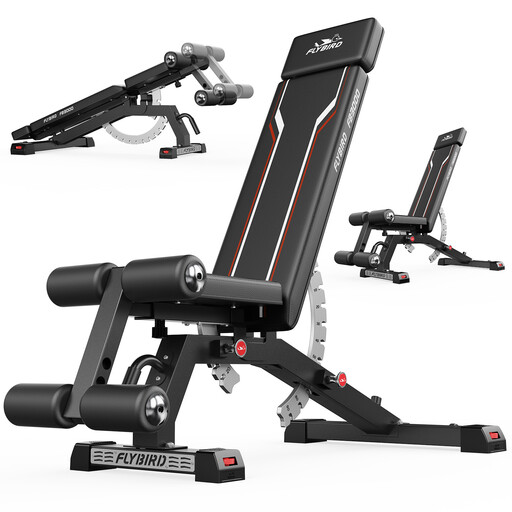
Why this choice suits this profile: Its flat, incline and decline positions let you vary your exercises without needing multiple pieces of equipment. Its folding design is especially suited to rooms where every square metre counts.
The product sheet mentions a steel frame designed for heavy use, quick adjustment and 80 % pre-assembly delivery. It’s still essential to check every lock before use.
Stated maximum load of 544 kg, quick adjustment system and folding design for easy storage.
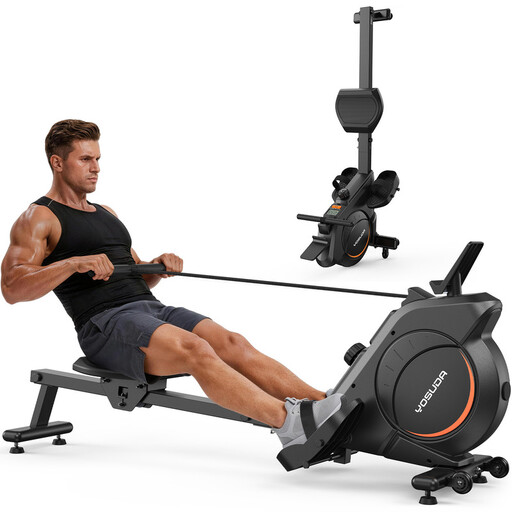
Why this choice suits this profile: To complement an adjustable bench with full-body training, this rower offers 16 levels of magnetic resistance and a folding frame suitable for a home gym.
The product sheet specifies a maximum load of 160 kg, compatibility with users from 1.55 m to 2 m tall, and assembly requiring around ten screws. Useful details to check the product matches your needs.
16 levels of magnetic resistance, reinforced rail, practical folding and Bluetooth connectivity stated on the product sheet.

Why this choice suits this profile: If your space doubles as both a gym and a storage area, this compact bike rack helps organise equipment around the bench while keeping the area clear.
With its stated dimensions of 54 × 40.5 × 20.5 cm, it lets you plan storage precisely rather than leaving gear lying on the floor.
ABS construction, tool-free assembly stated and compatibility indicated with several types of bikes.
We’ve put together a complete, real-time updated selection of products that meet these demanding criteria, as well as European safety standards.
Before your first session, check the following points:
For a barbell bench press, plan for suitable additional equipment, such as a stand designed for this purpose. A bench alone does not replace a power rack or spotter arms when the exercise requires holding the bar at height.
A model with quick adjustment, a flat position and an incline lets you progress with dumbbells. Prioritise a stable frame, a clearly stated maximum load and a folding system that works with your space. The stated capacity should not be your only deciding factor.
It depends on how often you use it, the loads handled, storage conditions and maintenance. Check the fixings before each session, wipe down the frame after training and avoid leaving the bench in a damp environment. Replace any part that shows a crack, deformation or questionable lock.
It provides a versatile base for dumbbell exercises, bench presses and shoulder work. A complete home gym may also include dumbbells, resistance bands, a mat and suitable storage solutions. Choose your accessories based on the moves you actually do and the space you have available.