
Livraison le jour même ou le lendemain

Qualité garantie

Débloquez vos offres de bienvenue: Livraison GRATUITE | Jusqu'à -80 % | 30 jours d'essai gratuits à JoyPlus
Téléchargez l'application
Choosing adjustable inline skates for children seems simple… until the first outing, when poor support, an unintuitive brake, or a size that’s already too tight spoils the experience. To avoid a purchase you’ll soon regret, it’s best not to stop at the colours or the number of sizes advertised.
For recreational use, children’s inline skates should first and foremost match the actual length of the foot, provide good ankle support, and allow for gradual slowing down. Here are the points to consider before choosing inline skates for children.
The indication “four sizes” doesn’t mean the pair will fit every foot. It generally corresponds to a well-defined range. A model designed for sizes 30 to 33 won’t replace a pair covering sizes 34 to 37.
Measure the child’s foot while they are standing, wearing the socks they usually wear, then compare the result with the length stated by the manufacturer. There’s no need to deliberately buy a much larger size: excessive space compromises support and makes the skates harder to control.
Polyurethane wheels and ABEC-5 bearings are interesting details, but they aren’t enough to judge a pair’s comfort. The design of the boot, the foot support, and the surface quality all affect the feel.
A pair fitted with PU 82A wheels can be perfectly suitable for recreational use on a smooth surface. Speed, however, depends on many factors: the child’s weight, wheel wear, bearing condition, and maintenance. Skate wheels cannot be inflated; their grip and glide quality change over time.
The presence of a rear brake doesn’t mean the child will know how to use it from the first few minutes. They need to be able to bend their knees slightly, shift their weight forward, and press the brake pad gradually.
Also check the safety buckle and adjustment straps. A closure that’s too loose lets the heel move; excessive tightening, on the other hand, can become uncomfortable after a few minutes.
The adjustable skates shown here use a push-button mechanism offering four positions, identified by the letters A, B, C and D. To adjust the length, loosen the buckle and the hook-and-loop strap, press the button, then slide the front of the shell.
The three variants cover the following ranges:
These figures give a first indication, but every foot has its own shape. Before buying, check the stated internal length, the available width, and whether the child can wiggle their toes slightly without the heel lifting.
The PW-117 model combines a printed soft boot, a front shell made of highly impact-resistant plastic, and a rigid plastic frame. The overall design aims for a balance between low weight and sufficient support for leisurely skating and early learning.
For a beginner child’s skate, check the following points in particular:
Each pair comes with 8 PU 82A wheels and ABEC-5 carbon steel bearings. The 82A hardness refers to a polyurethane formulation characteristic. It indicates the balance between grip and glide, but on its own it guarantees neither high speed nor great longevity.
The ABEC-5 standard indicates the manufacturing precision of the bearings. These must be kept clean and dry. After a session on wet ground, wipe the wheels and bearings, then store the junior inline skates in a dry place. Also remember to regularly check the tightness of the frame components and replace any visibly worn parts.
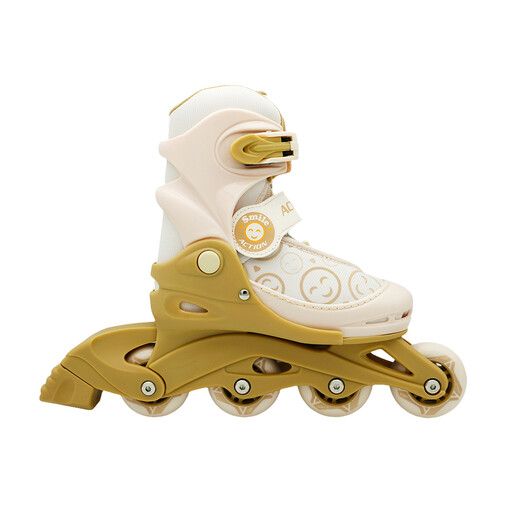
Why this choice suits this profile: The 30-33 range is ideal for children starting out on skates during walks or on a smooth paved surface. The adjustment allows them to keep up with growth over several shoe sizes.
The button adjustment and safety buckle allow you to fit the boot precisely, rather than choosing a pair that is deliberately too big.
8 PU 82A wheels, ABEC-5 bearings, wear-resistant brake and hook-and-loop straps.

Why this choice suits this profile: The 34-37 version offers an intermediate range suited to a child who skates regularly, with a soft boot and four adjustment positions.
The length of 210 to 234 mm is clearly stated. This makes it easier to choose the right range without relying solely on the usual shoe size.
Robust plastic frame, highly impact-resistant front shell and brake included.
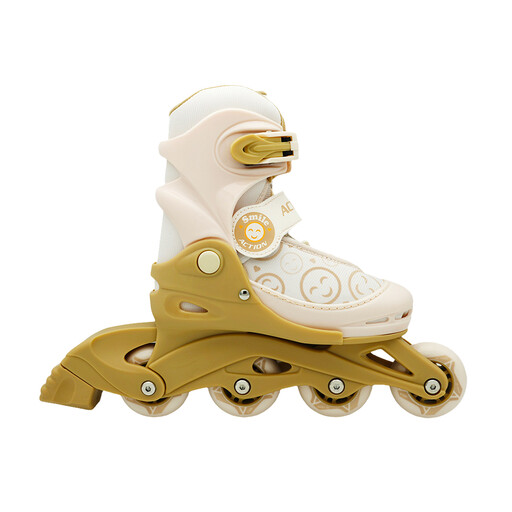
Why this choice suits this profile: The 38-41 range and length of 242 to 266 mm target older children and teenagers who want to continue recreational skating with an adjustable pair.
The four-position adjustment accommodates several shoe sizes, without presenting this pair as a competition model.
Wear-resistant brake, safety buckle, hook-and-loop strap and ABEC-5 bearings.
We’ve put together a complete, real-time updated selection of products that meet these selection criteria as well as European safety regulations.
Before the first outing, adjust the skates with the child sitting down, then ask them to stand up and bend their knees. The closures should stay firmly in place without creating any pressure points. To start, choose a smooth, dry, level surface away from traffic.
Wearing a helmet, as well as knee, elbow and wrist guards, is strongly recommended. Inexperienced children should be accompanied by an adult. This product is intended for recreational skating and is not suitable for children under 3 years old, particularly due to the presence of small parts.
After each session:
Don’t rely solely on the shoe size worn with everyday shoes. Measure the foot in millimetres, then compare the result with the stated range: S for 178-202 mm, M for 210-234 mm and L for 242-266 mm. If the measurement falls between two ranges, also check the width and heel hold.
It all depends on how often they are used, the child’s weight, the type of surface, and maintenance. The four-position adjustment can delay replacement due to growth, but it doesn’t prevent wear on the wheels, brake or bearings. Regular checks help you quickly spot parts that need replacing.
A rear brake can make learning to stop easier, provided it is used gradually. The child must first learn to maintain a stable posture and practise braking in a clear area. Initial exercises should be done with an adult, away from traffic and obstacles.