
Livraison le jour même ou le lendemain

Qualité garantie

Débloquez vos offres de bienvenue: Livraison GRATUITE | Jusqu'à -80 % | 30 jours d'essai gratuits à JoyPlus
Téléchargez l'application
Choosing adjustable inline skates for children involves far more than picking an appealing colour or taking advantage of a promotion. For a first purchase, parents should make sure the size is suitable, the ankle is properly supported, the braking system is effective and all protective equipment is included. A poorly fitted pair can quickly end up at the back of a cupboard, even if the product listing promises several sizes.
Here are the key points to check before ordering children’s inline skates, along with a selection of models suited to different needs.
The term “adjustable” does not mean that one model will suit every child. Each version covers a specific size range: XS 27–30, S 30–33 or M 34–37, depending on the model. Even when adjustable, skates that are too large provide less control and may cause rubbing.
Measure the child’s foot length in millimetres, preferably at the end of the day, then compare it with the measurements listed on the product page. The foot should be held securely without feeling compressed.
ABEC-5 bearings and 82A polyurethane wheels are useful technical specifications to compare, but they do not guarantee an enjoyable experience for a beginner. For children, stability, straightforward braking and a comfortable boot generally matter more than achieving high speeds.
For recreational use, it is better to look for a well-balanced setup: suitable wheels, a stable frame, reliable fastenings and a replaceable brake.
A helmet alone is not enough. For beginners, inline skates with helmet and protective gear should be complemented by properly fitted wrist guards, elbow pads and knee pads. Some kits include this equipment as standard, while others require separate purchases.
Inline skates are intended for recreational use on a dry, clear surface away from traffic. Adult supervision remains essential, particularly for beginners and children under 6 years old.
4-size adjustable inline skates generally use a push-button mechanism with size indicators. Operate the adjustment system after loosening the buckle and hook-and-loop strap. Once the size has been set, check that the heel does not lift and that the toes do not touch the front of the boot.
The sizes available in this selection cover the following ranges:
These figures come from the product listings and do not replace measuring the child’s foot.
A safety buckle, hook-and-loop strap and rigid shell or frame all contribute to ankle support. Soft-boot models may feel more comfortable, while an impact-resistant shell provides greater structure.
Before every outing, inspect the fastenings, frame screws and brake condition. Even when a brake is included in the box, check it regularly and replace it once it shows significant wear.
The models featured include configurations such as eight 82A polyurethane wheels with ABEC-5 bearings, or PVC wheels paired with 608Z bearings. These specifications make it easier to compare models, but skating performance also depends heavily on the surface.
For the first sessions, choose a flat, dry area free from gravel, steps and obstacles. After skating on a damp surface, wipe the wheels and store the skates somewhere dry. Regularly checking that the frame components are tight can also help prevent premature wear.

Why this model fits the brief: With its XS 27–30 range, this model is designed for smaller feet and suits children discovering inline skating on a private, level surface.
The size is adjustable, and the fastening combines a safety buckle with a hook-and-loop strap. A replaceable brake is included.
Plastic shell and frame, PVC wheels, 608Z bearings and four-position adjustment.

Why this model fits the brief: Its aluminium frame is suited to children who want to skate regularly and are looking for a more rigid structure.
The buckle, hook-and-loop straps and included brake mean you do not need to purchase the essential adjustment and braking accessories separately.
Aluminium-alloy frame, eight 82A PU wheels and carbon-steel ABEC-5 bearings.
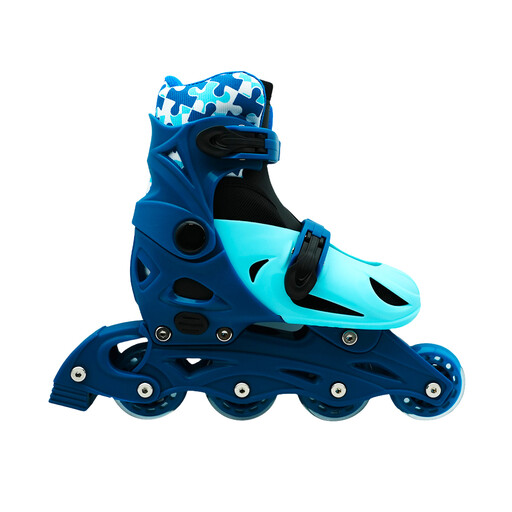
Why this model fits the brief: Its M 37–40 range and impact-resistant shell suit a child whose foot size is changing and who skates outdoors.
A button allows you to select from four adjustment positions. The plastic shell and frame provide a clearly specified structure.
Eight 82A PU wheels, ABEC-5 bearings, wear-resistant brake and comfortable lining.

Why this model fits the brief: This kit includes the inline skates, helmet, knee, elbow and wrist protection, plus a carry bag. It is a practical way to give a beginner a complete setup.
The included protective equipment reduces the risk of overlooking an important item. You should still check the fit of every piece before the first outing.
XS 26–29 inline skates, PVC wheels, 608Z bearings, included brake and storage bag.
Beginner inline skates for children require a gradual introduction to balance, braking and forward movement. They are well suited to outings on smooth paths or private driveways, particularly when the child enjoys continuous movement.
A beginner’s skateboard focuses more on foot placement, weight transfer and turning. The Marvel Spider-Man 28 × 8-inch and Skids Control Shark 28 × 8-inch models feature a nine-ply Chinese maple deck, an anti-slip surface and a stated maximum load of 50 kg. The Skids Control Carbon 31 × 8-inch model uses an eight-ply deck, aluminium trucks, 54 × 36 mm PU wheels and ABEC-5 bearings.
For these skateboards, the product listing states compliance with EN13613:2009, recreational use from age 3, the need to wear a helmet and protective equipment, and a prohibition on use on public roads. Adult supervision remains essential.
Explore a regularly updated selection of skating products, with specifications to compare based on age, foot size and intended use.
The product listings for the featured models indicate use from age 3, but age is not the only consideration. The child should be able to understand simple instructions and wear their protective equipment correctly. First sessions should take place with an adult, on a flat, dry surface away from traffic.
Service life depends on how often the skates are used, the child’s weight, the skating surface and maintenance. Multi-size adjustment can accommodate a growing foot, but it does not make the wheels, brakes or bearings wear-proof. Inspect the wheels, brake, screws and fastenings regularly, and replace any damaged parts.
A complete kit reduces the risk of forgetting an important piece of protective equipment and makes transport easier. However, you should still check the helmet size, strap tension and fit of the knee pads, elbow pads and wrist guards. No equipment replaces adult supervision or the need to choose a suitable skating location.