
Livraison le jour même ou le lendemain

Qualité garantie

Débloquez vos offres de bienvenue: Livraison GRATUITE | Jusqu'à -80 % | 30 jours d'essai gratuits à JoyPlus
Téléchargez l'application
Buying adjustable inline skates for children may seem fairly straightforward. However, several details directly affect comfort, stability and how long they can be used. A pair that is too large, a poorly positioned brake or a fastening that is difficult to secure can quickly put off a beginner.
To help parents and relatives compare the different models, the Joybuy Product Recommendation Officer has focused on the criteria that really matter, rather than just the claims highlighted on the packaging.
The term ‘adjustable’ does not mean that the skate will fit every foot size. Each model has a specific range, usually expressed as an internal length or shoe sizes. Even if it is adjustable, a skate that is too large allows the foot to move around and reduces control.
Measure the foot in millimetres, preferably while the child is standing, then compare this measurement with the details on the product page. 4-size adjustable inline skates offer plenty of room for growth, but they should initially be worn in the most snug setting.
ABEC-5 inline skates are very common on models designed for children. This classification mainly indicates certain manufacturing tolerances of the bearing. On its own, it does not determine the maximum speed, product lifespan or how easy the skates are to use.
The liner’s comfort, the diameter and hardness of the wheels, and regular maintenance also play an important role.
For a first pair, children’s inline skates with a brake allow beginners to learn how to stop gradually. However, the brake must be correctly positioned and the buckle must remain securely locked. A hook-and-loop strap can improve support, but it does not replace a properly fastened safety buckle.
The models featured here have a push-button adjustment system with four positions, generally marked A to D. Depending on the version, the ranges include, for example:
Do not rely solely on your child’s age or usual shoe size. Feet do not all grow at the same rate, and sizes can vary from one brand to another.
The product pages for the selected models mention 8 PU 82A polyurethane wheels. This is a classic configuration, with two rows of four wheels per skate. The 82A hardness is a useful point of comparison between products, but it does not, by itself, guarantee the same performance on tarmac, paving or a gym floor.
For recreational use, it is best to choose a flat, smooth and dry surface. After skating in damp weather, wipe the wheels and bearings: water and dirt can accelerate wear.
A soft liner may feel more comfortable during the first few sessions. A reinforced plastic shell or frame will provide greater support. Some models also have an aluminium frame, which offers a different level of rigidity.
Before every outing, check the following:
A helmet, wrist guards, elbow pads and knee pads are all part of the children’s inline skating equipment to have ready. For a young beginner, adult supervision and presence remain essential.
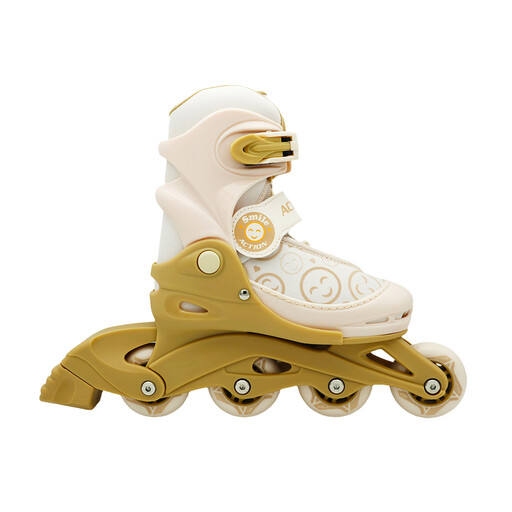
Why this choice suits this profile : Its XS 26-29 range is suitable for smaller feet, while its patterned soft liner may help a beginner develop a taste for inline skating.
The button adjustment and safety buckle help prevent you from choosing a pair that is far too large simply to allow for growth.
8 PU 82A wheels, ABEC-5 bearings, wear-resistant brake and hook-and-loop straps.

Why this choice suits this profile : Its aluminium alloy frame is designed for users looking for more structured support during regular outings.
The product page specifies the frame material, the S 31-34 range and the fastening components, rather than focusing solely on the design.
Aluminium frame, PU 82A wheels, ABEC-5 bearings, brake and four-position adjustment.
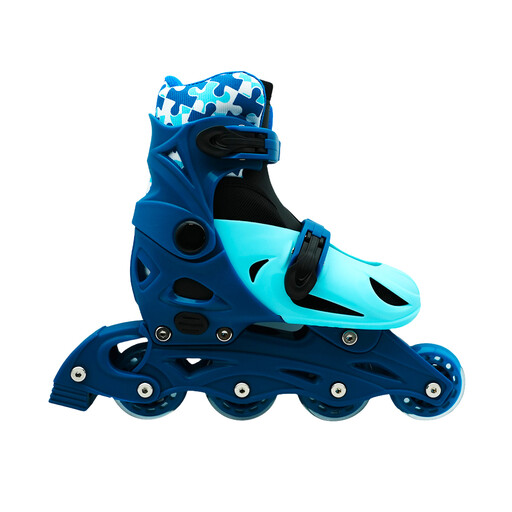
Why this choice suits this profile : Its M 37-40 size and reinforced shell construction make it suitable for teenagers and children who skate regularly.
The adjustment lets you keep the same pair as the foot grows, while the lockable buckle helps prevent imprecise adjustments.
Reinforced plastic shell and frame, comfortable liner, 8 PU 82A wheels and wear-resistant brake.
To adjust a pair of children’s inline skates, start by loosening the buckle and strap, where included. Then press the adjustment button and slide the front section to the desired position. The foot should be held securely without excessive pressure.
After each use:
Beginner inline skates should be used on a flat, dry, paved surface away from traffic. This product is intended for recreational use and is not suitable for children under 3 years of age, particularly because it contains small parts.
We have put together a complete, real-time selection of products that meet these demanding selection criteria, as well as European safety standards.
Yes, they can support several stages of learning, provided you choose the correct size to begin with. The adjustment should not be used to make up for a pair that is too large. Wearing a helmet and suitable protective gear remains essential.
It depends on how often they are used, the child’s weight, the surfaces they skate on and how well they are maintained. Wheels, brakes and bearings are wear parts. Regular checks make it easier to quickly spot a misshapen wheel, a loose fastening or a brake that has become too thin.
Colours and patterns may encourage a child to wear their equipment, but the priority criteria remain foot length, ankle support, fastening quality, whether a brake is included and the materials specified on the product page.